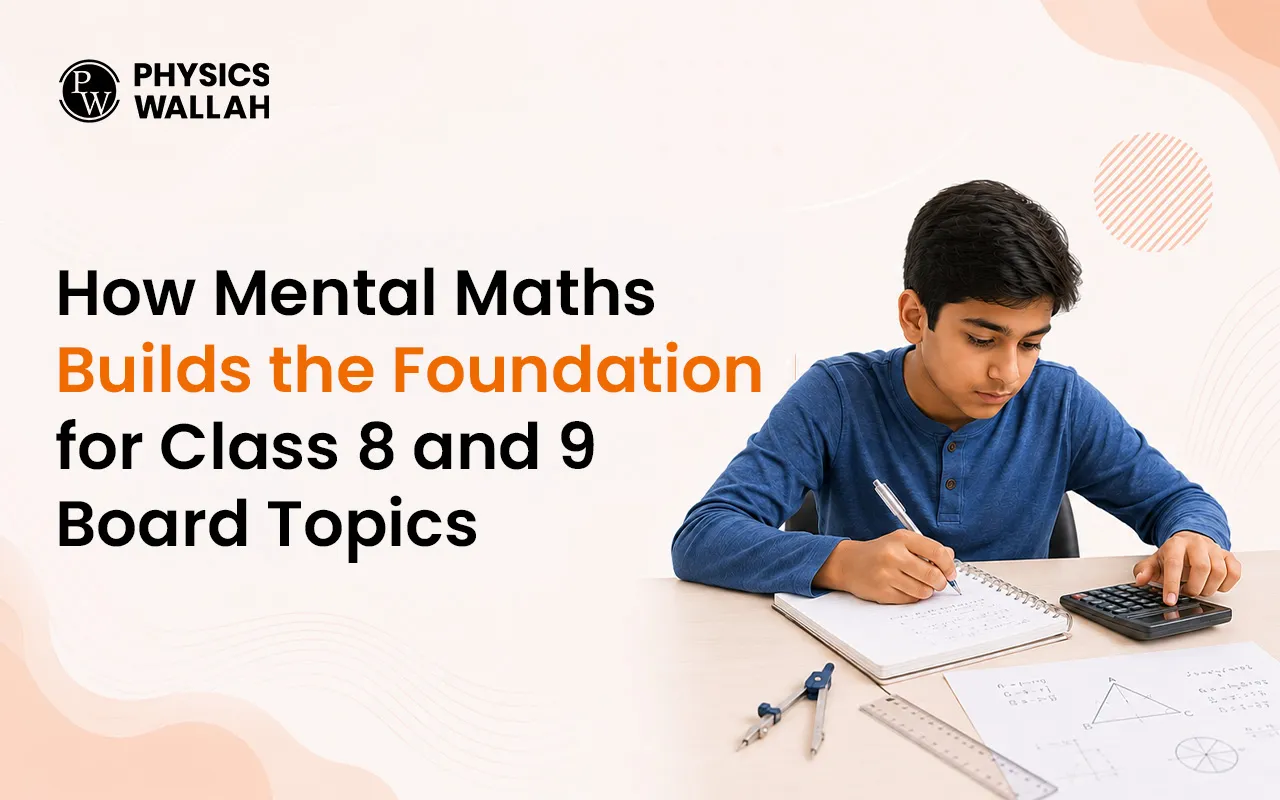
How Mental Maths Builds the Foundation for Class 8 and 9 Board Topics
 Nikita Aggarwal26 Jun, 2026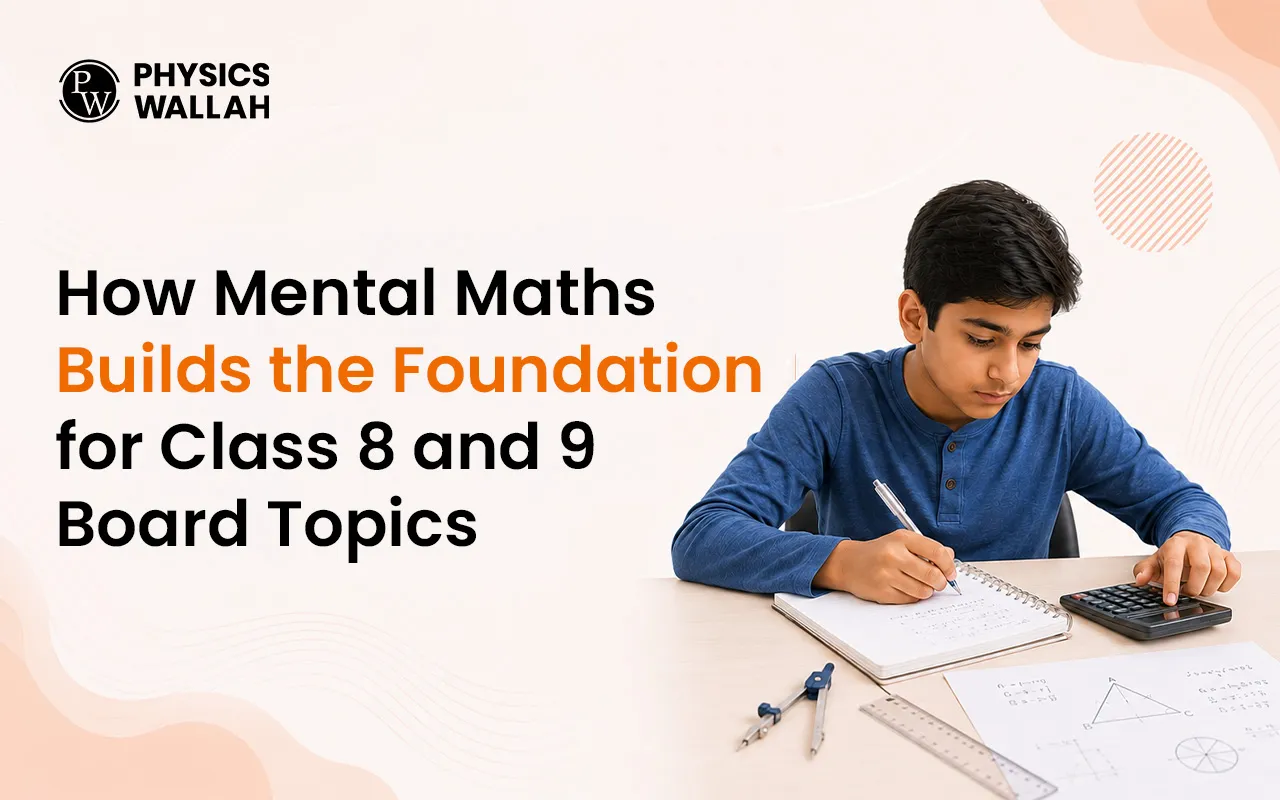
Importance of Mental Maths Foundation for Class 8 and 9 Boards
In the Senior School textbooks, multi-tiered steps are shown in which simple arithmetic is the nucleus of each final evaluation. Two minutes dividing numbers or simplifying fractions and the student loses the sight of the main theorem. Everything in longhand computations hinders progress during important experiments.
Building a mental maths foundation for Class 8 and 9 boards, when students learn to process complex numerical patterns internally. This habit releases a lot of brain energy so that they can fully concentrate on the hard core concepts instead of getting stuck with simple additions or subtractions.
How Class 7 Mental Maths Supports Class 8 and 9 Board Preparation
Junior high school is the perfect bridge to senior board concepts. The students get a new perception of tricky equations, with the introduction of systematic calculation methods in this transitional period. It teaches the mind to think of numbers as blocks you can move around, not fixed numbers."
The data below shows how regular calculation practice alters performance across common areas of study.
|
Junior Level Topic |
Advanced Senior Application |
Mental Arithmetic Advantage |
|
Basic Fractions |
Rational Numbers & Exponents |
Instant common denominator tracking |
|
Simple Variables |
Linear Equations & Polynomials |
Speedy coefficient balancing |
|
Area Estimation |
Surface Area & Volume |
Rapid square and cube calculations |
Utilising Class 7 mental maths for board prep ensures that when a student encounters lengthy formulas later, they do not feel intimidated by large numerical values.
How to Build Strong Mental Maths Skills from Class 7 to Class 9
The intellectual leap from junior numbers to complex abstract variables requires a step-by-step strategy. Students cannot suddenly calculate long roots mentally without structured training. The change must happen incrementally over many months of schooling.
To make a perfect bridge with mental maths Class 7 to 9, students should aim at some calculation targets:
-
Visualizing Factorization: Breaking composite values into prime components without relying on long division trees.
-
Applying Direct Ratios: Utilizing unitary methods mentally to solve percentage, profit, and loss challenges in single steps.
-
Decimal Management: Moving decimal points instantly during multiplication or division by multiples of ten.
Key Skills Required for a Strong Mental Maths Foundation for Class 8 and 9 Boards
A solid academic foundation comes from a deep acquaintance with the numbers, not from facile memorisation. Students need to know how values relate to each other within equations. True competency is knowing why the shortcut works.
A complete Class 7 maths foundation consists of the following core skills:
-
Operation Inversion: Understanding that dividing by a fraction means multiplying by its reciprocal instantly.
-
Distributive Property Usage: Splitting difficult multiplications like $45 \times 11$ into $(45 \times 10) + 45$ internally.
-
Perfect Power Awareness: Remembering squares up to thirty and cubes up to fifteen instantly.
Read More - Exponents Shortcut Methods for Class 8
Benefits of Online Learning for a Mental Maths Foundation for Class 8 and 9 Boards
In traditional classrooms, there is often insufficient time to provide the necessary individual attention to address specific calculation bottlenecks. Training portals in digital form provide customised methods that identify the exact point at which a student gets stuck in calculation processes.
There are academic advantages of joining a structured program for online mental maths class 7. These are:
-
Interactive Visual Aids: Virtual tools show how numbers break down, making abstract concepts easy to understand.
-
Time-Bound Exercises: Gamified formats train the mind to process numbers accurately under mild time constraints.
-
Adaptive Problem Sets: Systems adjust difficulty based on individual performance, ensuring continuous growth without boredom.
Strategies to Improve a Mental Maths Foundation for Class 8 and 9 Boards
In the senior years, exams become the kind of tests that require deep analytical skills. Long descriptive questions need good step-by-step documentation. So very little time is left for rough paperwork. Speed is just as important as accuracy.
Implementation of tactical board exam prep mental maths makes it easy for students to double check what they have written. Before doing the written work they estimate an approximate final value in their heads so they can quickly spot any misplaced numbers or wrong signs, saving valuable marks.
Read More - Mensuration Tricks Using Mental Maths for Class 8
How to Improve Your Mental Maths Foundation for Class 8 and 9 Boards
Speedy calculation is not an innate talent; it is an analytical skill developed through regular, focused practice. Developing a daily habit of evaluating numbers mentally sharpens logical reasoning skills over time.
To learn Class 7 mental arithmetic effectively, students should adopt these simple lifestyle habits:
-
Daily Calculation Practice: Dedicate ten minutes every morning to solving arbitrary arithmetic puzzles mentally.
-
Eliminate Rough Sheets: Attempt to solve intermediate steps of homework problems entirely inside the head.
-
Analyze Errors Immediately: When a calculation goes wrong, trace the mental path taken to identify the structural slip.
How CuriousJr Builds a Mental Maths Foundation for Class 8 and 9 Boards
Succeeding in senior school requires moving away from traditional rote learning methods. True understanding comes when a child learns to enjoy playing with numbers through interactive and practical exercises. Modern learners require systematic, engaging programs that fit their unique learning speeds while steadily building essential skills for future challenges.
The structured training programs at CuriousJr class 8 mental maths classes provide an excellent platform for this development. By blending logic building with structured arithmetic practice, the platform transforms abstract mathematics into an enjoyable journey. This board exam preparation mental maths training prepares students for advanced topics, ensuring they develop a comprehensive mental maths foundation for Class 8 and 9 boards.




How Mental Maths Builds the Foundation for Class 8 and 9 Board Topics FAQs
Will mental arithmetic help with senior school physics and chemistry?
How much daily time should students spend on mental math exercises?
Can a student with math anxiety benefit from mental math tools?
Can focusing on Class 7 mental arithmetic reduce the need for rough paperwork in board exams?

Get Free Counselling Today
and Clear up all your Doubts
 Live & recorded classes available at easeDashboard for progress trackingLakhs of practice questions