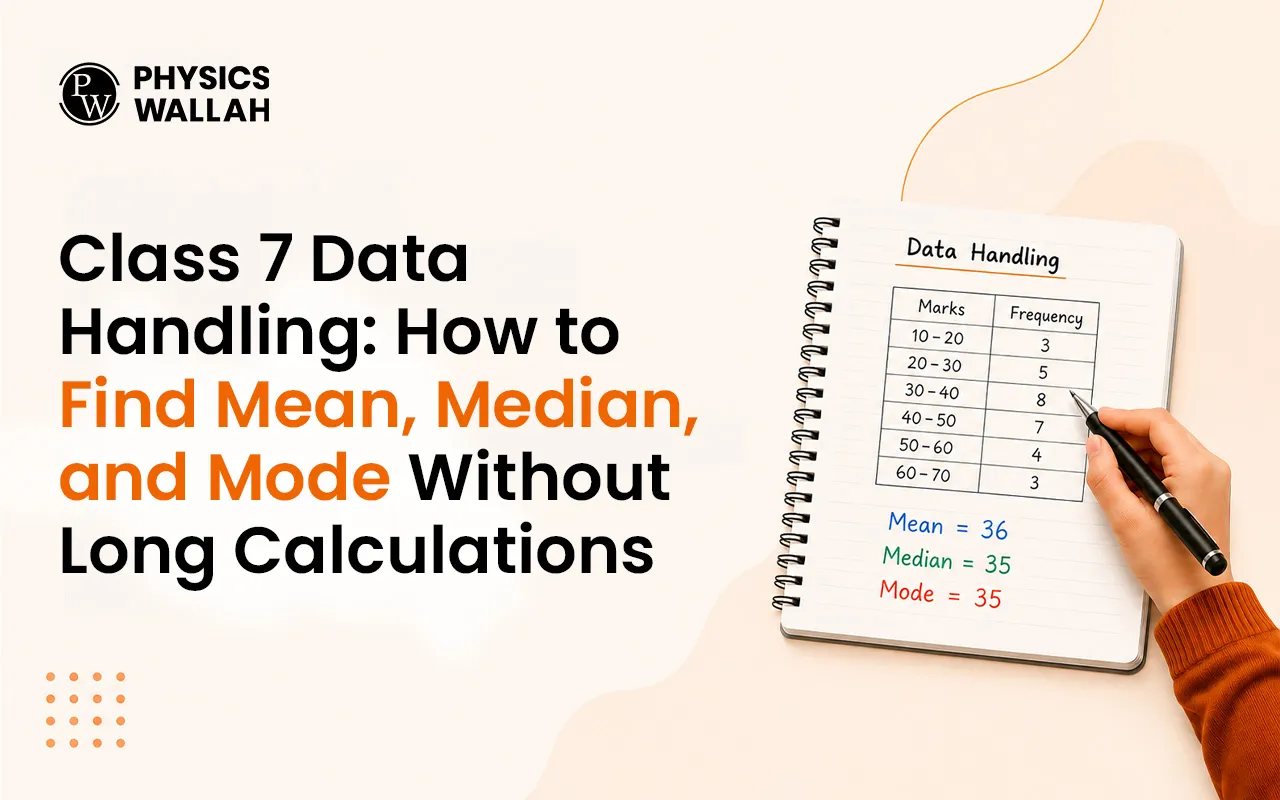
Class 7 Data Handling: How to Find Mean, Median, and Mode Without Long Calculations
 Nikita Aggarwal29 Jun, 2026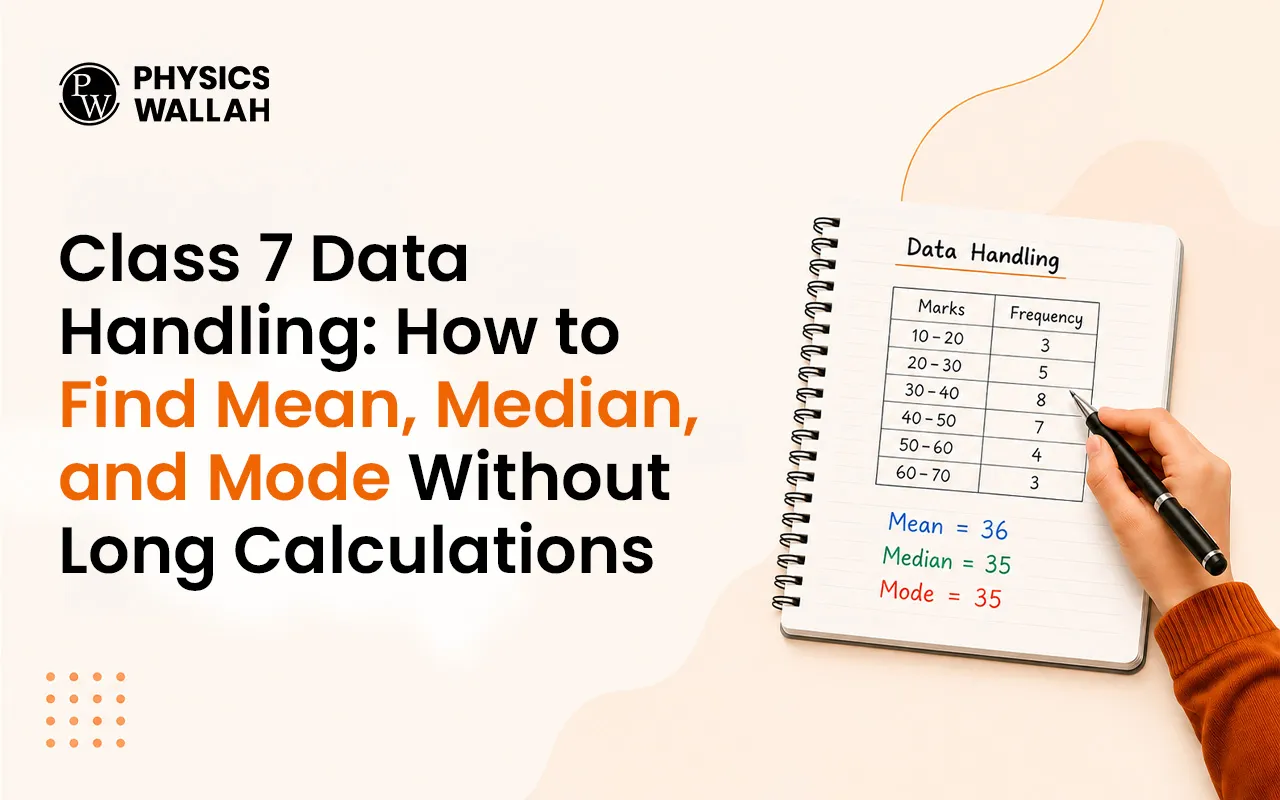
Benefits of Class 7 Data Handling Mean Median Mode Mental Maths
Learning how to calculate statistical values in your head saves time and builds strong numerical intuition. Students who learn these skills can verify their answers during exams without rewriting entire steps.
Speed Up Your Class 7 Maths Data Handling Homework
When dealing with data handling shortcuts Class 7 methods, your speed improves naturally. Instead of adding a long column of two-digit numbers, you learn to look for compatible pairs that add up to multiples of ten. This approach turns tedious homework sessions into quick exercises.
Reduce Rough Work in Exams
Most of the mistakes in school exams are made in long division or messy rough work. You don’t need scratch paper as much when you train your brain to see data sets in a visual manner. This simple technique will keep your answer sheet clean and also boost your overall confidence.
How Class 7 Data Handling Mean Median Mode Mental Maths Speeds Up Homework
The traditional way to find the average involves adding all values and dividing by the total count. However, mental calculation statistics Class 7 strategies offer a faster route through smart grouping.
The table below demonstrates how to pair numbers that naturally complement each other to find a quick sum.
|
Original Dataset |
Smart Pairing Strategy |
Combined Sum |
|
12, 18, 25, 15 |
(12 + 18) and (25 + 15) |
30 + 40 = 70 |
|
43, 57, 21, 79 |
(43 + 57) and (21 + 79) |
100 + 100 = 200 |
|
14, 26, 35, 65 |
(14 + 26) and (35 + 65) |
40 + 100 = 140 |
Find a Balanced Assumed Mean
Instead of adding large numbers directly, guess a reasonable average near the middle of your dataset. Look at how much each number deviates from this assumed center, add those small differences together, and adjust your initial guess.
-
Choose a central number as your baseline benchmark.
-
Calculate how much each data point is above or below that benchmark.
-
Combine the small positive and negative differences mentally.
-
Divide the net difference by the total number of items and adjust your baseline.
Read More - Binary Logic Mental Maths Tricks for Class 7
Quick Median Tricks in Class 7 Data Handling Mean Median Mode Mental Maths
Finding the median usually requires writing out a long ordered list. With the right mental tricks, you can eliminate options from both ends simultaneously to spot the center.
Streamline Your Data Sorting
You do not need to rewrite the entire dataset from smallest to largest on paper. Scan the list to find the absolute highest and lowest values, then cross them out mentally to narrow down the middle.
-
Locate the minimum and maximum numbers in the given set.
-
Mentally ignore these extremes and move your focus inward.
-
Repeat the process for the next layer of remaining numbers.
-
Identify the single middle number for odd datasets instantly.
Handle Even Datasets Without Effort
When a dataset has an even number of values, you will be left with two middle numbers. Instead of using a complicated formula, simply find the exact halfway point between those two remaining figures.
Easy Tricks to Find the Mode Using Class 7 Data Handling Mean Median Mode Mental Maths
The mode is the value that appears most frequently in a dataset. Identifying it does not require complex calculations, just sharp visual tracking.
Track Frequencies Visually
Train your eyes to scan the data for identical digits that cluster together. You can count the repetitions without creating a formal tally mark chart.
-
Look for repeating pairs of numbers as you read the list.
-
Keep a mental count of the most frequent number you see.
-
Ignore unique numbers that only appear once in the dataset.
Avoid Common Frequency Traps
Sometimes a dataset has more than one mode, or no mode at all if every number appears only once. If two different numbers appear three times each, list both as the correct modes without trying to average them.
Read More - Mental Division Tricks for Class 7
Class 7 Data Handling Mean Median Mode Mental Maths Applications
Let us look at a practical example to see how these quick mental strategies work in real-time scenarios. Consider a student's test scores: 15, 18, 15, 12, and 20.
To find the average, pick 15 as your assumed center. The differences are 0, +3, 0, -3, and +5. Combining these gives a net difference of +5. Divide 5 by the 5 total scores to get +1, meaning the true average is 15 + 1 = 16. To find the median, mentally cross out the extremes (12 and 20, then 15 and 18) to leave 15 in the middle. The mode is clearly 15 because it appears twice.
Building these quick mental skills helps students feel comfortable with numbers early on. Developing an intuitive grasp of Class 7 statistics mental maths transforms regular school math into an enjoyable puzzle.
How CuriousJr Improves Class 7 Data Handling Mean Median Mode Mental Maths
Building confidence in statistics requires more than memorising formulas—it requires strong number sense and quick mental calculation skills. CuriousJr Class 7 mental maths class helps students strengthen these abilities through interactive live classes, engaging activities, logical reasoning exercises, and regular practice sessions. By focusing on faster calculations, pattern recognition, and problem-solving skills, the program enables students to approach mean, median, and mode questions with greater speed and accuracy, making data handling easier and more enjoyable.




Class 7 Data Handling: How to Find Mean, Median, and Mode Without Long Calculations FAQs
What is the quickest way to find the mean of consecutive numbers?
Can a dataset have more than one mode in Class 7 math?
How do I find the median mentally if the total count is even?
Why does the assumed mean method save time during calculations?

Get Free Counselling Today
and Clear up all your Doubts
 Live & recorded classes available at easeDashboard for progress trackingLakhs of practice questions