Skimming vs Scanning: Definition, Differences, Examples
 Nikita Aggarwal15 Apr, 2026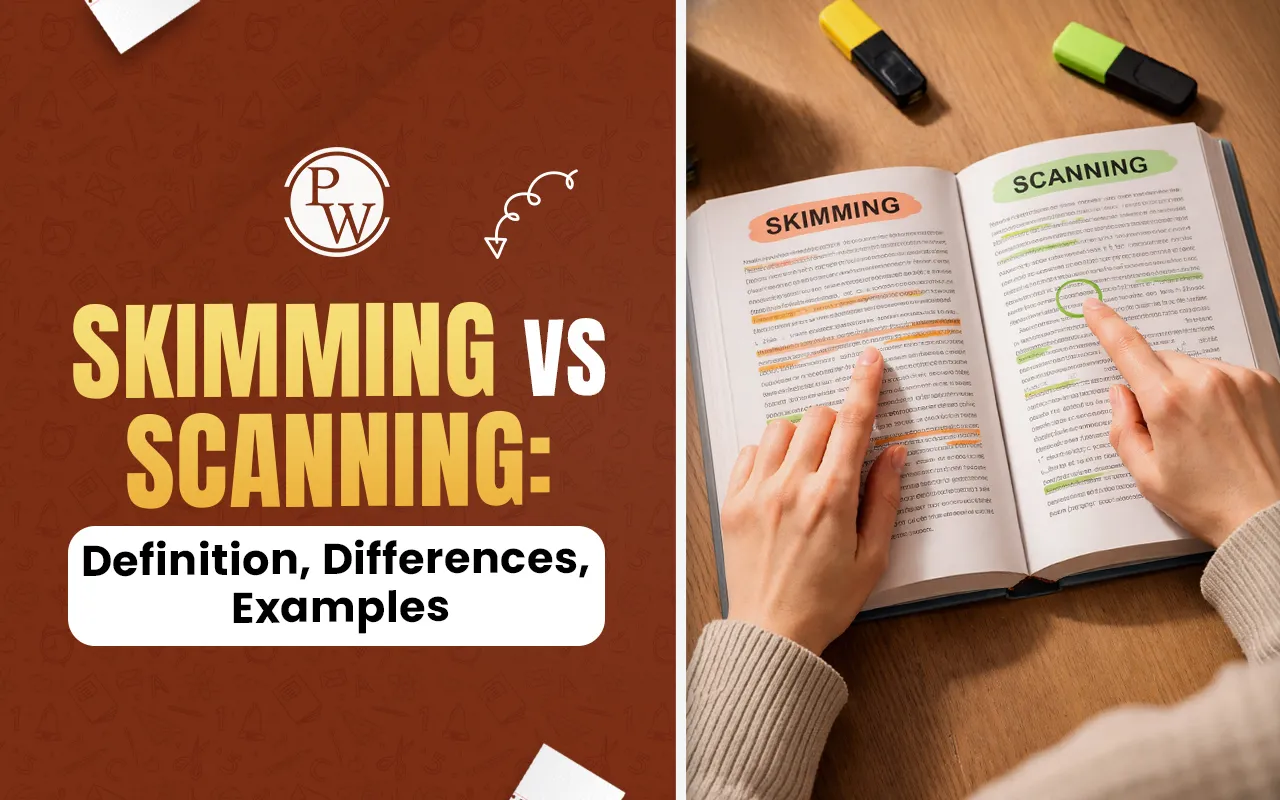
What is Skimming and Scanning?
Before we go into the technical details, let's break these ideas down into simple terms. Both methods need you to quickly move your eyes over a page, yet they are used for quite different things.
Skimming Meaning
Skimming is the process of reading a text rapidly to get a general overview of the content. You aren't looking for specific details; instead, you want to understand the "big picture." When you skim, you focus on titles, headings, and the first and last sentences of paragraphs.
Scanning Meaning
Scanning is a technique used when you are looking for a specific piece of information. Think of it like using a search engine within your own brain. You ignore most of the text and only stop when your eyes catch the specific keyword, date, or name you need.
Skimming vs Scanning Based on Reading Purpose
Before you start reading any text, it is important to ask yourself a simple question: What am I trying to find? Your purpose will determine whether you should use skimming or scanning.
-
If your goal is to understand the overall idea or decide whether a chapter or article is useful, skimming is the better choice.
-
If you are looking for a specific answer, keyword, or fact, scanning will save you time.
For example, in an exam, you might skim a passage to understand the theme and then scan it to locate answers to specific questions. Choosing the right technique based on your purpose makes your reading faster and more efficient.
Skimming vs Scanning
It's important to know the scanning and skimming difference because utilising the improper method can waste time.
When to Skim
-
To find out if an article or book is useful for your research.
-
To go over a chapter you've already read to help you remember.
-
To get the main idea of a news story.
-
To preview a lesson before a class starts.
When to Scan
-
To look for a certain date in a history book.
-
To find a word in a dictionary.
-
To look for your name on a list of exam results.
-
To look up the price of something in a catalogue.
Read More - Shall vs Should: Meaning, Rules, Differences, and Examples
Skimming and Scanning Examples
Let's look at some real-life instances to help us grasp how things work better.
Example 1: A Restaurant Menu
-
Skimming: You immediately look at the menu to discover what kinds of food they provide. You see the categories for "Appetisers," "Main Course," and "Desserts." You know that it's an Italian restaurant.
-
Scanning: Since you don't eat meat, you look for the word "Paneer" or the green veg sign to identify a dish you can eat.
Example 2: A Newspaper
-
Skimming: You skim the main headlines and pictures on the front page to see what happened in the world today.
-
Scanning: You go straight to the sports section to see how the cricket game went last night.
Difference Between Skimming and Scanning
The table below shows the main distinctions between these two important ways to read.
|
Feature |
Skimming |
Scanning |
|
Primary Goal |
To get the general idea or "gist." |
To find a specific fact or detail. |
|
Reading Speed |
Very fast, but covers the whole text. |
Very fast, but ignores most of the text. |
|
Method |
Reading headings, intros, and conclusions. |
Moving eyes in a "Z" or "S" pattern for keywords. |
|
Result |
An overall understanding of the topic. |
Finding a specific answer. |
|
Focus |
Main ideas and themes. |
Keywords, numbers, and names. |
Benefits of Learning Skimming vs Scanning
Why should a student care about knowing the difference? There are many benefits:
-
Time Management: You can get more done in less time, which is very important during tests like the IELTS or board finals.
-
Less Mental Fatigue: You don't have to worry about extra details when you don't need to.
-
Better Focus: Scanning helps your brain learn how to ignore "noise" and find only what is important.
-
Better Memory: Skimming before a deep read gets your brain ready for the material, which makes it easier to remember later.
Read More - No vs Not – Difference Between No and Not with Examples
Skimming vs Scanning in Exams and Studies
In the context of NCERT solutions and school curriculum, these techniques are game-changers.
-
During Exams: If you are faced with a long comprehension passage, scanning the questions first and then scanning the passage for keywords helps you find answers in seconds.
-
Chapter Summaries: Use skimming to read the summary and "points to remember" sections in your NCERT textbooks to quickly grasp the lesson's objective.
-
Researching Projects: When looking through multiple sources for a school project, use skimming to decide which books are worth reading in full and which ones aren't useful.
Tips to Use Skimming and Scanning Effectively
To truly benefit from these techniques, you need to practice them with the right approach:
-
Define Your Purpose First: Always decide whether you are reading for general understanding or specific information.
-
Focus on Keywords: Train your eyes to identify important words, phrases, and patterns quickly.
-
Use Visual Clues: Pay attention to headings, bold text, numbers, and bullet points to locate information faster.
-
Avoid Reading Every Word: Let your eyes move quickly across the text instead of stopping at each sentence.
-
Practice Regularly: The more you practice, the faster and more accurate you become.
Skimming vs Scanning Practical Exercises
You don't need diagrams to practice these skills. Try these simple text-based exercises:
Exercise 1: The Scanning Challenge
Read the following list of names and find how many times the name "Rahul" appears as quickly as possible.
-
Ankit, Rohan, Rahul, Priya, Sneha, Rahul, Amit, Rahul, Vikas, Rahul, Sunita.
(Answer: 4 times)
Exercise 2: The Skimming Challenge
Read the following paragraph in 10 seconds and identify the main topic.
-
"Climate change is one of the biggest challenges facing the world today. Rising temperatures are causing polar ice caps to melt, leading to increased sea levels. Scientists suggest that reducing carbon emissions is the only way to slow down this process and protect the environment for future generations."*
(Main Topic: Climate change and the environment)
How to Skim Effectively?
-
Read the Title and any subheadings.
-
Read the Introduction carefully to understand the author's intent.
-
Read the first sentence of every paragraph (the topic sentence).
-
Look at Bold or Italicised words.
-
Read the Summary or final paragraph.
How to Scan Effectively?
-
Keep the specific keyword in your mind.
-
Don't read every word; let your eyes "drift" over the lines.
-
Look for visual clues like capital letters (for names), digits (for dates/stats), or symbols.
-
Once you find the word, read the surrounding sentence to confirm the information.
Build Your Child’s Confidence in English Speaking with CuriousJr
Does your child feel shy speaking in English or find it difficult to form correct sentences? This can affect their confidence, classroom participation, and overall communication skills. CuriousJr’s online English classes are designed to make learning simple, interactive, and effective.
The program covers essential grammar, clear pronunciation, vocabulary development, and basic writing skills. Through live, interactive sessions, children get regular speaking practice with experienced mentors. Engaging activities like games, storytelling, and writing exercises make learning fun and interesting. Parents also receive regular updates to track their child’s progress.
With structured levels designed for different learning paces, CuriousJr helps children improve step by step while building a strong foundation in English. Book a demo class today.