Capital Letters in English – Rules, Uses & Examples Explained
 Nikita Aggarwal30 May, 2026
Capital Letters in English
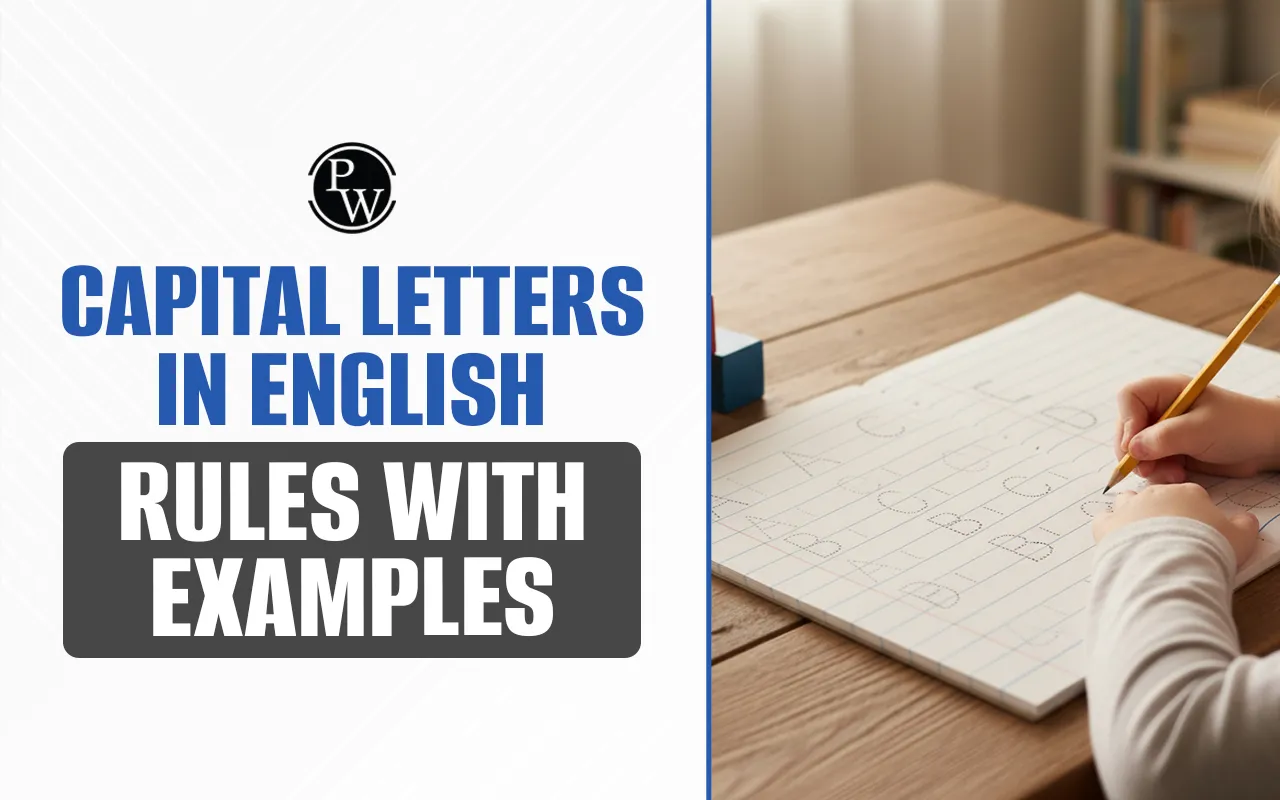
Capital letters in English are the big forms of the alphabet. They are also called uppercase letters. For example, A, B, C, D … Z are capital letters, while a, b, c, d, and so on are small letters. We use capital letters in English for many important reasons.
Uppercase letters show the beginning of a sentence, names of people and places, days, months, the word “I,” and many more. Knowing the rules of capital letters helps us write correctly and makes our writing more clear and easy to understand. So, to learn more about the capital letter in English rules, keep reading.
Read more: Prepositions of Time
Capital Letter in English Rules With Examples
The English alphabet has both lowercase and uppercase letters. The uppercase ones are also called capital letters. In order to use these capital letters in English in the right way, there are special rules. Let's go through each capital letter in English rules one by one with examples.
Rule 1. Use of Capital Letters At the Beginning of a Sentence
The first word of every sentence must start with a capital letter. It does not matter if the sentence ends with a full stop, a question mark, or an exclamation mark. For example:
-
The sun is shining.
-
Where are you going?
-
Wow! That is a big balloon.
Rule 2. Capitalizing Pronoun “I”
According to the rules of capital letters in English, the pronoun "I" is always written with an uppercase letter. This is one of the unique rules in grammar. For example:+
-
I am reading a book.
-
My friend and I went to the park.
Read more: What are Compound Words
Rule 3. Use of Capital Letters For Names and Proper Nouns
As per the capital letter in English rules, all names in sentences must begin with uppercase letters. This includes names of people, cities, countries, rivers, mountains, days, months, festivals, and important events. For example:
-
Riya lives in Delhi.
-
The Amazon River is very long.
-
Christmas is celebrated in December.
We also use capital letters in English for family names when we use them in place of the person’s name. For example:
-
I love playing with Mom.
-
Grandpa is telling me a story.
But there is an exception here. As per the rules of capital letters, when we use the words in general, we do not use uppercase letters; for instance:
-
My mom is cooking dinner.
Additionally, titles like Mr., Mrs., Dr., and St. also begin with capital letters in English. For example:
-
Dr. Mehta is a kind doctor.
-
Mr. Sharma is my teacher.
Rule 4. Use of Capital Letters For Days, Months, and Holidays
We always use capital letters in English for days of the week, months of the year, and special holidays. But the names of seasons, such as summer, winter, spring, and autumn, do not need capitals. For example:
-
We will meet on Monday.
-
My birthday is in June.
-
We enjoy Holi together.
-
It is hot in summer.
Read More: Direct and Indirect Speech
Rule 5. Use Uppercase Letters For Names of Languages
Another use of capital letters is for the names of languages. But names of subjects like math, science, or history are not capitalized unless they start a sentence. For example:
-
I can speak English and Hindi.
-
Mathematics is my favourite subject.
Rule 6. Capitalizing Cities, Countries, and Place Names
Always start the names of cities, countries, nationalities, and places with capital letters. For example:
-
She went to Mumbai.
-
They live in India.
-
Mount Everest is the highest peak in the world.
Rule 7. Use of Capital Letters For Time Periods and Eras
Important historical ages and time periods also start with capital letters in English. But centuries are written with small letters. For example:
-
The Stone Age was very different from today.
-
The Victorian era saw many changes.
-
There were many inventions in the twentieth century. (no capitalization in centuries).
Rule 8. Capitalizing Titles of Books and Stories
When we write a title, we use uppercase letters for the first word and also for all important words like nouns, pronouns, verbs, and adjectives. Shorter words like “a,” “the,” “and,” or “of” are not capitalized unless they are the first or last word. For example:
-
Have you read The Jungle Book?
-
The teacher gave homework on Time Is Precious.
Also read: Abstract Nouns
Practice Questions on Use of Capital Letters in English
Now that you have learned about the rules of capital letters in English, use them to correct these sentences:
-
my brother and i went to mumbai last june.
-
she is reading the jungle book.
-
they will celebrate diwali in october.
-
we saw mr. khan near the park.
-
the ganges river flows in india.
-
my mom made pasta on sunday.
-
english and hindi are spoken in delhi.
Answers:
-
My brother and I went to Mumbai last June.
-
She is reading The Jungle Book.
-
They will celebrate Diwali in October.
-
We saw Mr. Khan near the park.
-
The Ganges River flows in India.
-
My Mom made pasta on Sunday.
-
English and Hindi are spoken in Delhi.
Help Your Child Speak English Clearly and Confidently with CuriousJr
Does your child often use broken English while speaking? This can make them less confident in class and affect their marks in exams, as well as their communication skills, while growing up. CuriousJr English Learning Online Classes are made to help your child improve their grammar, vocabulary, pronunciation, and writing skills in a fun and simple way.
Here's what CuriousJr English online classes offer:
-
Simple Grammar Lessons: Children learn grammar in easy ways to help them speak and write correctly.
-
Live Interactive Classes: Dedicated mentors use examples and exercises so children can practice and improve.
-
Vocabulary and Pronunciation: Children learn new words and speak clearly while improving grammar.
-
Fun Activities: Games, writing tasks, and speaking exercises make learning enjoyable.
-
Progress Reports: Parents get updates to see how their child is improving in English.
-
Different levels to match your child’s speed of learning.
Book a demo class today to explore how CuriousJr can help your child become a confident English speaker with a strong foundation for the future.




Capital Letters in English FAQs
What are capital letters in English?
What are the rules of capital letters for nouns?
Do I always use capital letters after punctuation marks?
We are going to paris for the holidays. Is this the right use of a capital letter?

Get Free Counselling Today
and Clear up all your Doubts
 Live & recorded classes available at easeDashboard for progress trackingLakhs of practice questions