

Unique Speech Topics for Students
 Nivedita Dar30 Sept, 2026
Unique Speech Topics for Students
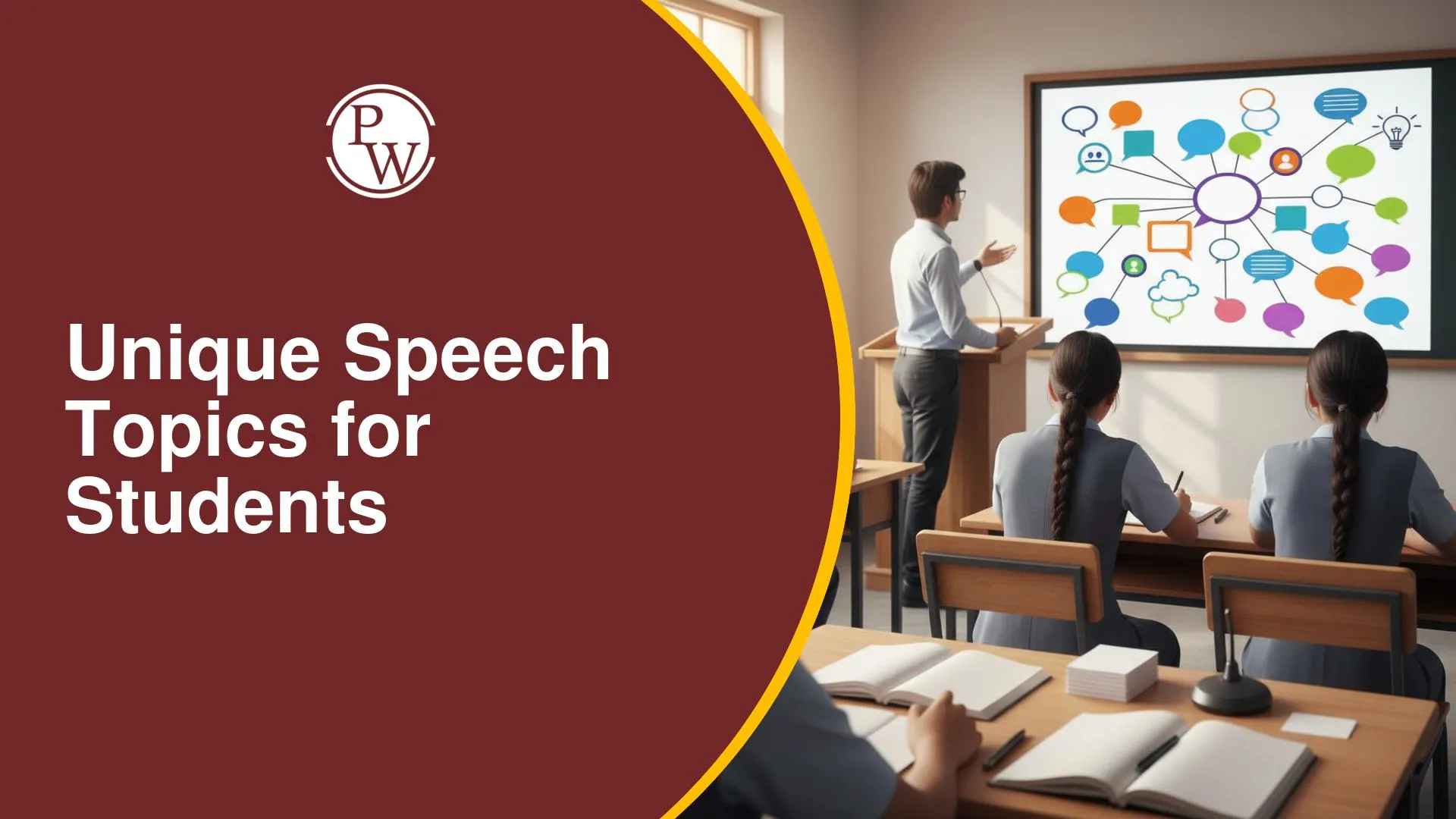
Choosing the right speech topic makes it easier to prepare, speak confidently and keep your audience interested. A good topic should match your age, speaking time, audience and level of knowledge.
Here is a list of unique speech topics for students covering school, kids, English, public speaking, declamation, technology, environment, daily life and creative ideas.
Quick List of Unique Speech Topics
|
Speech Topic |
Best For |
|
If Animals Could Talk |
Kids and primary students |
|
What If There Were No Internet? |
School students |
|
Should Students Get More Recess? |
Primary and middle school |
|
Can Robots Become Our Teachers? |
Middle school |
|
Why Do We Need More Trees? |
School speech |
|
Is Being Famous Always Good? |
Middle school |
|
A World Without Plastic |
Environment speech |
|
What Would Happen If Gravity Disappeared? |
Creative speech |
|
Should Homework Be Optional? |
School debate |
|
Can AI Help Students Learn Better? |
Older students |
|
The Power of Kindness |
Kids and school |
|
What Makes a Good Friend? |
Primary students |
|
If I Could Invent One Thing |
Creative speech |
|
Why Failure Can Help Us Learn |
Older students |
|
A Day Without a Smartphone |
School speech |
What Makes a Speech Topic Unique?
A unique speech topic does not always have to be completely new. It can be a familiar subject presented through an unusual question, situation or point of view.
For example:
-
Instead of “Save the Environment,” try “What Would Happen If Every Tree Disappeared?”
-
Instead of “Technology,” try “Could We Live Without Smartphones for One Week?”
-
Instead of “Animals,” try “If My Pet Could Speak for One Day.”
A useful topic gives you enough ideas to explain, examples to share and a clear point to make.
Explore Our Course: CuriousJr English Learning B1 Preliminary Classes
Easy Speech Topics for Students
If you are giving a speech for the first time, choose a topic that you already understand. These topics are simple enough to research and explain:
-
My Favorite Hobby
-
The Importance of Good Friends
-
Why Reading Is a Good Habit
-
My Favorite School Subject
-
Why We Should Help Others
-
The Importance of Exercise
-
How to Be a Good Student
-
Why We Should Keep Our Surroundings Clean
-
The Value of Time
-
My Dream for the Future
-
Why Kindness Matters
-
The Importance of Teamwork
-
A Person I Admire
-
My Favorite Book
-
One Thing I Would Change About My School
Interesting Speech Topics for Students
These topics can help students move beyond common subjects:
-
What If Everyone Had a Superpower?
-
What If School Started at Noon?
-
Can Money Buy Happiness?
-
Should Students Have More Free Time?
-
What Would Happen Without Electricity?
-
Can Video Games Be Educational?
-
Is Being Busy Always a Good Thing?
-
Why Do We Remember Some Dreams?
-
What If Humans Could Live Underwater?
-
Could Robots Become Our Friends?
-
Is Social Media Helpful for Students?
-
What Can We Learn From Failure?
-
Why Do People Love Stories?
-
Would You Rather Live in the Past or Future?
-
What Would You Do With One Extra Hour Every Day?
Read More: Speech on Discipline for Students
Unique Speech Topics in English
For students searching for unique speech topics in English, these ideas are suitable for classroom speaking activities, competitions and school presentations:
-
The World I Want to Live In
-
One Small Change That Can Make a Big Difference
-
If I Could Talk to My Future Self
-
What Makes Someone a Good Leader?
-
Why Curiosity Is Important
-
Can Technology Make Us Happier?
-
The Importance of Listening
-
What Can Children Teach Adults?
-
Why Everyone Should Have a Hobby
-
The Value of Saying Sorry
-
What Would You Do If You Could Stop Time?
-
Why Mistakes Are Part of Learning
-
Is Competition Always Healthy?
-
The Importance of Asking Questions
-
What Does Success Really Mean?
Speech Topics for School
School speeches can be informative, persuasive, creative or based on everyday student experiences.
School and Education Topics
-
Should Homework Be Reduced?
-
Should School Start Later?
-
Are School Uniforms Necessary?
-
Should Students Be Allowed to Use Phones in School?
-
Is Group Study Better Than Studying Alone?
-
Should Schools Have More Sports Periods?
-
Why Is Attendance Important?
-
Should Students Choose Some of Their Subjects?
-
Is Learning From Books Better Than Learning From Videos?
-
Why Are School Libraries Important?
Environment Topics
-
Why Should We Plant More Trees?
-
How Can Students Reduce Plastic Waste?
-
Why Is Saving Water Important?
-
How Can Schools Become Greener?
-
What Can We Do About Air Pollution?
-
Why Should We Protect Animals?
-
How Can Students Help the Environment?
Technology Topics
-
Can Artificial Intelligence Help Students?
-
Should Children Have Screen-Time Limits?
-
Can Robots Replace Some Human Jobs?
-
Is the Internet a Good Learning Tool?
-
How Has Technology Changed Education?
-
Are Video Games Helpful or Harmful?
-
What Would Life Be Like Without the Internet?
Speech Topics for Kids
Younger students usually do better with topics connected to their daily lives, imagination and interests.
-
My Favorite Animal
-
My Favorite Cartoon Character
-
If I Could Fly
-
If Toys Could Talk
-
My Dream Playground
-
If Animals Could Talk
-
My Favorite Food
-
A Day as a Superhero
-
My Favorite Game
-
If I Were the Principal for a Day
-
Why I Love My Family
-
My Favorite Festival
-
My Best Friend
-
A Visit to My Favorite Place
-
If I Could Build a New School
Speech Topics for Class 2
Simple topics work best for Class 2 students. Some useful choices are:
-
My Family
-
My School
-
My Best Friend
-
My Favorite Animal
-
My Favorite Toy
-
My Favorite Food
-
My Hobby
-
Why I Like Reading
-
A Rainy Day
-
My Favorite Festival
-
If I Had a Superpower
-
How I Help at Home
Read More: Vote of Thanks Speech
Speech Topics for Class 4
Class 4 students can handle slightly more descriptive and opinion-based subjects:
-
Why We Should Save Water
-
The Importance of Trees
-
My Favorite Invention
-
Should Children Have Less Screen Time?
-
If Animals Could Talk
-
Why Teamwork Matters
-
The Importance of Exercise
-
A World Without Plastic
-
My Dream School
-
If I Could Invent Something
-
Why We Should Be Kind
-
How Technology Helps Us Learn
Speech Topics for Class 5
For Class 5, students can begin using reasons, examples and simple arguments in their speeches:
-
Should Homework Be Optional?
-
Is Social Media Good for Students?
-
Why Reading Is Important
-
Can Robots Replace Teachers?
-
Should Students Be Allowed to Use Smartphones?
-
Why Should We Protect Animals?
-
The Benefits of Outdoor Games
-
How Technology Has Changed Our Lives
-
Why Failure Helps Us Learn
-
The Importance of Good Habits
-
How Can Children Help the Environment?
-
What Makes a Good Leader?
Short Speech Topics for Students
If you have only one or two minutes, choose a topic that can be explained in a few clear points.
-
Kindness
-
Time Management
-
My Favorite Book
-
The Value of Friendship
-
Healthy Food
-
Saving Water
-
Teamwork
-
Honesty
-
Reading
-
Exercise
-
Good Habits
-
Helping Others
-
Cleanliness
-
My Dream
-
The Importance of Nature
A short speech usually works best when it focuses on one main idea rather than trying to cover too many points.
Public Speaking Topics for Students
Public speaking topics can be based on ideas, experiences, questions or problems that students can explain clearly.
Informative Topics
-
How Solar Energy Works
-
How the Internet Changed Communication
-
Why Sleep Is Important
-
How Plants Help the Environment
-
How Recycling Works
Opinion-Based Topics
-
Should Students Have Less Homework?
-
Should Mobile Phones Be Allowed in Class?
-
Is Online Learning Better Than Classroom Learning?
-
Should School Days Be Shorter?
-
Are Competitive Exams Too Stressful for Students?
Creative Topics
-
If I Could Travel to the Future
-
If I Were an Astronaut
-
A Message From My Future Self
-
If the Moon Could Speak
-
A School on Another Planet
Declamation Topics for Students
Declamation activities focus on speaking clearly, confidently and expressively. Suitable topics include:
-
The Importance of Education
-
Save Water, Save Life
-
The Power of Kindness
-
The Value of Time
-
Believe in Yourself
-
Unity Is Strength
-
Reading Is a Good Habit
-
The Importance of Discipline
-
Protect Our Planet
-
Every Child Deserves Education
For declamation, CuriousJr helps students choose a topic that allows them to use clear expression, pauses, voice variation, and confident body language.
Current and Everyday Speech Topics
Students can also choose subjects connected with things they see around them:
-
The Role of AI in Education
-
Screen Time and Children
-
Online Safety for Students
-
Plastic Waste in Our Community
-
The Importance of Mental Well-Being
-
How Technology Changes the Way We Learn
-
The Future of Online Education
-
Why Digital Responsibility Matters
-
How Students Can Save Energy
-
The Importance of Fact-Checking Information Online
For current topics, check recent and reliable information before preparing your speech because facts and examples can change over time.
Creative and Uncommon Speech Topics
If your teacher asks for an uncommon or creative topic, try one of these:
-
What If Shadows Could Talk?
-
A World Where Nobody Could Lie
-
What If Humans Could Breathe Underwater?
-
If I Could Borrow One Superpower
-
What If Everyone Had the Same Dream?
-
A Conversation With My Future Self
-
What Would Happen If Time Stopped for One Hour?
-
If My School Were on Mars
-
What If Books Could Choose Their Readers?
-
If I Could Invent a New Day of the Week
These topics are especially useful when the goal is to demonstrate imagination rather than simply present facts.
How to Choose a Speech Topic
Use these five questions before selecting your topic:
1. Do I understand the topic?
Choose something you can explain using your own words.
2. Will my audience understand it?
A Class 2 audience and a college audience may need very different topics and examples.
3. Can I find enough information?
For factual topics, make sure you have reliable information and examples.
4. Does the topic fit my time?
A two-minute speech needs a narrower topic than a ten-minute presentation.
5. Can I speak about it with confidence?
A topic you genuinely find interesting is often easier to present naturally.
How to Structure a School Speech
A simple speech can follow this structure:
|
Part |
What to Include |
|
Introduction |
Introduce the topic and get attention |
|
Main Point 1 |
Explain the first idea |
|
Main Point 2 |
Give another reason or example |
|
Main Point 3 |
Add a useful fact, example or opinion |
|
Conclusion |
Summarise the message and finish clearly |
For a short speech, two or three main points are usually enough.
How to Start a Speech
Avoid beginning with a long explanation. Start with something that makes the audience want to listen.
You can begin with:
-
A question: “What would happen if there were no trees?”
-
A surprising idea: “Imagine going one whole day without electricity.”
-
A short story: “Yesterday, I saw something that made me think about this topic.”
-
A direct statement: “Every student should learn how to manage time.”
How to End a Speech
A good conclusion reminds the audience of your main message.
You can:
-
repeat your key idea in a new way
-
give the audience a simple action to take
-
end with a thought-provoking question
-
leave them with a memorable statement
For example:
“Small actions may seem unimportant, but when many people take them, they can create a big change.”
Tips for Delivering Your Speech
Choosing a good topic is only the first step. Your delivery also matters.
Practise Before Speaking
Read your speech aloud several times. Practising helps you notice difficult words and remember the order of your points.
Speak Clearly
Do not rush through the speech. Pause between important ideas.
Make Eye Contact
Look at different parts of the audience instead of looking only at your notes.
Use Natural Gestures
Small hand movements can make your delivery more natural. Avoid repeating the same gesture throughout the speech.
Use Your Voice
Change your speed and tone when appropriate. A completely flat voice can make even an interesting topic difficult to follow.
Do Not Memorise Every Word
Understand the main points instead of trying to remember every sentence exactly. This can make your speech sound more natural.
Common Mistakes Students Make
-
Choosing a topic that is too difficult
-
Trying to cover too many ideas
-
Reading every sentence directly from a paper
-
Speaking too quickly
-
Using facts without understanding them
-
Writing an introduction that is too long
-
Forgetting to practise the conclusion
-
Choosing a topic only because it sounds impressive
Quick Revision: Speech Topics for Students
-
Unique topics: creative and less-common ideas
-
Easy topics: hobbies, school, friends, habits and daily life
-
School topics: education, homework, uniforms, technology and environment
-
Kids' topics: animals, superheroes, toys, hobbies and imagination
-
Short topics: subjects that can be explained in one or two minutes
-
Declamation topics: subjects that allow expressive and confident speaking
-
Public speaking topics: informative, opinion-based and creative subjects
-
Class-wise topics: choose difficulty according to the student's age and speaking ability




Unique Speech Topics for Students FAQs
How do I find a good speech topic for students?
What are some easy speech topics for beginners?
What are some unique speech topics for school?
What is the difference between a speech topic and a declamation topic?
How long should a student's speech be?





Get Free Counselling Today
and Clear up all your Doubts
 Live & recorded classes available at easeDashboard for progress trackingLakhs of practice questions

