
Basic English Words for Kids
 Nivedita Dar30 Sept, 2026
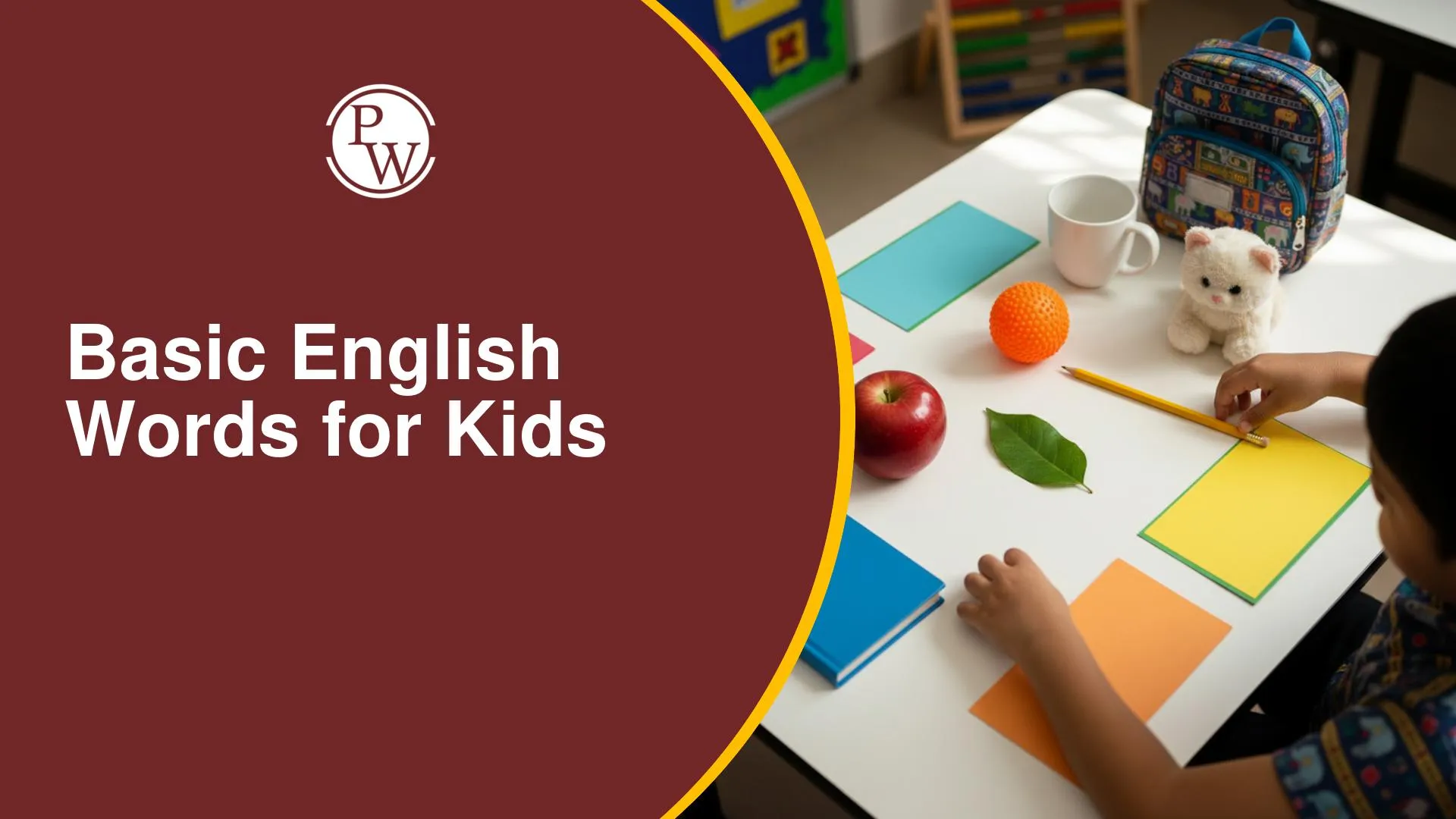
This list of English words for kids includes simple words with meanings and examples. The words are grouped into common topics so children can learn and practise them easily.
Simple English Words for Kids with Meaning
Here are some easy English words that children can learn first.
|
Word |
Simple Meaning |
Example Sentence |
|
Apple |
A fruit |
I eat an apple. |
|
Book |
Something we read |
This is my book. |
|
Cat |
A small animal |
The cat is sleeping. |
|
Dog |
A common pet animal |
The dog is running. |
|
Ball |
A round object used for playing |
I have a red ball. |
|
Home |
The place where we live |
I am at home. |
|
School |
A place where children learn |
I go to school every day. |
|
Friend |
Someone we like and play with |
My friend is kind. |
|
Water |
A liquid that we drink |
Please give me some water. |
|
Food |
Something we eat |
The food is hot. |
|
Happy |
Feeling good or pleased |
I am happy today. |
|
Sad |
Feeling unhappy |
He looks sad. |
|
Big |
Large in size |
The elephant is big. |
|
Small |
Little in size |
I have a small bag. |
|
Good |
Nice or right |
She is a good student. |
|
Bad |
Not good |
It was a bad day. |
|
Hot |
Having a high temperature |
The soup is hot. |
|
Cold |
Having a low temperature |
The water is cold. |
|
Fast |
Moving quickly |
The horse runs fast. |
|
Slow |
Moving without speed |
The turtle is slow. |
Common English Words for Kids
Children use many common English words while speaking, reading, and writing. These words can be grouped into simple categories.
Family Words
-
Mother – a female parent
-
Father – a male parent
-
Brother – a male sibling
-
Sister – a female sibling
-
Baby – a very young child
-
Grandmother – the mother of a parent
-
Grandfather – the father of a parent
-
Uncle – the brother of a parent
-
Aunt – the sister of a parent
-
Cousin – a child of an aunt or uncle
Example: My brother and I play together.
Read More: Jumbled Words in English
School Words
-
Teacher – a person who teaches
-
Student – a person who learns
-
Class – a group of students or a lesson
-
Book – something used for reading
-
Pen – a tool used for writing
-
Pencil – a writing tool
-
Bag – something used to carry things
-
Desk – a table used for study
-
Board – a surface used for teaching or writing
-
Lesson – something taught or learned
Example: My teacher gave us a new lesson.
Food Words
-
Apple – a fruit
-
Mango – a sweet fruit
-
Rice – a common food
-
Bread – a baked food
-
Milk – a drink
-
Water – a drink needed by the body
-
Egg – a food produced by birds
-
Cake – a sweet baked food
-
Fruit – a food that grows on plants
-
Vegetable – an edible part of a plant
Example: I drink milk every morning.
Read More - Class 5 English Grammar Worksheet on Conjunctions
Action Words
Action words tell us what someone or something does.
-
Eat – to have food
-
Drink – to take liquid
-
Run – to move quickly on foot
-
Walk – to move on foot
-
Jump – to push yourself off the ground
-
Read – to look at and understand written words
-
Write – to form letters or words
-
Play – to take part in an activity for fun
-
Sleep – to rest
-
Help – to do something for someone
Example: I read a book before I sleep.
Easy English Words for Kids
Some simple words are especially useful for children who are beginning to learn English.
Easy Naming Words
boy, girl, baby, dog, cat, bird, ball, book, bag, car
Easy Action Words
eat, go, come, run, walk, sit, stand, play, read, write
Easy Describing Words
big, small, good, bad, happy, sad, hot, cold, fast, slow
Easy Everyday Words
yes, no, hello, bye, please, sorry, thanks, home, school, friend
Children can practise these words by saying them aloud and using them in short sentences.
Read More - Class 2 English Practice for A, An, The
Basic English Words for Kids with Meaning and Sentences
Learning a word with its meaning and sentence helps children understand how to use it.
|
Word |
Meaning |
Sentence |
|
Help |
To give someone support |
Please help me with my bag. |
|
Clean |
Free from dirt |
Keep your room clean. |
|
Kind |
Caring and helpful |
My friend is kind to everyone. |
|
Brave |
Not easily afraid |
The brave girl helped her friend. |
|
Quiet |
Making little or no noise |
Please keep the classroom quiet. |
|
Loud |
Making a lot of noise |
The music is loud. |
|
Early |
Before the usual time |
I woke up early today. |
|
Late |
After the expected time |
He came late to class. |
|
New |
Recently made or obtained |
I have a new pencil. |
|
Old |
Having existed for a long time |
This is an old book. |
|
Near |
Close to something |
My school is near my home. |
|
Far |
A long distance away |
The moon is far away. |
|
Open |
Not closed |
Please open the door. |
|
Close |
To shut something |
Close the window, please. |
|
Give |
To hand something to someone |
Give me the pencil. |
|
Take |
To carry or receive something |
Take your book with you. |
|
Look |
To use your eyes to see |
Look at the picture. |
|
Listen |
To pay attention to sound |
Listen to your teacher. |
|
Come |
To move towards someone or somewhere |
Come here, please. |
|
Go |
To move from one place to another |
Go to your classroom. |
Small English Words for Kids
Small English words are useful for forming simple sentences. Children can begin with short and familiar words such as:
am, an, at, be, by, do, go, he, if, in, is, it, me, my, no, of, on, or, so, to, up, us, we
Examples:
-
I am happy.
-
He is my friend.
-
The book is on the table.
-
We go to school.
-
It is a cat.
-
Give the book to me.
These words can be practised alongside naming, action, and describing words.
Read More - Class 2 English Practice Worksheet A, An, The
Basic English Words for Class 1
Children in Class 1 can begin with words that they see and hear regularly.
People
boy, girl, mother, father, teacher, friend
Things
book, pen, bag, ball, chair, table
Animals
cat, dog, cow, bird, fish, lion
Actions
eat, run, jump, sit, stand, play
Describing Words
big, small, good, bad, happy, sad
Places
home, school, park, shop, room, road
These words can be practised through reading, picture activities, spelling, and simple sentence formation.
Read More - List of Word Families for Kids with Examples
How to Help Kids Learn Basic English Words
Children can learn new English words through regular, simple practice.
-
Start with familiar words: Begin with objects, people, and actions children see every day.
-
Use pictures: Show a picture and ask the child to name it in English.
-
Make short sentences: Use each new word in a simple sentence.
-
Read together: Read age-appropriate stories and point out familiar words.
-
Repeat regularly: Revise previously learned words instead of introducing too many at once.
-
Practise speaking: Encourage children to use new words while talking about everyday activities.
For example, after learning apple, a child can say:
“This is an apple.”
After learning run, the child can say:
“I can run.”




Basic English Words for Kids FAQs
What are basic English words for kids?
How many basic English words should kids learn daily?
What are everyday English words for kids?
What are basic English words related to family?





Get Free Counselling Today
and Clear up all your Doubts
 Live & recorded classes available at easeDashboard for progress trackingLakhs of practice questions

