What is Gender in Grammar - Meaning and Definition
 Shivam Singh19 Jan, 2026
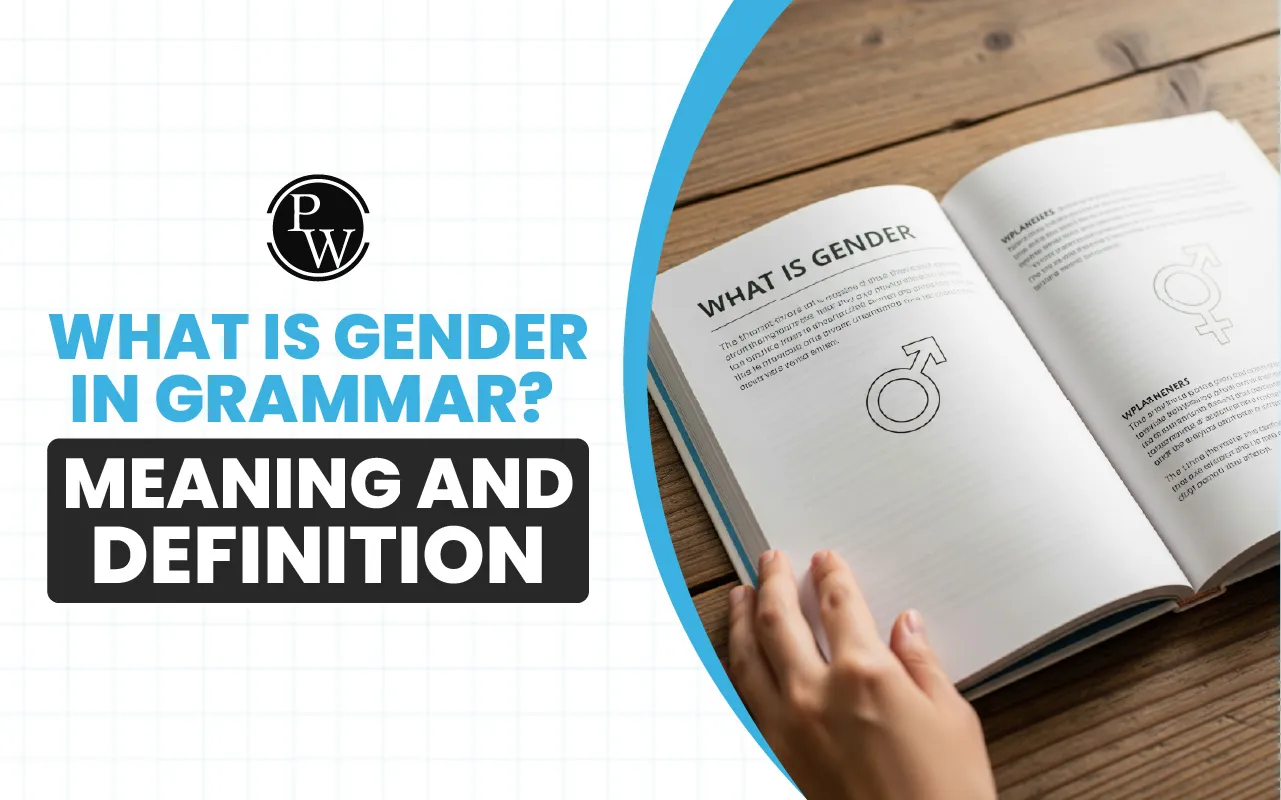
Gender: In the English language, nouns and pronouns are grouped into different types based on gender. Some words change slightly to show whether they refer to a male or a female. Others use completely different forms for each gender. For example, “actor” and “actress” share the same root word, while “king” and “queen” are entirely different.
These differences are part of what we call gender in grammar. Understanding gender helps us choose the right words when we talk about people, animals, or objects. It also helps us use pronouns correctly, such as “he,” “she,” or “they.” Here, we will learn about gender in detail with examples.
Read More: Why Learning English is Important for a Global Career
What is Gender in Grammar?
In grammar, gender shows whether a word refers to a male, female, or neither. This helps us know which pronoun to use (like he, she, or it) when we talk about people, animals, or things.
For example:
-
We say ‘he’ for a boy.
-
We say ‘she’ for a girl.
-
We say ‘it’ for a book or car, because those are things.
Most nouns in the English language are neuter, which means they do not have a gender. But when we talk about people or animals, we often use masculine or feminine gender based on whether they are male or female.
Definition of Gender in Grammar
Let’s look at how two well-known dictionaries define gender in grammar:
The Oxford Learner’s Dictionary defines gender as the classes that nouns, pronouns, and sometimes adjectives are divided into. These classes are usually:
-
Masculine (for male people or animals)
-
Feminine (for female people or animals)
-
Neuter (for things or ideas that are not alive)
It also explains that different genders may have different word endings. For example, “actor” is masculine and “actress” is feminine, both are similar words but show different genders.
According to the Merriam-Webster Dictionary, gender is a smaller group (called a “subclass”) within a larger group of grammar types like nouns, pronouns, or adjectives. This smaller group is used to help make sure all the words in a sentence agree with each other.
That means, if we know a noun is masculine, we must use matching pronouns or adjectives with it. For example:
-
The boy lost his pencil. (not “her”)
-
The girl wore her hat. (not “his”)
Read More: Figures of Speech
Types of Gender in English Grammar
There are four main types of gender in English grammar. Each type helps us understand whether a word is talking about a boy, girl, thing, or someone whose gender we don’t know. Here, we will discuss each type of gender with easy examples, so you can learn how to use them correctly.
1. Masculine Gender
The masculine gender is used when we talk about male people or male animals. These are words that show something or someone is a boy or a man.
Examples of masculine gender:
-
Boy
-
Man
-
Father
-
Uncle
-
King
-
Lion
-
He, him, his (pronouns for masculine)
The boy played with his toy car.
In this sentence, “boy” and “his” both show masculine gender.
2. Feminine Gender
The feminine gender is used for female people or female animals. These are words that tell us someone is a girl or a woman. This is also called the female gender.
Examples of feminine gender:
-
Girl
-
Woman
-
Mother
-
Aunt
-
Queen
-
Lioness
-
She, her, hers (pronouns for feminine)
The queen wore her golden crown.
Here, “queen” and “her” show the feminine gender.
3. Neuter Gender
The neuter gender is used for things that are not alive, like objects or ideas. These words are neither male nor female.
Examples of neuter gender:
-
Table
-
Pencil
-
Book
-
Chair
-
City
-
It, its (pronouns for neuter)
The computer lost its battery charge.
“Computer” is a non-living thing, so it is neuter, and we use the pronoun “its”.
4. Common Gender
The common gender is used when the gender is not clear, or when a word can mean either a boy or a girl. This is often used for jobs, roles, or young children and animals when we don’t know the gender.
Examples of common gender:
-
Baby
-
Friend
-
Teacher
-
Student
-
Doctor
-
Parent
-
They, them, their (gender-neutral pronouns)
The doctor helped their patient feel better.
In this sentence, “doctor” could be a man or a woman, so it is a common gender. The word “their” is a gender-neutral pronoun.
Read More: 7 Daily Habits to Improve English Fluency
How Gender Affects Pronouns?
In English grammar, pronouns are words that take the place of nouns. When we talk about people, animals, or things, we often use pronouns like he, she, it, or they instead of repeating the noun again and again. The gender of the noun helps us decide which pronoun to use.
|
Pronouns According to Gender |
|||
|
Gender |
Subject Pronoun |
Object Pronoun |
Possessive Pronoun |
|
Masculine Gender |
He |
Him |
His |
|
Feminine Gender |
She |
Her |
Hers |
|
Neuter Gender |
It |
It |
Its |
|
Common Gender |
They |
Them |
They, Theirs |
Read More: Comprehension
Tips for Using Gender in English
Using gender correctly in grammar is not just about following rules. It is also about speaking and writing in ways that are clear, kind, and respectful. Whether you are in school, at home, or talking to new people, here are some helpful tips for using gender-related words the right way.
1. Use “They” as a Singular Pronoun
In English, we usually use he for a boy or man and she for a girl or woman. But what happens when we do not know the person’s gender? Or what if the person does not want to be called he or she?
In these situations, we can use “they” as a singular pronoun. This means that “they” refers to one person, not more than one.
Example:
Each student must bring their notebook to class.
In this sentence, we are talking about one student, but we do not know if the student is a boy or a girl. Instead of saying “his” or “her,” we say “their” to include everyone.
Other examples:
-
If someone knocks at the door, tell them I will be right there.
-
A good teacher always helps their students.
Even though “they” is often used for more than one person, it is also correct to use it for just one person when the gender is not known. This is called singular they, and it is now widely accepted in both writing and speaking.
2. Choose Gender-Neutral Nouns
Some older words for jobs or roles include male or female forms. Today, many people use gender-neutral nouns so that anyone can be included, no matter their gender.
Examples of gender-neutral words:
-
Police officer (instead of policeman)
-
Firefighter (instead of fireman)
-
Flight attendant (instead of stewardess)
-
Chairperson (instead of chairman)
Example:
The flight attendant helped the passengers find their seats.
Gender-neutral nouns do not tell us whether the person is male or female. This is useful when gender is not important or not known.
3. Think About the Situation
When you are choosing words to use, think about where you are and who you are talking to. The right choice of words may change depending on whether you are writing a story, doing a school assignment, or talking to someone new.
-
In formal writing, such as essays or reports, it is best to use gender-neutral language. Example: Every worker must complete their report by Monday.
-
In creative writing, such as stories or plays, you can use gendered words to describe characters clearly. Example: The princess took her crown and walked into the throne room.
Also read: Idioms and Phrases in English
Boost Your Child’s Confidence in English Communication with CuriousJr Online Classes
Many children understand English but still hesitate when speaking or struggle to express themselves in writing. Weak grammar, limited vocabulary, and low confidence can affect school performance and make communication challenging.
CuriousJr’s Online English Classes are designed to close that gap. With structured lessons, interactive tools, and Cambridge-aligned content, your child will build strong skills in grammar, speaking, writing, reading, and pronunciation step by step.
What your child will experience:
-
Live classes led by two dedicated teachers
-
Grammar that’s easy to understand and apply
-
Vocabulary and pronunciation practice through fun activities
-
Creative writing and public speaking to build expression
-
Regular progress updates so you can track improvement
Book a demo class today and help your child grow into a clear, confident English speaker.