Reciprocal Pronouns - Definition, Uses & Examples
 Shivam Singh24 Oct, 2025
Reciprocal Pronouns
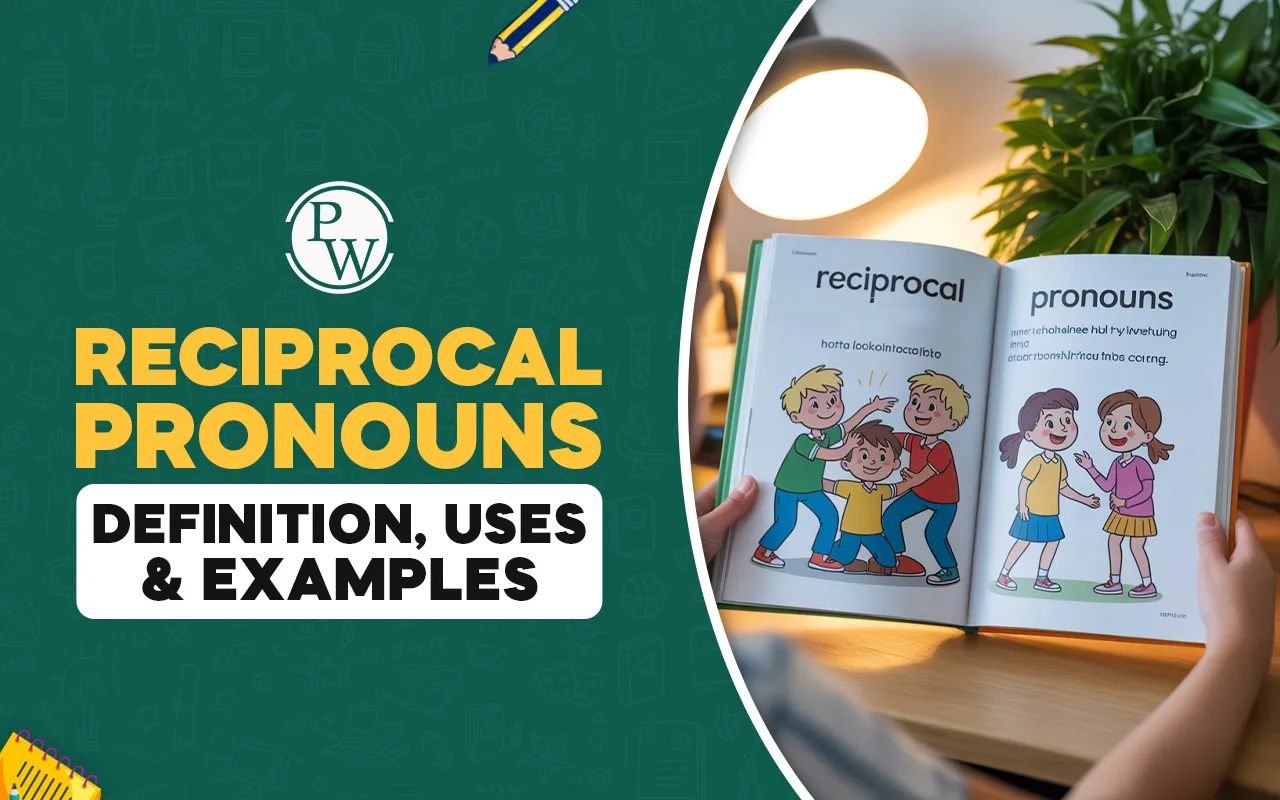
Reciprocal pronouns are an essential component of English grammar that can be used to describe activities or emotions exchanged between two or more individuals or objects. They enable us to demonstrate the mutual relationship in an easy and understandable manner.
As an example, we can say that Ravi and Meera helped each other as opposed to saying that Ravi helped Meera and Meera helped Ravi. This makes communication smoother and avoids repetition. They are used in everyday English in speaking, writing, and storytelling. Students will learn about reciprocal pronouns, types, examples and more below.
Read More: Reflexive Pronouns
What is a Reciprocal Pronoun?
Reciprocal pronoun is a kind of pronoun which is applied when two or more subjects do the same action to each other. It is an action in mutuality or sharing.
Reciprocal Pronoun Definition: A reciprocal pronoun refers to a word or phrase that shows a two-way or shared action or feeling between subjects.a
Each other and one another are the most widespread reciprocal pronouns. They simplify the sentences and make the communication short.
Types of Reciprocal Pronouns
There are only two types of reciprocal pronoun in English.
1. Each Other
-
Used for: Two people or two things
-
Formality: Common in both formal and informal English
2. One Another
-
Used for: More than two people or things
-
Formality: Slightly more formal, often used in academic or written English
Traditionally, this distinction was important, but in modern English each other and one another are often used interchangeably.
Read More: Possessive Pronouns
List of Reciprocal Pronouns
The reciprocal pronouns list is short and easy to remember:
|
List of Reciprocal Pronouns |
|
|
Reciprocal Pronoun |
Used For |
|
Each Other |
Two people or things |
|
One Another |
More than two people or things |
Uses of Reciprocal Pronouns
Reciprocal pronouns are important in English grammar because they show mutual actions or feelings between two or more people or things. They make sentences clear, short, and easy to understand. Below are the main uses of reciprocal pronouns:
1. To Show Mutual Actions
Reciprocal pronouns are used in cases where one does something to another and another person does the same thing.
-
Example: The friends assisted one another in their homework.
This indicates that the act is collective and it is everybody.
2. To Express Shared Feelings
Reciprocal pronouns reflect on emotions that are mutual in nature such as love, respect and care.
-
Example: “The students respect each other’s opinions.”
This means that the sentiment is reciprocal.
3. To Avoid Repetition
Reciprocal pronouns help to avoid repeating the subject and verb in a sentence.
-
Example: Instead of “John helped Mary, and Mary helped John,” we say, “John and Mary helped each other.”
This makes the sentence shorter and easier to read.
4. In Possessive Forms
Reciprocal pronouns can show that something belongs to the people involved in the action.
-
Example: “The team members reviewed each other’s reports.”
This shows mutual responsibility or ownership.
5. To Keep Subject-Verb Agreement
Reciprocal pronouns always need a plural subject because they involve more than one person.
-
Correct: “The students encouraged each other.”
-
Incorrect: “The student encouraged each other.”
6. In Professional and Academic Writing
Reciprocal pronouns are useful in formal writing to show cooperation or teamwork.
-
Example (professional): “Colleagues shared ideas with one another.”
-
Example (academic): “The researchers reviewed each other’s work for accuracy.”
7. To Make Sentences Clear and Smooth
Reciprocal pronouns help sentences flow naturally. They make writing easier to read and understand.
-
Example: “The team members support each other during projects.”
Tip: Using reciprocal pronouns in your writing shows mutual actions or feelings clearly and avoids unnecessary repetition.
Read More: Relative Pronouns
Reciprocal Pronouns Examples
The following are some simple reciprocal pronoun examples to understand their use:
1. In Daily Conversation:
-
“We call each other every evening.”
-
“The neighbors often visit one another during holidays.”
2. In Academic Writing:
-
“The students compared each other’s essays.”
-
“The scientists reviewed one another’s research papers.”
3. In Literature or Storytelling:
-
“The lovers gazed into each other’s eyes.”
-
“The knights fought against one another bravely.”
4. In Work and Team Settings:
-
“Colleagues should respect each other’s time.”
-
“Managers and employees must support one another to achieve goals.”
These examples show how reciprocal pronouns can be applied in informal, formal, academic, and professional contexts.
Also Read: Demonstrative Pronouns
Help Your Child Learn English Better with CuriousJr
Every parent hopes to see their child speak English with confidence and perform well in school. At CuriousJr, we make English learning engaging and effective through online English classes designed especially for young learners.
Our program helps children strengthen key language skills:
• Grammar and vocabulary to build a solid foundation
• Reading and writing to boost academic success
• Listening and speaking to improve communication and fluency
The CuriousJr curriculum is based on the Cambridge English Scale and CEFR standards, providing a clear and structured path for steady progress. As children learn, they begin to express themselves clearly, speak more fluently, and gain confidence in everyday situations.
With the support of qualified mentors, learning becomes a fun and motivating experience. Parents can easily track progress and see improvement in both language skills and school performance.
Enroll with CuriousJr today and help your child grow into a confident English speaker through interactive, enjoyable, and child-focused online lessons.
Reciprocal Pronouns FAQ
What is example and a reciprocal pronoun?
How do you learn reciprocal pronouns?
Which is the time to use a reciprocal pronoun?
What are the 4 reciprocal teaching strategies?
Does each other grammatically make sense?