Possessive Pronouns – Definition, Examples, Sentences & How to Use
 Jasdeep Singh19 Jan, 2026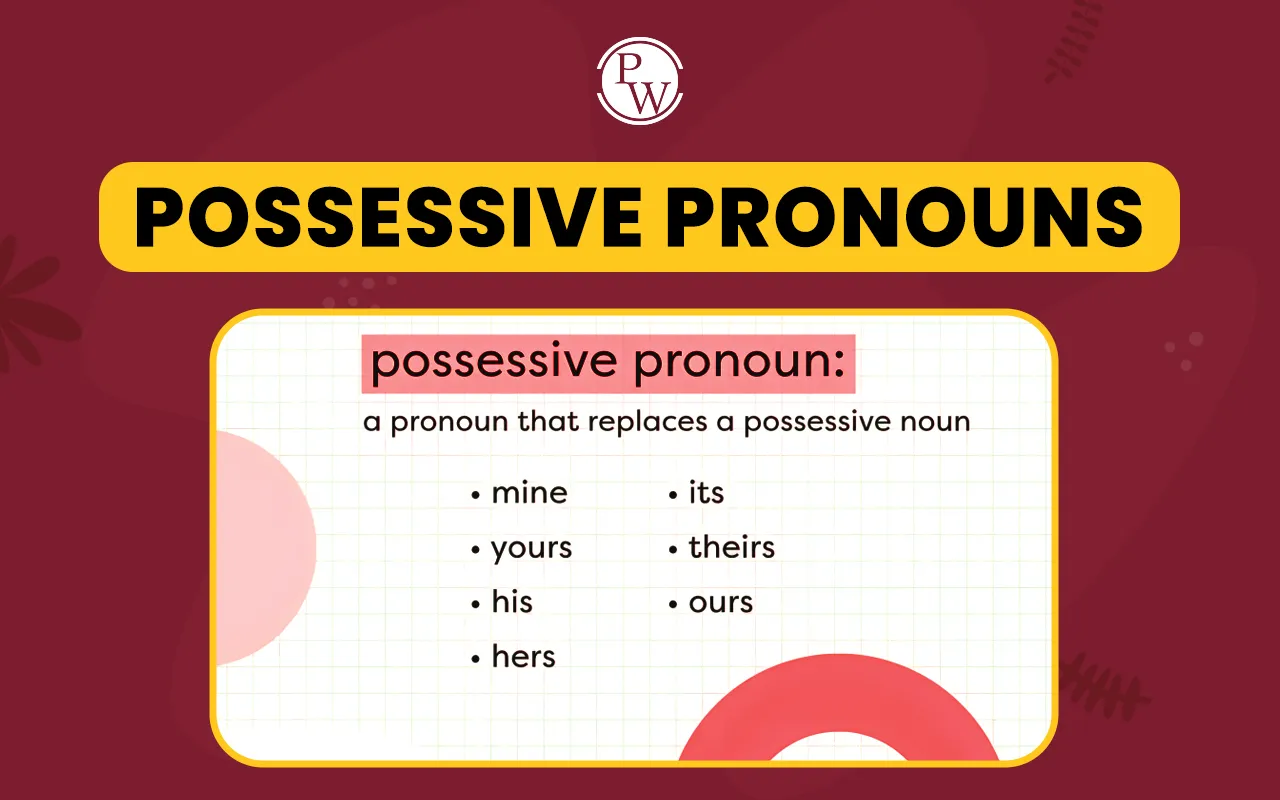
Possessive Pronouns
Possessive Pronouns are words that show who owns or is connected to something. They help describe people, animals, or things and how they relate to each other. Possessive Pronoun Examples: Instead of saying, “This is my dog,” you can say, “This dog is mine.” In this article we will learn what is possessive pronoun
For example, instead of saying, “This is my dog,” you can say, “This dog is mine.”
Possessive pronouns take the place of a noun in a sentence and can do the same jobs that nouns do. They make it clear who or what has ownership without repeating the noun.
Possessive pronouns are different from possessive adjectives, which also show possession but need to come before a noun, like “my” in “my book.” Knowing how to use possessive pronouns can make your writing simpler and more engaging.
Read More - Demonstrative Pronouns
What Are Possessive Pronouns?
Let us learn what is possessive pronoun here. Possessive pronouns are pronouns that indicate ownership or possession. They tell us that something belongs to a particular person or group. They are used to replace nouns in sentences and show that something belongs to someone or something. These pronouns are often used instead of repeating a noun or noun phrase in order to avoid redundancy.
For example:
- That book is mine. (Instead of saying "That book is my book.")
- The house next door is ours. (Instead of saying "The house next door is our house.")
Possessive Pronouns in English
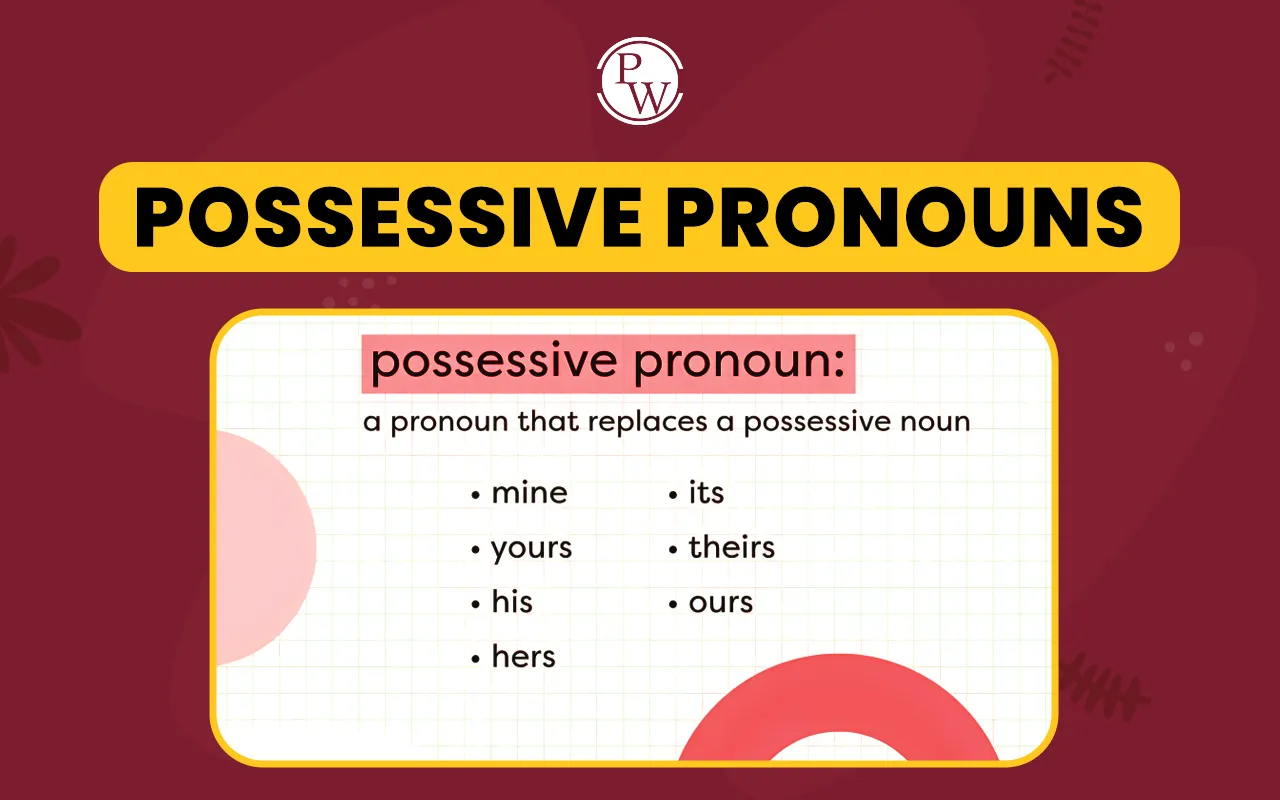
Possessive pronouns in English denote ownership. Mine, yours, his, hers, its, ours, and theirs are the primary possessive pronouns. They avoid duplication by substituting a word and indicating to whom or what something belongs. For instance, in the phrase "This book is mine," the pronoun "mine" denotes that the book belongs to the speaker.
Possessive Pronoun Definition
The definition of possessive pronoun is discussed here. A possessive pronoun is a term that expresses ownership or possession by replacing a noun, such as "mine," "his," or "theirs". "This book is mine" is an example of a phrase that uses them in separate terms. Possessive pronouns reduce the length of sentences and save repetition by taking the place of a noun or noun phrase.
Read More - English Grammar
How to Use Possessive Pronouns in Sentences
We have understood definition of possessive pronoun now, move to the use of possessive pronouns. Possessive pronouns are used to show that something belongs to a specific person or group. They are used in place of a noun phrase and function as replacements for possessive adjectives plus a noun. Let’s look at how each personal pronoun changes when it becomes a possessive pronoun :
- I → Mine
- Possesive Pronouns Example : This book is mine. (Instead of "This book is my book.")
- You → Yours
- Possesive Pronouns Example : Is this pen yours? (Instead of "Is this your pen?")
- He → His
- Possesive Pronouns Example : That jacket is his. (Instead of "That jacket is his jacket.")
- She → Hers
- Possesive Pronouns Example : The flowers were hers. (Instead of "The flowers were her flowers.")
- It → Its (Note: This is rare as it’s usually an adjective rather than a pronoun)
- Possesive Pronouns Example : The cat chased its tail. (Instead of "The cat chased the cat’s tail.")
- We → Ours
- Example : The victory was ours. (Instead of "The victory was our victory.")
- They → Theirs
- Possesive Pronouns Example : The house is theirs. (Instead of "The house is their house.")
Read More - Abstract Nouns
Possessive Pronouns Common Mistakes
Here are common mistakes students often make when using demonstrative pronouns, along with tips to avoid them:
- Using Apostrophes Incorrectly : One common mistake is putting an apostrophe in possessive pronouns, which is never correct.
For example, writing “The book is her’s” is wrong. The correct way is “The book is hers.” Always remember that possessive pronouns like “hers,” “yours,” and “theirs” do not need an apostrophe.
- Mixing Up “Its” and “It’s” : Many people confuse “its” (showing ownership) and “it’s” (meaning “it is”).
- Correct: “ The cat lost its toy.” (“Its” shows the toy belongs to the cat.)
- Correct: “It’s a sunny day.” (“It’s” means “it is.”)
- Using the Wrong Pronoun : Make sure the possessive pronoun matches the noun it replaces. Don’t use a plural pronoun for a singular noun.
- Correct: “The project is mine.”
- Incorrect: “The project is ours” (unless it’s shared by more than one person
How to Use Possessive Pronouns Effectively?
To use possessive pronouns in the best way possible, follow these tips:
Clarify Ownership
Use possessive pronouns to show who owns something. Possessive pronoun examples sentences: “Whose phone is this? It’s mine.”
Avoid Repetition
Replace repeated nouns with possessive pronouns to make sentences smoother. Possessive pronoun examples sentences: instead of “Lisa’s cake is tasty, but my cake is tastier,” use “Lisa’s cake is tasty, but mine is tastier.”
Make Sure Context Is Clear
Ensure that the pronoun’s reference (the noun it replaces) is clear to avoid confusion. incorrect: “We won, but they lost theirs.” (It’s not clear what “theirs” refers to.) Correct: “We won the championship, but they lost theirs.” (Now it’s clear that “theirs” refers to their championship.)
Unique Uses of Possessive Pronouns
Here are the different unique uses of possessive pronouns:
- Possessive pronouns can be used in special ways to show relationships or where someone comes from.
Possesive Pronouns example:
- “The cat is mine” means that the cat belongs to the speaker.
- “The hometown of my family is Chicago, and Atlanta is ours.” Here, “ours” means “our home city,” showing where the speaker’s family comes from.
2. Another unique use of possessive pronouns is using “theirs” as a gender-neutral singular pronoun. This makes sentences more inclusive.
Possesive Pronouns example: “Someone left their backpack here. I wonder if it’s theirs.” In this sentence, “theirs” refers to one person without specifying gender.
Possessive Pronouns vs. Possessive Adjectives
Both possessive pronouns and possessive adjectives show who owns something, but they are used differently.
Possessive Pronouns
- Take the place of a noun and can stand alone.
- Possesive Pronouns Example: “This hat is mine.” (Here, “mine” replaces “my hat.”)
Possessive Adjectives
- Go before a noun to show who owns it and cannot stand alone.
- Possesive Pronouns Example: “This is my hat.” (Here, “my” comes before “hat” to show ownership.)
Comparison
- “Your bike is new.” ( “Your” is a possessive adjective showing ownership of the bike.)
- “The new bike is yours.” ( “Yours” is a possessive pronoun replacing “your bike.”)
Possessive pronouns replace the noun, while possessive adjectives describe the noun.
Possessive Pronouns Practice Questions
Here are a few practice questions for kids on possessive pronouns:
- Replace the repeated word with a possessive pronoun: “This is Sarah’s pencil, and that is also Sarah’s pencil.”
What should you say instead? 2. Choose the correct possessive pronoun to complete the sentence: “The toy belongs to me. It is ______.” (A) mine (B) my (C) ours
- Fill in the blank with a possessive pronoun:
“Those books belong to us. They are ______.” 4. Which sentence uses a possessive pronoun correctly? (A) “That is mine book.” (B) “That book is mine.” (C) “That is my.”
- Replace the noun phrase with a possessive pronoun:
“This is Tom’s ball.” How would you say it using a possessive pronoun?
- Choose the correct possessive pronoun:
“This bag belongs to you. It is ______.” (A) yours (B) your (C) mine
- Complete the sentence with the correct possessive pronoun:
“They found their dog, but we still haven’t found ______.” Answers :
- “This is Sarah’s pencil, and that is also hers.”
- (A) mine
- ours
- (B) “That book is mine.”
- “This is his.”
- (A) yours
- ours
Possessive pronouns play an essential role in making sentences clear and concise by indicating ownership without the need for repetition.
By understanding how to use them properly and avoiding common mistakes, you can enhance your writing and speaking. Whether it’s expressing possession, relationships, or origins, possessive pronouns are a valuable tool for clear communication.
Join CuriousJr English Learning Classes Online Now!!
| Related Links | |
| Pronouns | Antonyms |
| Singular nouns | Synonyms |
| Plural nouns | Conjunctions |
Possessive Pronouns FAQs
Can possessive pronouns be used at the beginning of a sentence?
Do possessive pronouns agree with the gender of the noun they replace?
Do possessive pronouns change in different tenses?
How many possessive pronouns are there?