Properties of Triangle with Examples
 Nikita Aggarwal10 Apr, 2026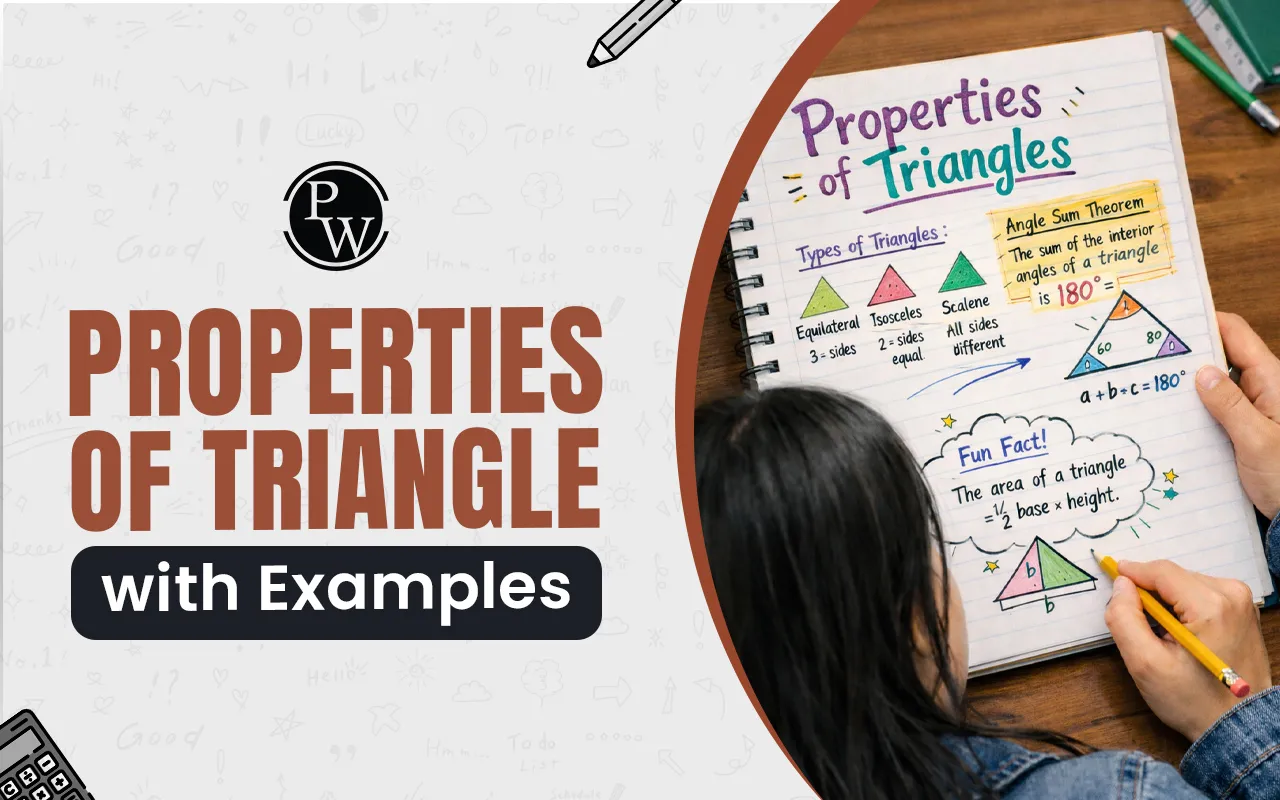
What are the Properties of Triangle?
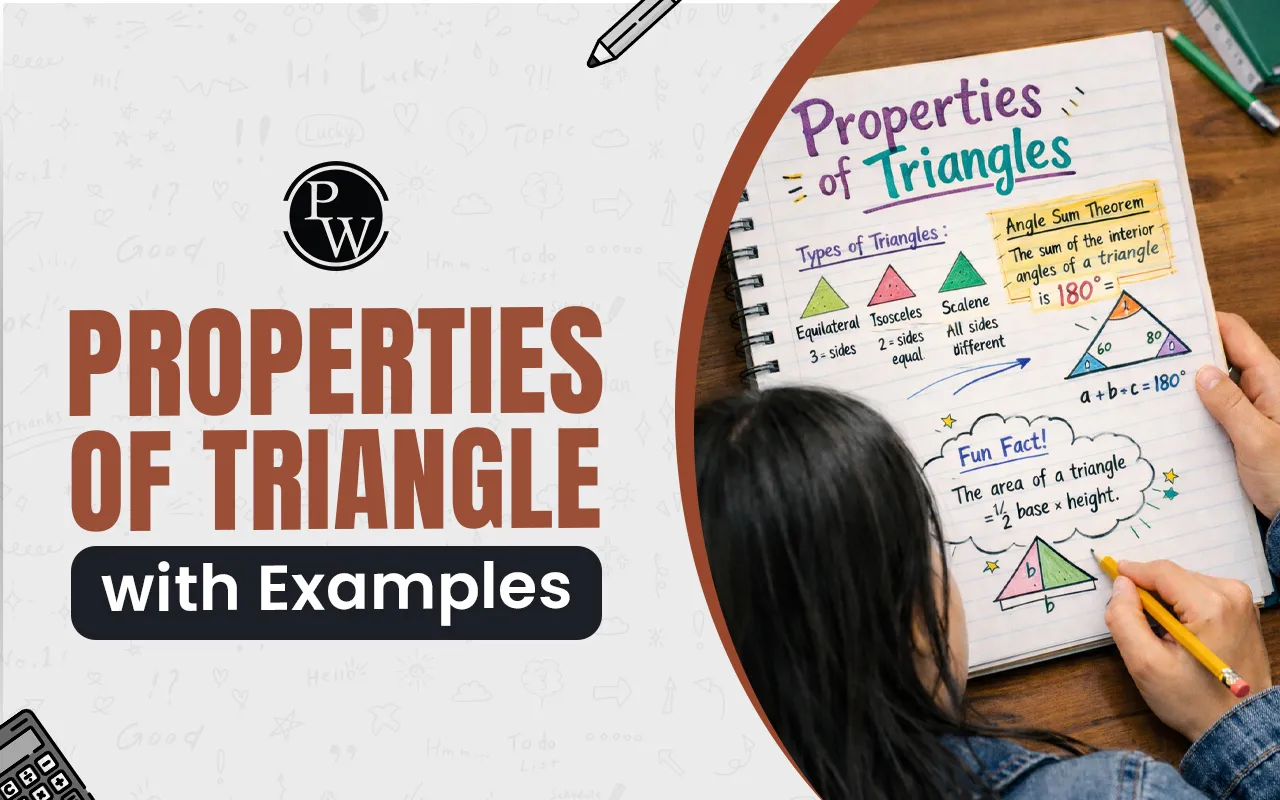
The properties of a triangle help us understand the relationship between its sides and angles.These properties make it easier to identify triangles, solve geometry questions, and find missing sides or angles. Some of the main properties of a triangle include the angle sum property, triangle inequality property, exterior angle property, Pythagoras theorem, and congruence property.
Elements of a Triangle
Before we get into the hard rules, let's look at the basic parts:
-
Sides: The three lines that make up the edge.
-
Vertices: The three points where the sides meet.
-
The three angles that make up the inside of the triangle.
-
Exterior Angles: Angles that are made between one side and the extension of the side next to it.
Read More - 30-60-90 Triangle - Sides, Formula, Examples
Important Properties of Triangle
Angle Sum Property
This is a well-known rule in geometry. This rule says that the three inside angles of any triangle always add up to 180 degrees.
No matter how big or little the triangle is, or whether it is acute, obtuse, or right-angled, this total stays the same. You can always find the third angle of a triangle by taking 180 and subtracting the total of the other two.
Example:
What is the third angle of a triangle that has two angles that are 50° and 60°?
-
110° is the sum of the known angles, which are 50° and 60°.
-
The third angle is 70° since 180° - 110° equals 70°.
Exterior Angle Property
This feature tells us how the exterior of a triangle is related to the inside. It says that the outside angle is equal to the sum of the two interior angles that are opposite it.
This is quite helpful for determining angles without having to figure out all the other parts inside first.
-
Key Rule: Exterior Angle = Sum of Remote Interior Angles.
-
An outside angle and the angle next to it inside are supplementary, which means they add up to 180°.
For example:
If the two opposite interior angles of a triangle are 40° and 70°, the exterior angle that is made by extending the third side will be 40° + 70° = 110°.
Triangle Inequality Property
Can any three lengths form a triangle? The answer is no. To form a closed shape, the sides must satisfy this property.
This property states that the sum of the lengths of any two sides of a triangle must be greater than the length of the third side. Similarly, the difference between any two sides must be less than the third side.
If you have side lengths of 2 cm, 3 cm, and 10 cm, you cannot form a triangle because 2 + 3 is not greater than 10. The lines simply won't meet!
Side–Angle Relationship Property
Another important rule connects the sides and angles of a triangle. The side opposite the largest angle is always the longest side, and the side opposite the smallest angle is the shortest.
This means that if one angle in a triangle is greater than another, the side opposite it will also be longer. This property helps compare sides and angles without measuring them directly.
Pythagoras Property
It is a special rule that only works for right-angled triangles. It is also called the Pythagorean Theorem. It tells you how the two shorter sides (legs) and the longest side (hypotenuse) are related.
-
The rule: The hypotenuse squared is the same as the sum of the squares of the other two sides.
-
The formula says that the square of the base plus the square of the perpendicular equals the square of the hypotenuse.
-
This attribute is very important for figuring out distances and is a common part of mental maths problems.
For example:
If a right triangle has sides that are 3 cm and 4 cm long:
9 is the square of 3.
16 is the square of 4. 25 is the sum of 9 and 16.
Five is the square root of 25. That means the hypotenuse is 5 cm.
Congruence Property
We use this property to tell two distinct triangles apart. Two triangles are congruent if they are the same size and shape. This means that the sides and angles that go together are the same.
There are many ways to establish that two items are congruent:
-
SSS (Side-Side-Side): All three sides are the same length.
-
SAS (Side-Angle-Side): The angle between two sides and the two sides are the same.
-
ASA (Angle-Side-Angle): The side between two angles and the two angles are the same.
-
RHS (Right angle-Hypotenuse-Side): The hypotenuse and one side of a right triangle are the same length.
Properties of Triangle Basic Formulas
In addition to their geometric qualities, triangles also obey some important rules for doing math:
-
The perimeter of a triangle is the sum of the lengths of all three sides.
-
Side 1 + Side 2 + Side 3 = Perimeter
-
The area of a triangle is the space inside it.
-
Area = ½ × Height × Base
A lot of people use these formulas to solve math difficulties with triangles.
Properties of Triangle Summary
You can quickly look up and grasp all the important facts about triangles in this table:
|
Property Name |
Key Definition |
Mathematical Relationship |
|
Angle Sum Property |
The total of all the angles inside |
A + B + C = 180°. |
|
Exterior Angle Property |
Angles on the outside vs angles on the inside |
Exterior Angle = the sum of the two opposite interior angles |
|
Exterior Angles Sum |
The sum of all the outside angles |
The sum of the outside angles is 360°. |
|
Triangle Inequality |
What a triangle needs to be real |
Sum of any two sides > third side |
|
Side–Angle Relationship |
Longer side ↔ bigger angle |
The biggest angle is across from the longest side. |
|
Pythagoras Property |
For right-angled triangles |
a² + b² = c² (c is the hypotenuse). |
|
Congruence Property |
Triangles that are the same |
SSS, SAS, ASA, AAS, or RHS standards |
|
Perimeter of Triangle |
Length of the whole boundary |
The perimeter is equal to a + b + c. |
|
Area of Triangle |
The area inside the triangle |
Area = 1/2 × base × height |
Properties of Triangle Classification
It also helps us sort them into different groups. Knowing these categories helps you use the proper formulas.
Based on the sides
-
Equilateral indicates that all three sides are the same length and all three angles are 60°.
-
Isosceles means that two sides are the same length and that the angles on the other two sides are the same length.
-
Scalene signifies that the angles and sides are all different.
By Angles
-
Acute-angled: All of the angles are less than 90°.
-
Right-angled: One angle is exactly 90 degrees.
-
One angle is more than 90 degrees, which is obtuse.
Read More - Right Angle Triangle: Definition, Properties, Formula & Examples
Properties of Triangle Examples
Let's apply these examples to a few real-world scenarios.
Scenario 1: Looking for an aspect that is lacking
The angle at the top of an isosceles triangle is 40°. What are the angles at the base?
The two base angles are the same since it is isosceles. Let them be "x."
The angle sum rule says that 40 + x + x equals 180.
2x = 140.
x = 70°. The angles at the base are both 70°.
Scenario 2: Checking how long the sides are
Can a triangle have sides that are 15 cm, 8 cm, and 5 cm long?
The triangle inequality theory says that 5 + 8 = 13.
These sides can't construct a triangle since 13 is less than 15.
Scenario 3: Using the relationship between the side and the angle
One angle in a triangle is 90°, another is 60°, and the last is 30°. Which side is the longest?
The side that is the longest is always across from the angle that is the biggest.
The largest angle here is 90°.
The hypotenuse is the longest side, which is the side that lies opposite the 90° angle.
Scenario 4: How to figure out the perimeter
The lengths of the sides of a triangle are 6 cm, 8 cm, and 10 cm. What is the length of its edge?
The perimeter is the sum of all the sides: 6 + 8 + 10 = 24 cm.
The triangle's perimeter is 24 cm.
Scenario 5: Finding the Area
The base of the triangle is 10 cm and the height is 6 cm. How big is it?
The area is equal to ½ times the base times the height, which is equal to ½ times 10 times 6, which is equal to 30 cm².
The triangle's area is 30 square centimetres.
Make Maths Easy and Enjoyable with CuriousJr
CuriousJr helps children build a strong foundation in maths by removing fear and boosting confidence. Our Mental Maths online classes for students from Classes 1 to 8 are designed to improve speed, accuracy, and logical thinking through simple techniques and interactive learning methods.
With our dual-mentor approach, students participate in engaging live classes and receive dedicated support for doubt-solving after every session. Animated lessons, fun activities, and exciting challenges make learning maths easy and enjoyable.
Parents get regular progress updates along with review sessions, ensuring full transparency in their child’s learning journey.
Book a demo class today and discover how CuriousJr makes maths simple, engaging, and confidence-building for your child.