Easy Practice for Reading Notices and Announcements (Level Key)
 Nikita Aggarwal23 May, 2026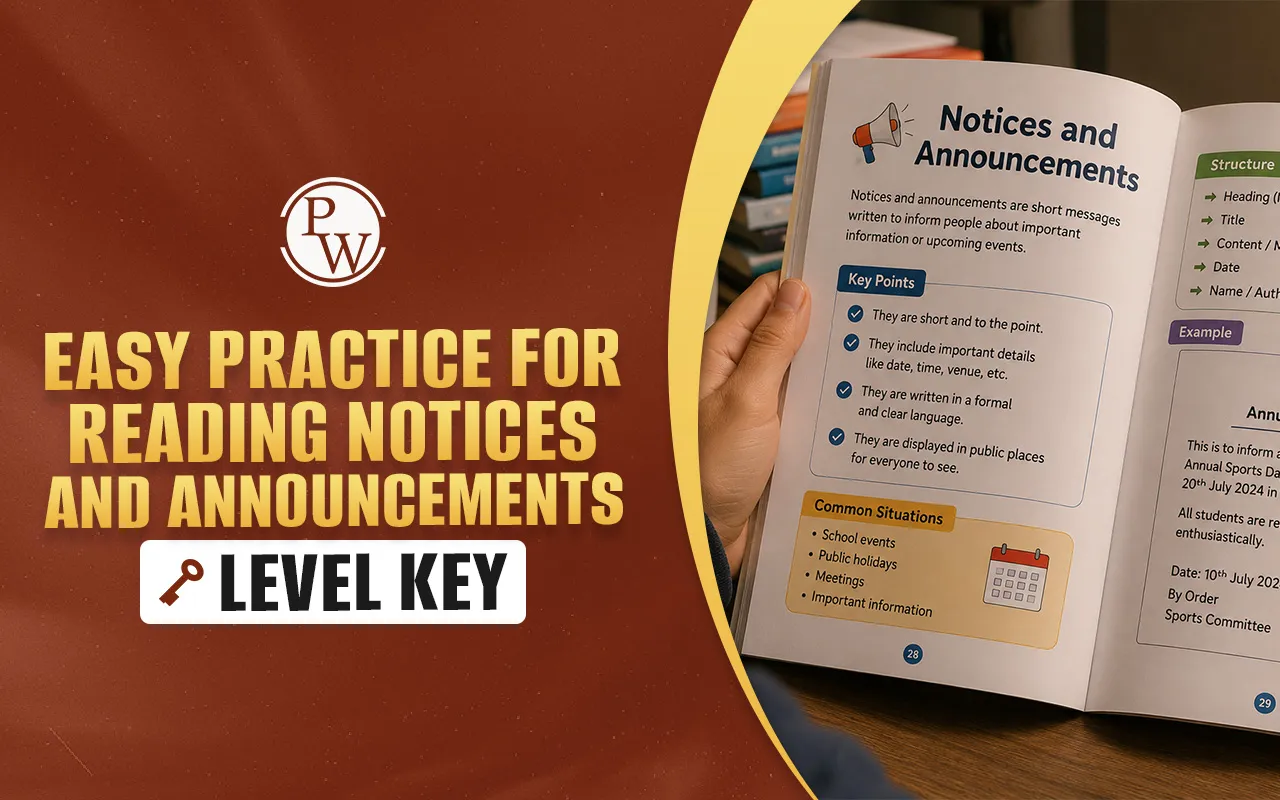
Why Practice for Reading Notices and Announcements Matters?
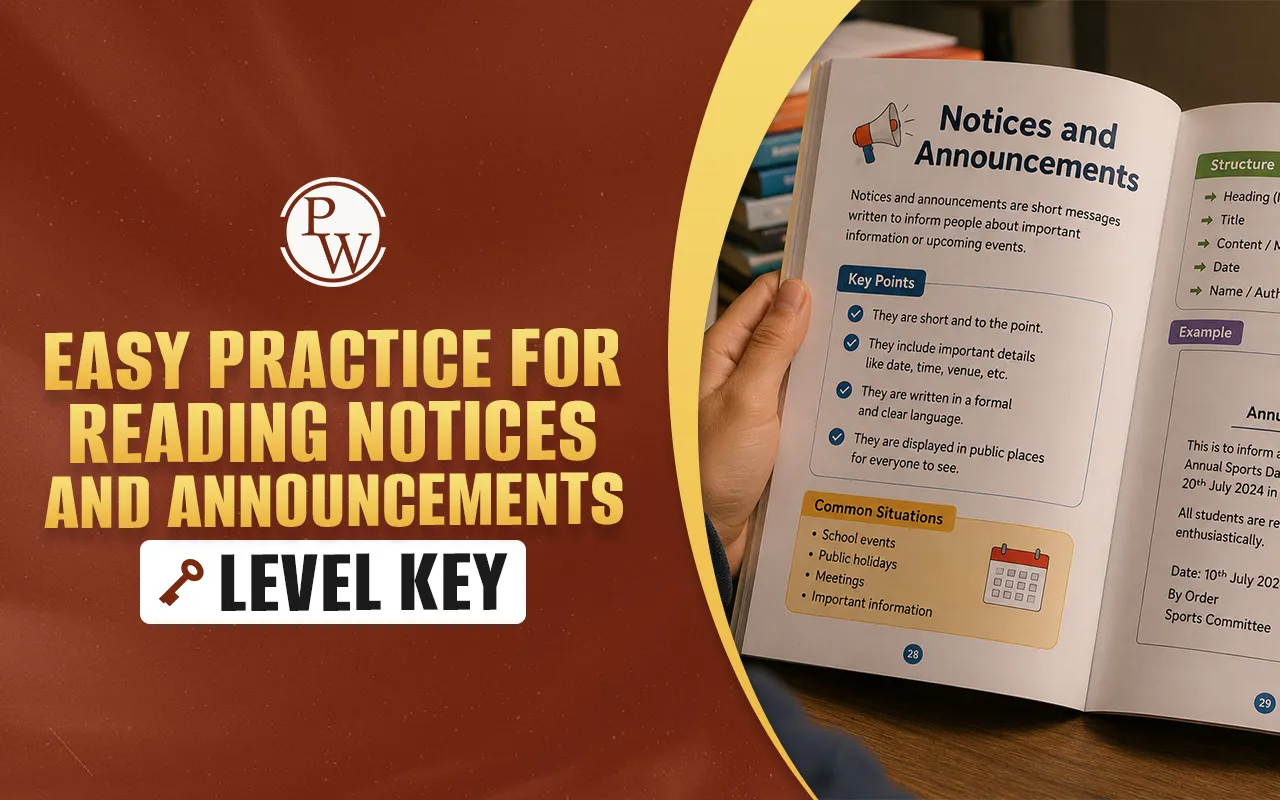
You will find short written instructions everywhere, like at airports, train stations, schools, and supermarkets. Practising regularly helps you find the main message without getting confused by difficult words.
Notices and signs use only a few words to give important instructions or rules. If you can understand them quickly, moving around in public places becomes much easier.
|
Key Notice Element |
What to Look For |
|
Core Message |
The main rule, instruction, announcement, or update |
|
Target Group |
The people who need to read or follow the notice |
|
Timeframe |
Important dates, times, deadlines, or urgency |
|
Location |
The place where the notice applies or takes effect |
If you get good at reading public notices, you will not miss important updates. For example, a store sign might look like an ad but actually tell you about special prices or closing times. Practicing reading in English helps you quickly find the important facts and ignore extra details.
Practice Reading Notices and Announcements Through Public Signs
To move from basic to intermediate English, you need to read more than just simple sentences. Public signs are a great way to practice because they use real language you see every day.
|
Sign Wording |
Actual Meaning |
|
No parking in front of this entrance |
Do not leave your vehicle here; keep the entrance clear for access. |
|
Only handbags available at a reduced price |
The discount applies only to handbags; all other items are sold at regular prices. |
|
Return your books before you leave the library |
Hand in borrowed books to the librarian before exiting the library. |
When you read real signs, look for keywords that show what you can or cannot do. Words like “must,” “permitted,” “prohibited,” or “except” can change the meaning of a notice. Noticing these words is an important part of practicing how to read notices and announcements.
-
Look for modal verbs: Words such as should, must, and cannot tell you if an action is optional or mandatory.
-
Identify synonyms: Real notices often use slightly different vocabulary than everyday casual talk.
-
Scan for icons: Visual cues next to the text usually confirm the core instruction.
Read More - Full Sentence Speaking Practice for Kids Learning English (Key Level)
Strategies for Reading Notices and Announcements Easily
To understand announcements, try to see the main idea instead of focusing on each word. People who write public notices keep them short so they fit on signs or labels.
-
Read the complete notice carefully to understand the full message before focusing on individual details.
-
Identify the purpose of the notice—whether it is informing, warning, requesting, inviting, or instructing readers.
-
Highlight important information, such as dates, times, locations, eligibility requirements, and specific instructions.
-
Focus on relevant details that directly answer the question being asked.
-
Eliminate distracting options in multiple-choice questions by comparing each choice with the information given in the notice.
-
Confirm your answer by checking that it matches the notice exactly and does not rely on assumptions.
If you scan the text in a careful way, you will not have to guess on multiple-choice questions. Always check who the notice is for before you decide what to do. This habit will help you read more accurately every day.
Practice for Reading Notices and Announcements with Examples
Practising with real text samples helps lock in your reading notes and English abilities. Below are three realistic scenarios designed to build solid intermediate English skills. Read each text block and focus on the core message.
Scenario 1: The Local Shop Sale Update
Notice text: "This shoe store will no longer serve customers after this week. All current floor stock must clear."
-
Core Fact: The business is closing down permanently very soon.
-
Key Detail: Customers need to complete their final purchases before the week ends.
-
Comprehension Focus: The phrase "no longer serve" marks an end to services.
Read More - Build Vocabulary without Memorizing (Level Key)
Scenario 2: School Equipment Rules
Notice text: "You must ask a teacher first before you use this equipment. External items are restricted."
-
Core Fact: Students cannot use the gear without adult permission.
-
Key Detail: The equipment belongs specifically to the school premises.
-
Comprehension Focus: "Ask first" emphasises that permission is mandatory.
Scenario 3: Transport Ticket Changes
Notice text: "Supersaver tickets can be used every day except Saturday. Regular rates apply on weekends."
-
Core Fact: You will pay more if you travel on a Saturday afternoon.
-
Key Detail: The discount is active throughout the standard workweek.
-
Comprehension Focus: "Except" excludes that single day from the discount.
Reading Notices and Announcements Practice Sheet
The best way to sharpen your abilities is through structured practice. Work through these practice exercises by reviewing the short text blocks and selecting the most accurate summary statement.
Exercise 1: Cafe Tray Notice
Notice text: "Customers should take their used plates to the trays provided next to the kitchen."
-
Option A: Give your dirty plates directly to the kitchen staff.
-
Option B: Leave your plates on the dining table for collection.
-
Option C: Place your used tableware on the designated trays near the kitchen area.
Correct Answer: Option C. The notice specifies using the trays provided rather than handling items directly by staff.
Exercise 2: Library Drop-Box Rule
Notice text: "The librarian needs to see your books before you go. Do not use the drop-box during daytime hours."
-
Option A: Return your books before you leave the library building.
-
Option B: Leave your books in the drop-box whenever the building is open.
-
Option C: Take all your books home without showing them to anyone.
Correct Answer: Option A. You must present the items to the staff member directly before exiting.
Exercise 3: Sports Team Transport Schedule
Notice text: "The match starts at 9:00, so the team bus leaves the sports centre no later than 8:00."
-
Option A: The team trains at the sports centre until 9:00.
-
Option B: Players must meet the bus by 8:00 to reach the match on time.
-
Option C: The team bus arrives back at the sports centre at 8:00.
Correct Answer: Option B. "Leaves no later than" means the transport departs at that specific hour.
Vocabulary for Reading Notices and Announcements
Succeeding at English reading practice involves mastering the short, formal phrases used in official communications. Authors often choose words that save space but carry significant authority.
|
Formal Term |
Simple Meaning |
Example Context |
|
Reduced price |
Cheaper / On sale |
Handbags are available at a reduced price. |
|
Permitted |
Allowed |
Parking is permitted in this area. |
|
Seek assistance |
Ask for help |
Seek assistance from the store manager. |
|
At present |
Right now / Currently |
The machine is out of order at present. |
Learning these connections lets you read notices effortlessly. When a notice says an item is "not working at the moment," you instantly know to find an alternative. Remembering these simple terms boosts your speed during timed exams or real-life situations.
Practice for Reading Notices and Announcements in Cambridge Exams
If you are preparing for formal tests like the Cambridge A2 Key or B1 Preliminary, this section is vital. These tests evaluate your understanding of real-world texts, authentic notices, and short messages.
|
A2 Key Reading Tasks |
B1 Preliminary Reading Tasks |
|
Designed for learners aged 10–12 |
Designed for learners with an intermediate level of English |
|
Focuses on understanding everyday information |
Focuses on understanding longer and more detailed texts |
|
Includes signs, notices, emails, and short messages |
Includes articles, reviews, stories, and opinion-based texts |
|
Tests comprehension of basic facts and instructions |
Tests understanding of main ideas, opinions, and attitudes |
|
Requires identifying clear information |
Requires distinguishing purpose, intent, and the writer’s viewpoint |
Learners tracking towards an A2 Key certificate learn to write short personal messages, understand basic instructions, and engage in simple conversations. Moving up to B1 Preliminary tasks requires analyzing text for the writer's attitude, global meaning, and specific details.
Using dedicated practice for reading notices and announcements helps you build the necessary skills for both stages. Regular practice helps you transition from basic signs to advanced text reading smoothly.
How to Measure Your Progress in Reading Notices and Announcements
To gauge your progress, track how quickly you find key details in an announcement. Try reading a sign just once, covering it, and summarising the core instruction from memory.
-
Check your error patterns: Are you missing dates, modal verbs, or location details?
-
Time your reading: Aim to process short 3-line notices in less than fifteen seconds.
-
Write summaries: Rephrase public texts into short emails or text messages for a friend.
Consistent practice with authentic notices makes real-world English much easier to understand. Over time, you will find yourself scanning billboards, packaging guidelines, and transport schedules effortlessly.