How to Teach a Class 1 Child to Count On and Count Back in Their Head
 Nikita Aggarwal19 Jun, 2026
Count On and Count Back Mental Maths Class 1 Overview
When kids begin to learn calculations they often start counting again from 1. When you ask them to count two more than 5, they often start counting (1, 2, 3...4, 5...6...7). This is called "counting all" and it takes more time and effort.
The key to building these true count on and count back mental maths Class 1 skills are about finding two much better paths.
-
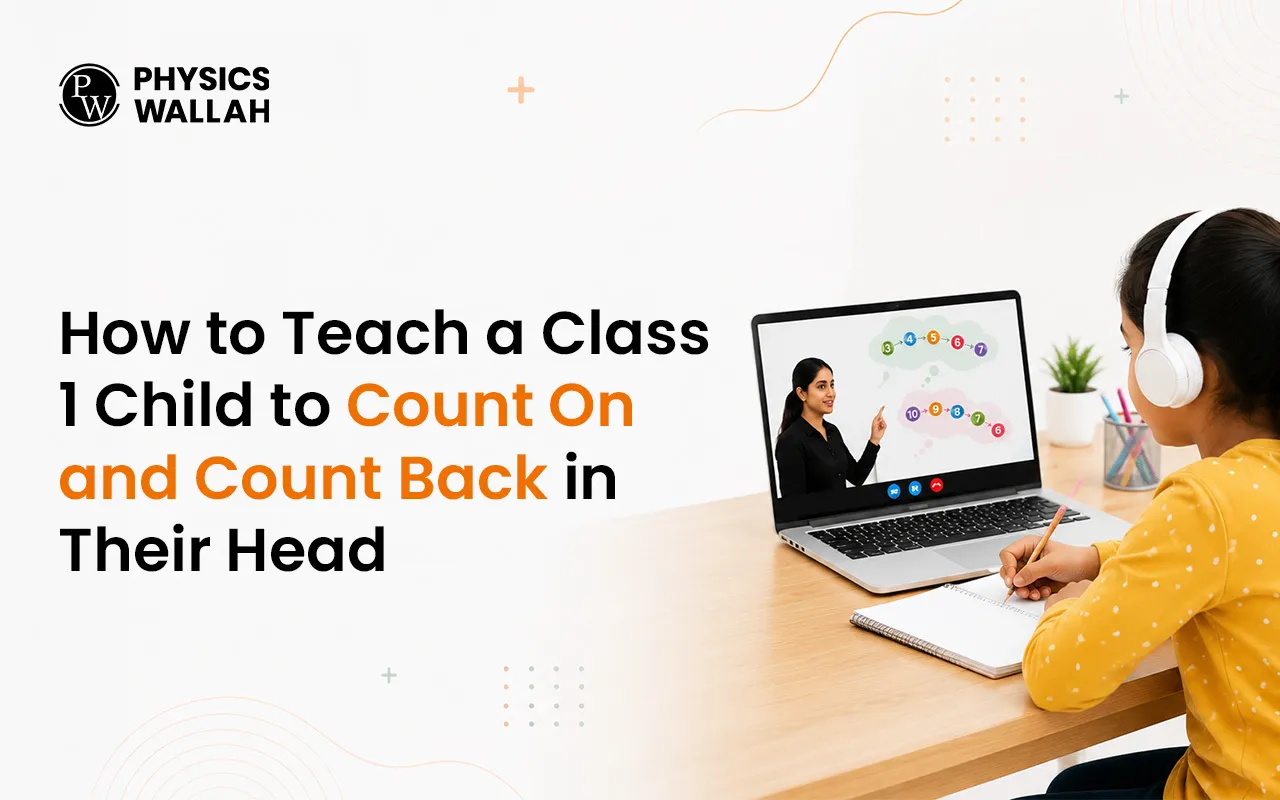
Counting On (Forward Counting): The child anchors a starting number in their mind and counts forward from that position. For instance, to do 5 + 3, they think "5" and then count forward three steps: "6, 7, 8".
-
Counting Back (Backward Counting): The child is given a number, and he/she will count down to smaller numbers. If they have to work it out in their head, 8 - 2. They think of an "8" and lock that number into their minds and count back two steps on their fingers : "7 — 1; 6 — 2".
They learn that numbers are flexible and that they can add or subtract to get the answers. Children learn to think about numbers spatially, not just by rote memorisation of facts like a song. This mental agility makes calculations for children no longer an abstract chore but instead intuitively visualised.
Importance of Count On and Count Back Mental Maths Class 1
With a keen ability to use mental math from an early age, students change their interaction with numbers for life. They help students move beyond rote learning and establish a lasting framework for mathematical thinking.
Class 1 mental maths techniques offer some important benefits for young learners:
-
Bypasses the Need for Finger Counting: Children who rely on their fingers can perform only single-digit calculations or addition and subtraction within 10 or 20, at best. And they have to count slowly using "one for me," which drastically slows their processing speed. These mental tricks unlock much faster and faster calculations.
-
Creates an Intuitive Connection to Subtraction: Each and every time a child counts backwards, they are doing subtraction. Before symbols are ever introduced into their world, they naturally practise the concept of reducing quantities simply by reversing the order.
-
Builds Lasting Number Sense: It shows children what number comes next and what goes before every integer from any position – more specifically, how all integers relate to one another.
-
Reduces Stress and Boosts Classroom Confidence: Since a child can do small calculations from memory, they engage in class more confidently than before and is not anxious when working on timed exercises.
Read More - Speed Maths Test for Class 1 (Try Now)
Fun Activities for Practising Count On and Count Back Mental Maths Class 1
For children, the more playful and active your lesson is and the more you encourage conversations between them and among themselves, the better they learn. Practising counting backward from 10 or even 20 to 1 is helpful because counting backward places a greater cognitive load on any child's brain than forward counting and demands conscious practice that has been done in range.
Here are four interesting counting strategies for Class 1 you can use to develop flexible mental math skills:
1. The Rocket Launch Countdown
Such a technique cannot only increase fluency but also helps to develop backward sequences. get your child to sit or stand on the floor and have them practise counting backward. Practise counting backwards together from 10 or even 20 to one.
-
The Action: "10, 9, 8, 7, 6, 5, 4, 3, 2, 1... BLAST OFF!"
-
The Benefit: The child hops high onto "Blast Off". This high-intensity action connects the countdown number line with a strong physical learning experience that sticks in your memory.
2. The Mental Number Lock
To prevent the children from counting upwards starting at zero every time they add, practise "locking" a number in their minds.
-
The Action: Reveal a 7 or show a close-up of a box with seven buttons in it. So, if you said, "We know there are 7 in there. Hold that number in your mind.
-
The Exercise: Hold up 3 fingers and ask them to keep counting from that number held in place—"7… 8, 9, 10." This very simple trick lays out a safe base for mental addition Class 1.
3. Floor Number Line Hops
Make a number line on your floor out of masking tape or chalk with very clear steps from 0 to 20.
-
The Action: Provide your child an instruction-based directive. One such example would be to stand on 8 and jump back three steps. Where do you land?" "Start with 11 then move forward by skipping numbers such as two."
-
The Benefit: The physical aspect of moving left to subtract and right is a bridge between manipulable play (like blocks or pegs) and visual-spatial mathematical understanding.
Read More - Weak Number Recognition Mental Maths Tricks for Class 1
4. The Quick Countdown Chain
Gather round and sit in a circle with your family or friends to strengthen the whole sequence.
-
The Action: Pick a random starting number, e.g., 15. The first person says 15, and the next person must say the number that comes immediately after it (14).
-
The Rule: Move around the circle as fast as you can without breaking it. Or maybe the child is stuck on a tricky transition, such as from 11 to 10 — just nudge them and let it roll along.
Benefits of Count On and Count Back Mental Maths Class 1
Frequent practice of these strategies alters how a child views mathematics. It reframes math not as an unyielding set of scary rules but in the form of a dynamic pattern game.
By spending a small amount of time on Class 1 maths at home, you can make an immediate positive difference to behaviour and academic success.
-
Sharper Memory Retention: Children learn to keep a starting number in their minds while also processing another kind of sequence. This builds overall working memory.
-
Smoother Transition to Complex Math: A child who can count back confidently from 20 will breeze through two-digit subtraction, the real meaning of place value, and regrouping in Class 2 and Class 3.
-
Greater Independence: Children can finish their assignments without the need to risk losing interest during study hours by not relying on tactile counters or finger tapping as they get older.
-
Stronger Logical Deduction: The use of reverse sequences encourages children to slow down, study the relationship between numbers and identify mistakes when performing calculations.
How Does Curious Jr Help with Class 1 Mental Maths?
When you need to practise and strengthen these fundamental skills outside of classic printed worksheets, online mental maths Class 1 platforms offer an engaging solution. Curios Jr helps bring young kids successfully from physical finger counting to speedy mental maths.
Curious Jr follows a systematic methodology to support your child in his/her learning journey:
-
Immersive Educational Games: The platform gamifies abstract maths practice, making it exciting, which removes academic pressure, and most importantly, the kids remain naturally engaged.
-
Clear Visual Explanations: Complex concepts like moving backward on a number line are broken down with bright, easy-to-understand animations that match a child's natural way of learning.
-
Structured, Step-by-Step Curriculum: With a natural progression from simple pre-number ideas to adding and subtracting up through 20, we ensure that no child is left behind!
-
Patience-First Live Support: Amazing educators work with children on advanced Vedic maths tricks that help them drop slow-finger habits and build years of confidence in mathematics.




How to Teach a Class 1 Child to Count On and Count Back in Their Head FAQs
What is the main goal of count on and count back mental maths Class 1?
Why do children find counting backward harder than counting forward?
When should I introduce counting back to a Class 1 child?
Can online platforms really help my child stop counting on their fingers?

Get Free Counselling Today
and Clear up all your Doubts
 Live & recorded classes available at easeDashboard for progress trackingLakhs of practice questions