Class 5 Geometry: How to Calculate Perimeter and Area Mentally
 Nikita Aggarwal15 Jun, 2026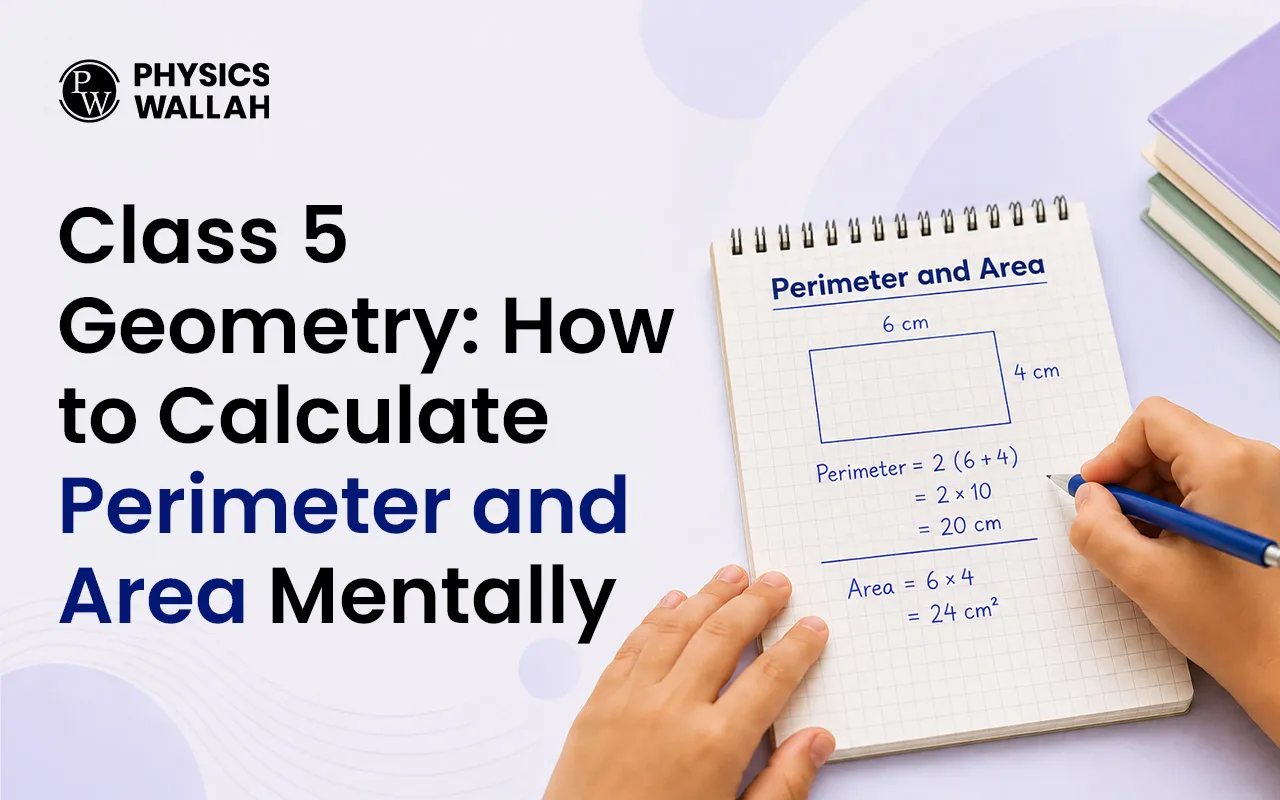
Importance of Class 5 Geometry Perimeter and Area Mental Maths
When students transition to higher primary classes, maths becomes more abstract. Instead of just drawing shapes, they are required to measure them, analyze properties, and solve complex problems. Relying on paper for every single calculation can slow down a child's learning pace and reduce their confidence during timed class tests.
Mental maths in Class 5 geometry perimeter and area mental maths helps kids to visualise shapes better. When a student can look at a rectangle and mentally compute its perimeter, they have a good spatial sense. This mental flexibility sets a good base for higher concepts like volume and coordinate geometry in later years.
Besides, fast calculation skills save precious time during school assessments. Instead of spending minutes writing down every single step for basic addition or multiplication students can use that time to tackle trickier word problems. It turns geometry into a mental game, not a boring memorisation task.
Simple Tricks for Class 5 Geometry Perimeter and Area Mental Maths
Calculating the boundary of a shape does not require complex formulas. Perimeter is simply the total distance around the outside of a two-dimensional shape. For regular shapes, you can easily use shortcuts that make calculations much faster than standard methods.
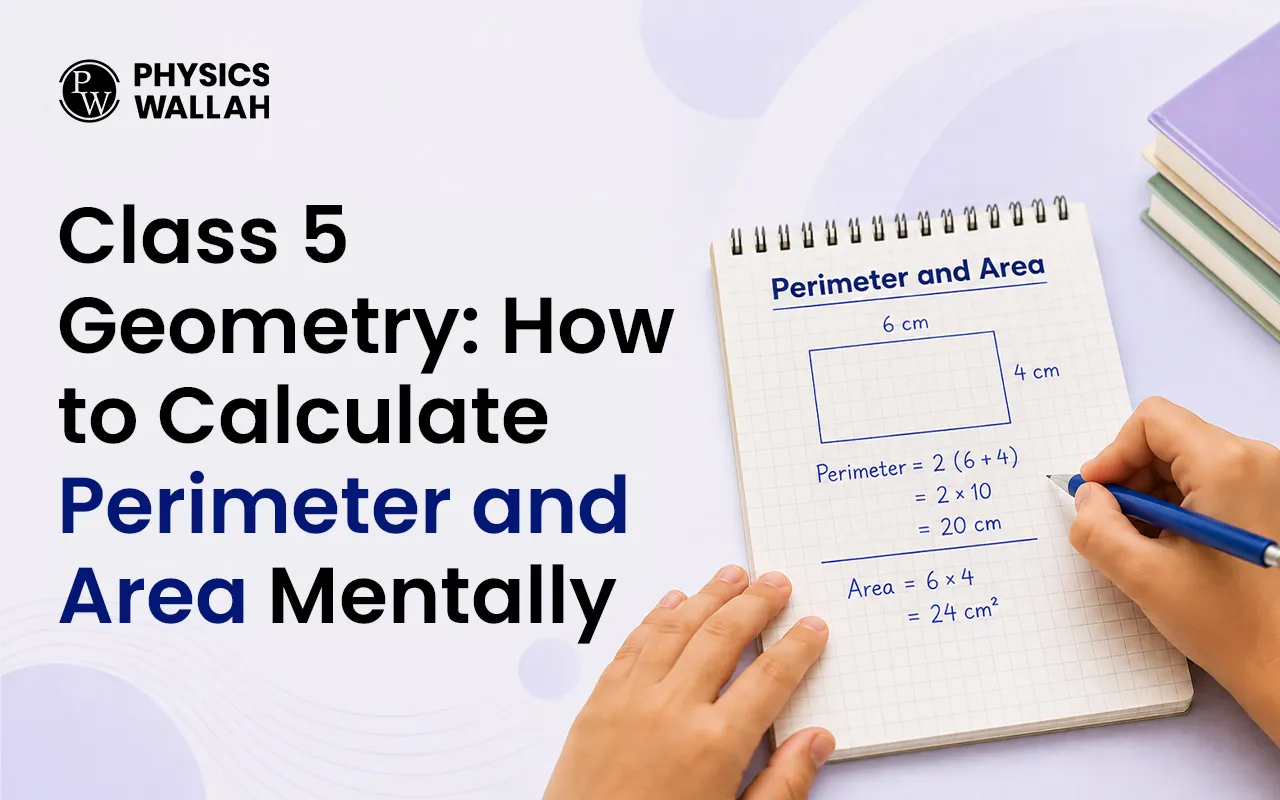
To calculate the perimeter of a rectangle in your head, use the doubling method. Instead of using the traditional formula, teach your child to add the length and the width first, and then double the result. For example, if a playground has a length of 12 metres and a width of 8 metres, add 12 and 8 to get 20, then double it to get 40 metres.
For regular polygons, such as squares, equilateral triangles, and regular pentagons, it’s even easier. All sides are the same length, so you only need to multiply the length of one side by the total number of sides. Here is a table to help you quickly calculate perimeters in your head.
The table below shows how to find the total perimeter of standard shapes quickly using simple multiplication steps:
|
Shape Name |
Number of Sides |
Mental Maths Trick to Find Perimeter |
|
Square |
4 |
Multiply the given side by 4 |
|
Equilateral Triangle |
3 |
Multiply the given side by 3 |
|
Regular Pentagon |
5 |
Multiply the given side by 5 |
|
Regular Hexagon |
6 |
Multiply the given side by 6 |
How to Calculate Class 5 Geometry Perimeter and Area Mental Maths Without Paper?
Area represents the total amount of space covered inside a flat shape. While perimeter deals with the outer edges, area focuses on the surface inside. Students often mix up these two concepts, but visualizing grid squares can make the distinction very clear.
To figure the area of a rectangle in your head, think of the rectangle as rows and columns. Multiply the base times the height. If the room is 6 metres by 5 metres, imagine 6 rows of 5 squares in each row. The answer is instantly 30 square metres.
For a square, the calculation is even more direct because you multiply the side by itself. If a square tile has a side of 9 centimetres, multiplying 9 by 9 gives 81 square centimetres instantly. Practicing these basic multiplication tables regularly makes Class 5 geometry perimeter and area mental maths incredibly easy for young minds.
Read More - How to Calculate Discounts and Simple Interest Mentally in Class 5
Examples of Class 5 Geometry Perimeter and Area Mental Maths
Let us look at some everyday scenarios where students can apply these fast calculation methods. Practicing with real-world objects helps children understand how geometry applies outside the classroom, making the concepts far more memorable.
Consider a square photo frame that has a side length of 7 centimetres. To find its total boundary line mentally, a student can quickly multiply 7 by 4 to get 28 centimetres. To find out how much space the photo covers on the wall, they can multiply 7 by 7 to get 49 square centimetres.
Another example is a rectangular study table measuring 10 units in length and 6 units in width. To find the perimeter, add 10 and 6 to get 16, then double it to get 32 units. For the area, simply multiply 10 by 6 to get 60 square units.
The following list provides easy mental steps to solve common word problems involving shapes:
-
Fencing a garden: Always calculate the perimeter because a fence only goes around the outer edge.
-
Tiling a floor: Always calculate the area because tiles cover the entire surface space.
-
Framing a painting: Calculate the perimeter to know the exact length of the wooden frame needed.
-
Painting a wall: Calculate the area to find out how much paint is required for the surface.
Read More - Visual Reasoning Mental Maths Tricks for Class 5
Tips for Class 5 Geometry Perimeter and Area Mental Maths
Mastering mental maths requires regular, short practice sessions rather than long hours of cramming. You can easily turn daily routines into quick maths quizzes to keep your child engaged and improve their retention.
Encourage your child to look for different Class 5 maths shapes around the house, such as television screens, doors, textbooks, and floor rugs. Ask them to estimate the dimensions first, and then calculate the perimeter and area mentally before checking with a ruler.
Another excellent tip is to break down larger numbers into smaller, manageable parts. If a rectangle has a length of 15 centimetres and a width of 4 centimetres, multiplying them might seem hard at first. Teach them to multiply 10 by 4 to get 40, then 5 by 4 to get 20, and add them together to get 60 square centimetres.
Mistakes to Avoid with Class 5 Geometry Perimeter and Area Mental Maths
The most common mistake students make is using the wrong units in their final answers. Perimeter is always measured in standard linear units like centimetres or metres, while area is always measured in square units.
To help your child avoid this confusion, ask them to imagine walking along the edge of a field for perimeter, which is just a straight path. For area, ask them to imagine covering the field with square patches of grass. This visual difference helps them remember why the units are written differently.
With consistent practice, children stop guessing formulas and start understanding the actual space a shape occupies. This conceptual clarity is exactly what transforms a struggling student into a confident maths learner.
How Does CuriousJr Helps with Class 5 Geometry Perimeter and Area Mental Maths?
To make these visualization techniques natural and effortless, children need structured guidance that goes beyond standard school textbooks. Interactive learning can bridge the gap between theoretical formulas and practical application.
Our specialized platform focuses on developing these exact cognitive skills through engaging content and expert guidance. If you want your child to excel in school assessments and build lifelong analytical skills, exploring our comprehensive study solutions is the perfect next step.
Discover how our tailored programs can transform your child's learning journey by visiting the CuriousJr Class 5 Mental Maths Course. Our interactive modules make learning geometry an enjoyable, stress-free experience for young minds.




Class 5 Geometry: How to Calculate Perimeter and Area Mentally FAQs
What is the easiest way to remember the difference between perimeter and area?
Can we use these mental maths tricks for irregular shapes?
Why do we write square units for area answers?
How can a student speed up their mental calculations for geometry?

Get Free Counselling Today
and Clear up all your Doubts
 Live & recorded classes available at easeDashboard for progress trackingLakhs of practice questions