How Place Value Understanding Builds Mental Addition Speed in Class 2
 Nikita Aggarwal19 Jun, 2026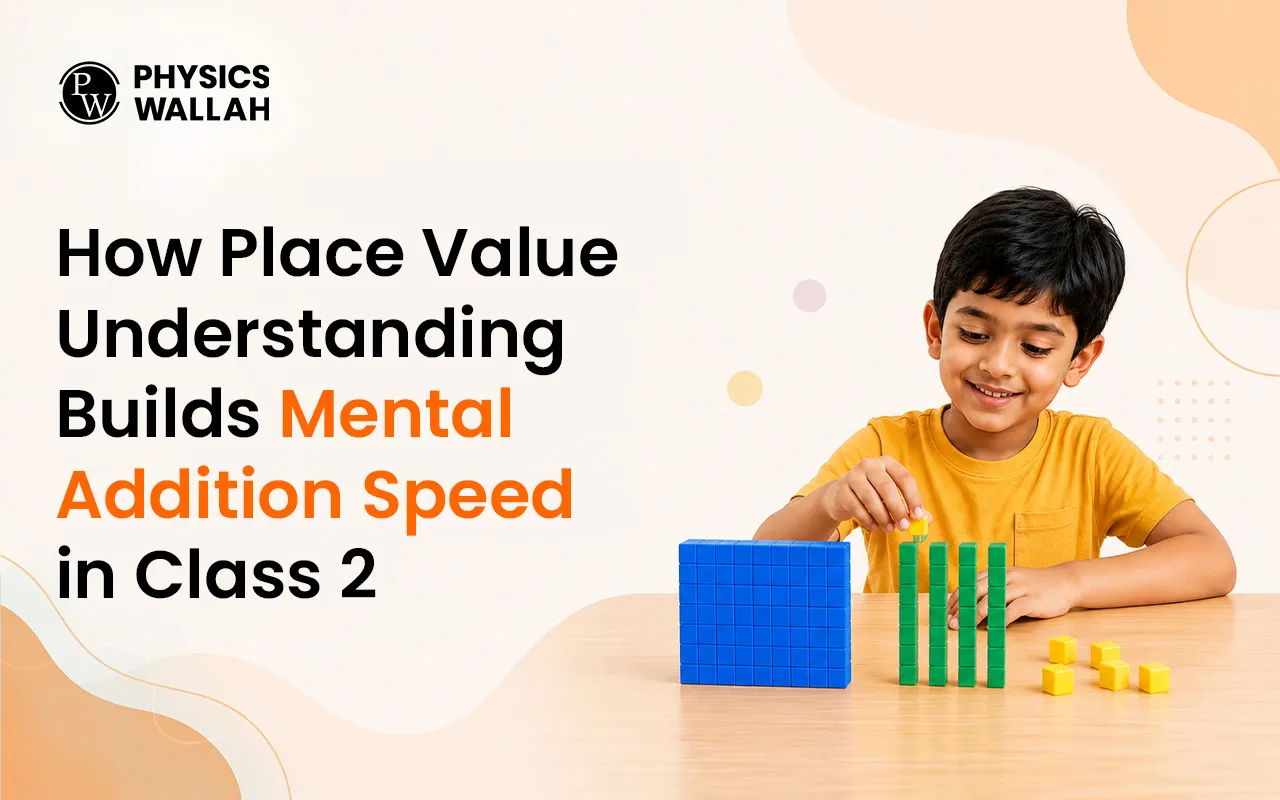
What is Place Value?
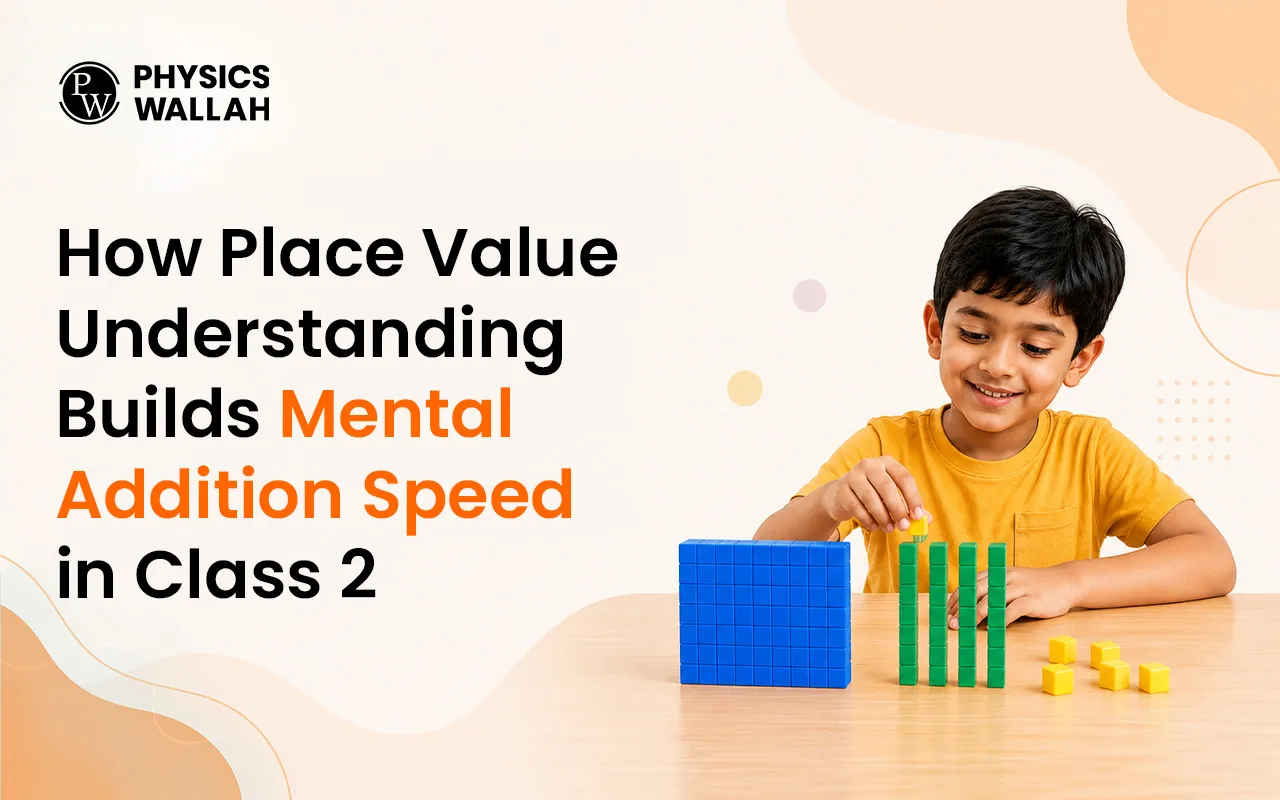
Simply put, place value is the mathematical principle that denotes the value of a digit based on its position in a number. This rule also explains why 5 denotes entirely different orders of magnitude in numbers such as 5, 52, and 500. This is the real foundation of number understanding and fluid mathematical reasoning for young learners when it comes to place value.
Inside primary school classrooms, numbers are arranged almost entirely according to a base-10 system. When a digit hops one column to the left, it is worth ten times more. Three foundational components — each of which students must master fully to build a strong structural base.
-
Digits vs. Positional Value: With a digit, we have just an isolated piece of data ranging from 0 to 9, but with position, it can tell us the proper placement value.
-
The Crucial Role of Zero: Zero is nothing; it serves as a critical placeholder. Since the zero in 50 indicates that we have no leftover ones, it means keeping the digit 5 in the tens place; otherwise, one can be tempted to think of this character as meaning simply "fifty".
-
Number Decomposing: A practical mental skill is breaking a two-digit or three-digit number, like separating 68 into its structural components (60 + 8).
When kids start internalizing these core Class 2 maths concepts, the blind rote memorization stops. Instead, they start to naturally see the actual magnitude and scale of numbers, which provides them with a fundamental quantitative bedrock necessary for faster mental calculations.
How to Learn Tens and Ones Through Place Value Mental Addition Class 2?
Once a young student learns tens and units Class 2 rules are clear; they change how students approach everyday maths problems. Take a mathematical addition like 45 + 32. If a child does not understand structural numbers, they will anchor the 45 in their mind and then count up by counting one number at a time or tapping with their finger 32 more times. This is a process that is painfully tedious work and extremely susceptible to basic tracking errors.
Traditional Finger-Counting:
45 ➔ 46, 47, 48, 49, 50, 51... (Very slow, high risk of calculation slips)
Place Value Separation Method:
Tens Column: 40 + 30 = 70
Ones Column: 5 + 2 = 7
Combined: 70 + 7 = 77 (Instant, highly accurate mental calculation)
Here, students are trained to break down the entire sum horizontally by columns, rather than based on particular structures:
-
Separate the Tens and Ones: The child instantly deconstructs 45 into 40 and 5 and breaks 32 down into 30 and 2.
-
Combine the Tens First: They combine the big, good-news blocks of ten mentally (40 + 30 = 70).
-
Combine the Remaining Ones: Next, they readily sum up the lone single digits (5 + 2 = 7).
-
Merge the Partial Results: Finally, they put the two neat answers together to arrive at an answer (70 + 7 = 77).
Instead of attempting to memorize every aspect of the multi-digit equation, we simply break a daunting multi-step calculation into small, digestible, straightforward components that can be answered much more quickly, alleviating total mental fatigue from the increased working memory load. This removes any need for physical finger tracking and prevents children from misreading place columns when numbers get larger.
Read More - Spot the Odd One Out Mental Maths Tricks for Class 2
Activities to Practise Place Value Mental Addition Class 2 at Home
Parents don’t need fancy school equipment to help with the Class 2 place value maths rules. You can do all of these abstract things in the comfort of your home, just creating simple daily routines using some physical household items.
1. The Bundle and Stick Game
Gather a significant number of simple items such as drinking straws, matchsticks or craft lolly sticks. Use a few rubber bands to group these items into separate, orderly packages of ten pieces each.
If you were to show your child a random mix of full bundles and single loose sticks, how many did they get? For example, when you present your child with 3 artificial bundles and 6 individual sticks, they might incorrectly add 30 + 6 and identify the total as 36. This tactile game gives an amazing visual demonstration of how units flowing from free systems combine to create groups of thirteen higher unit types, like ten.
2. The Price Tag Supermarket Game
Turn a Trip to the Grocery Store on any Typical Weekend into an Active Math Lab. Show your child the price tags of supermarket shelves and ask how much they cost, breaking down everything that has to be done using column rules.
For example, if a snack costs 0.48₹: Ask them to specify how many tens and ones are in that price For a genuine way of adding, near the checkout, put 2 cheap items in your basket—a 14₹ apple and a 13₹ plum—and prompt them to calculate independently in their head as you approach the checkout till; add up tens together, then ones, for an estimated total.
3. Place Value Dice Roll
What you need for this home game: You'll need two normal rolling dice and a blank piece of loose-leaf paper, divided cleanly in half, with one row labeled 'Tens' and the other 'Ones'.
-
First Roll: The first roll of the die is recorded for Tens, so 4 would be read as a 40.
-
Second Roll: They roll the second die and put it in the Ones column (3 = 3).
-
Create the Number: Get the child to read out the full expanded configuration (40 + 3 = 43). Repeat the process to create a second number in the row below, then ask if they can mentally separate both numbers to add them together.
Read More - Two Digit Addition Tricks for Class 2
Benefits of Learning Place Value Mental Addition Class 2
The massive academic rewards from dedicating oneself to mastering these column-splitting tactics could leave standard primary school worksheets in the dust.
-
Reduces dependence on finger counting: Moving Beyond Slow, Mechanical, Unit-by-Unit Counting to Number Manipulation in Big, Efficient Blocks.
-
Improves calculation speed: Itemize calculations vertically so young learners can resolve multi-digit arithmetic in seconds.
-
Simplifies the Carrying Over Process: Children understand that ten individual items in the ones column automatically combine to form a single ten, making column regrouping intuitive rather than confusing.
-
Builds Deep Mathematical Logic: Students cease the process of guessing answers indefinitely and instead begin to monitor specific and dependable patterns in base-10.
-
Boosts Daily Classroom Confidence: There's no better way to remove early anxiety than quick, repeated wins that foster an incredibly upbeat attitude when tackling large sets of math tasks.
How Does CuriousJr Help with Class 2 Mental Math?
Although interactive household games are great for teaching these principles, newcomers need real physical variety and consistent rewards to sustain a young child's engagement. And this is where CuriousJr online class 2 mental maths plays a crucial role: an online destination designed specifically to turn remote, intangible primary mathematics into engaging learning experiences.
The online learning platform aids young learners with a few features that make it particularly effective:
-
Interactive Virtual Learning Tools: The digital interface employs tactile virtual blocks and ten-frames as well as nimble animated abacus counters. These awesome tools let the kids drag, group, and move numbers right on screen so that the mental process of moving from physical toys to more abstract math calculation is seamless.
-
Gamified Problem Solving: Rather than pushing kids toward dull, monotonous drills, the program incorporates arithmetic practice directly into exciting stories and adventures. Students score points, receive rewards, and track badges, which creates a high level of motivation to work through the next problem.
-
Bite-Sized Daily Practice: The curriculum divides itself up into short, highly focused daily lesson modules. The layout makes the brain free from mental exhaustion, and children of Class 2 can grasp base number concepts without feeling burdened.
By combining rigorous academic guidelines with engaging, game-based learning, the system helps primary students abandon slow finger counting entirely, allowing them to calculate with speed, accuracy, and genuine joy.




How Place Value Understanding Builds Mental Addition Speed in Class 2 FAQs
Why is place value so critical for increasing Class 2 addition speed?
At what age should parents introduce place value for young learners?
How can I tell if my child is struggling with tens and units Class 2 concepts?
Why are place value mental addition Class 2 tactics superior to memorisation?

Get Free Counselling Today
and Clear up all your Doubts
 Live & recorded classes available at easeDashboard for progress trackingLakhs of practice questions