
What Are Number Bonds and Why Are They the Foundation of Mental Maths?
 Nikita Aggarwal19 Jun, 2026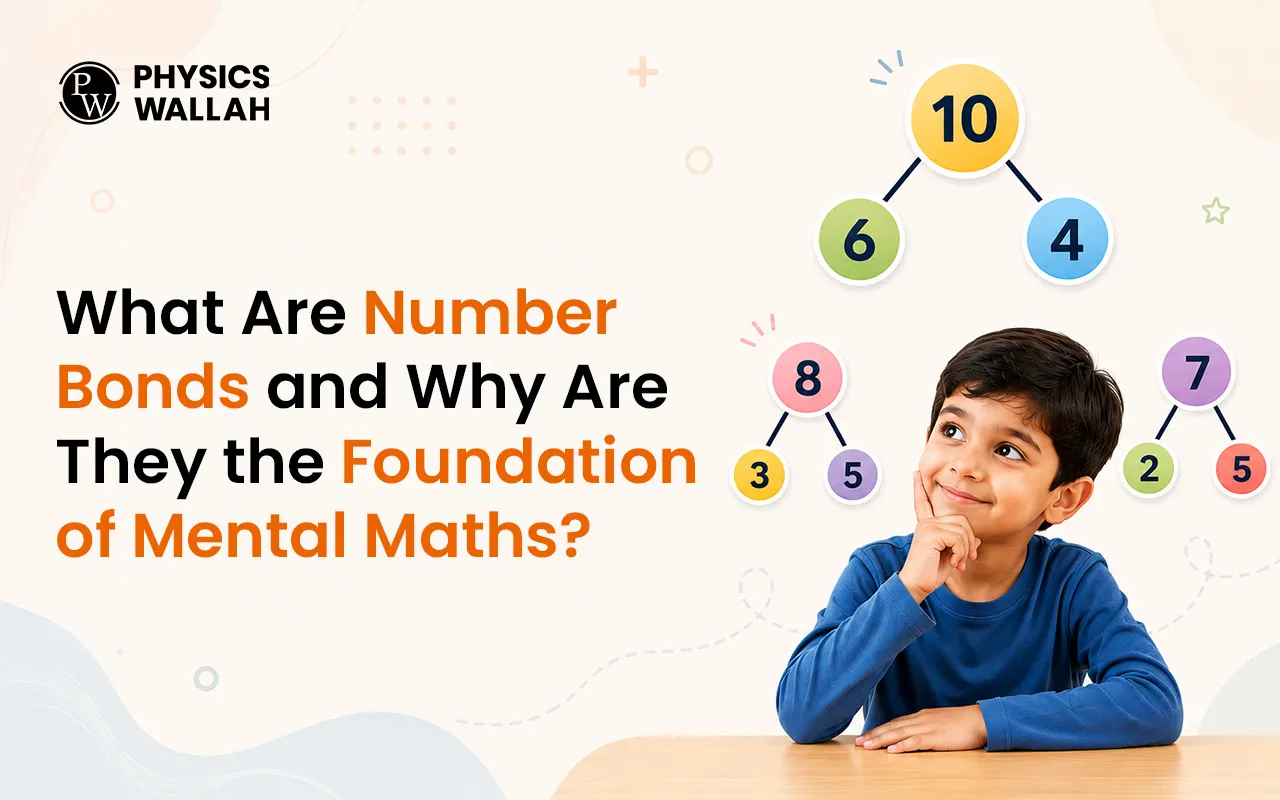
What are Number Bonds?
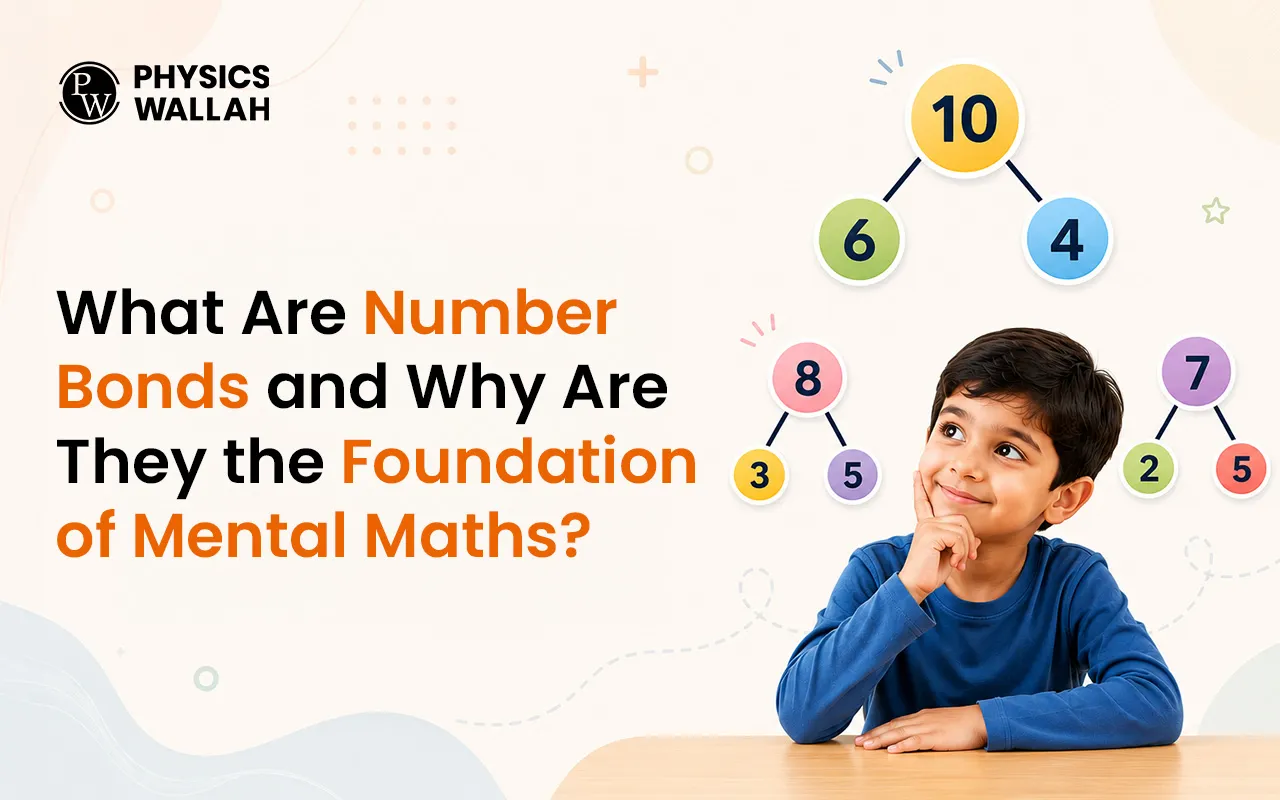
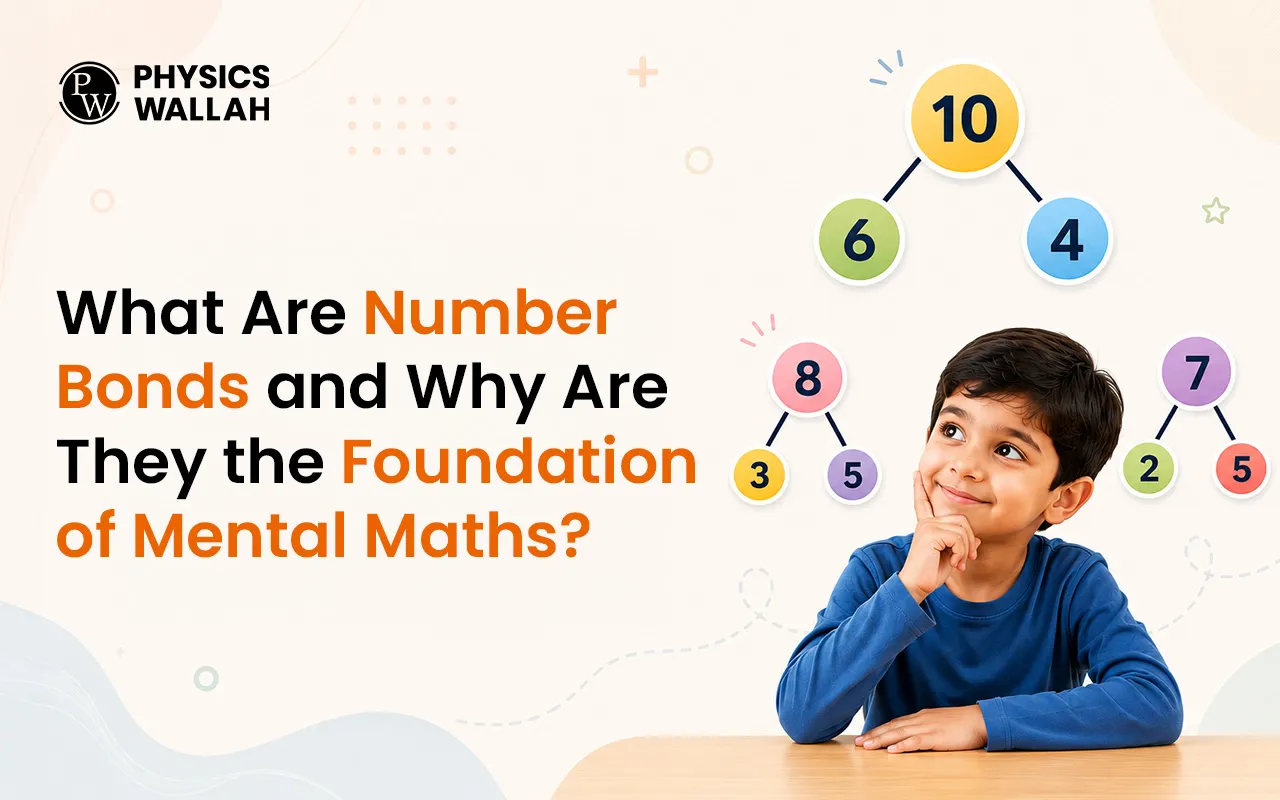
A number bond is a set of numbers that can be added together to equal another specific known value, the sum. These are also called number pairs or complement pairs. Simply, they illustrate how the pieces fit together with the completed set.
For example, it can be the number 10. You could decompose the number in pairs:
-
9 and 1
-
8 and 2
-
7 and 3
-
6 and 4
-
5 and 5
The method is based on a structured approach to learning called the CPA approach:
-
Concrete Step: Children work with real objects, such as dividing toys, counters, or buttons into two distinct piles.
-
Pictorial Step: Students use diagrams, typically consisting of two smaller circles that represent the "parts" and a large empty circle that represents the "whole".
-
Abstract Step: Students substitute operational symbols (like $+$ and $=) and numerical digits for objects and images in this step.
Number bonds can involve more than just simple whole numbers, though they start with simpler combinations. The same reasoning can be used for kids who can break down larger numbers or fractions and decimals as their confidence increases.
Read More: Top 10 Tricks to Master Mental Maths
Why Number Bonds for Mental Maths Are Essential
Getting to grips with number bonds for mental maths is a crucial step, because it liberates children from mechanical counting and encourages flexible thinking. The student learns to see patterns that repeat, instead of treating each addition and subtraction problem as an isolated puzzle.
With practice, children begin to recognise number bonds instantly, therefore, without having to do mental maths. This instant recognition builds the very base of maths in your head, supporting all four basic operations:
1. Simplifying Addition and Subtraction
Number bonds show that addition and subtraction are inverses of each other. They demonstrate how an integer consists of parts and that these constituent elements may appear in different combinations. A fact family is a group of four related equations, derived from one single number bond, that are all connected to each other. For example, using the numbers 10, 7, and 3, you will get the following:
-
3 + 7 = 10
-
7 + 3 = 10
-
10 - 3 = 7
-
10 - 7 = 3
Realising this link enables children to avoid having to rote-learn hundreds of disconnected facts separately. Once they have one fact, it is not particularly difficult to derive or otherwise deduce the other three.
2. Breaking Big Problems Into Smaller Steps
Skilled students find a way to work with numbers, using their knowledge of base-10 complements when confronted with larger calculations. Take 58 + 7, for example. A student can simplify the problem by using their understanding of pairs instead of counting up in ones:
-
They know that 8 needs 2 to reach the next ten.
-
They split 7 into 2 and 5
-
They add 58 + 2 = 60.
-
Finally, they add the remaining part: 60 + 5 = 65.
3. Connecting to Multiplication and Division
This idea later extends to multiplication and division of parts that make up a whole, leading to factor pairs in the classroom. For instance, the number 12
-
1 × 12
-
2 × 6
-
3 × 4
Multiplication and division are as closely related to these structures as addition and subtraction. A child can quickly determine that 12 ÷ 3 = 4 by considering 3 and 4 as factors of the product (12).
Read More - What is Mental Maths? A Guide for Beginners
Fun Activities to Practise Number Bonds for Mental Maths
Even though number bonds for kids are a fundamental idea, practice should be fun and feel like play rather than a chore. Interactive tasks that occur frequently and for brief periods of time sustain momentum and improve retention. Here are some excellent techniques for practising:
Target Number Flashcards
Flash cards with a particular target number, such as 10 or 20. Hold up a card with just one number (the first part of the equation) and see how quickly your child can identify the other partner needed. To make it a faster, more fun game for the kids, you can time their replies to help them develop rapid mental recall.
Real-World Object Splitting
Convert everyday activities to informal maths practice. Do a simple division: Pick some usual items, like 6 apples, 8 biscuits or even toys (10 in total). Ask your child to divide them into two groups. Let them explore all the different ways 4 and 2 (or 5 and 1) can combine to make the same total.
Math Dice and Board Challenges
Use a pair of dice and have your child add the numbers. If you want to go completely with bonds, take a die and set the number that you are aiming for, e.g. If they roll a 3, ask them what the rest of that number is to reach their target. This simple change teaches the brain to calculate missing values automatically.
Benefits of Learning Number Bonds for Mental Maths
Students in early primary can get an early head-start in cognitive development by having been taught number bonds Class 1 and 2, while it is even more important to give students a good grasp of these skills.
-
Eliminates Finger Counting: Helps kids get away from slow finger counting and turns them on to rapid mental counting.
-
Reduces Calculation Errors: Immediate recognition of pairs of numbers decreases chances for basic calculation errors in a testing scenario.
-
Enhances Number Sense: Builds an intuitive understanding of the relation and interactions between numbers, scaling, and breaking apart numbers with various operations.
-
Boosts Exam Confidence: Problem-solving techniques reduce exam anxiety and help you complete your academic work on time.
-
Prepares for Advanced Math: It sets a strong foundation in preparing you to easily handle fractions, decimals, algebra and percentages later.
These relationships are highly emphasised by young learners, developing their number sense. They see numbers as flexible, fluid amounts rather than as static symbols. The attitude helps to reduce the threat of maths and make it an enjoyable logical challenge.
How Does CuriousJr Help with Number Bonds?
If a child doesn't learn the foundations of mental arithmetic, concrete and abstract, there is no motivation to continue with homework. That's why CuriousJr online mental maths classes is created: to address these problems, they are offering well-structured on-line classes in a fun manner for students from Class 1 to Class 8.
Maths concepts are introduced in a manner which is completely stress-free, engaging and focuses on key concepts such as the following:
-
Making 10 and 20: Lessons will be introduced as guided lessons to help beginning learners develop each part of the unit easily.
-
Vedic Math Tricks: The Vedic Maths Effective Base Method is used to introduce clever shortcuts like Complements to 10, 100 and 1000.
-
Left-to-Right Addition: The method is to show children how to do calculations in their heads from left to right, a much faster way of doing calculations.
-
Interactive Games and Puzzles: Interactive online activities and games to keep kids engaged rather than repetitive puzzles.
Using the enthusiasm of teachers, kids are able to put CuriousJr to use and quickly boost the mental arithmetic skills of children, helping them to increase their accuracy, concentration and speed in problem solving.




Number Bonds FAQs
Why are number bonds important?
At what age should children start learning number bonds for kids?
Can number bonds be used for operations other than addition?
How do number bonds improve number sense for young learners?



Get Free Counselling Today
and Clear up all your Doubts
 Live & recorded classes available at easeDashboard for progress trackingLakhs of practice questions

