
Class 6 Symmetry and Constructions: How Visual Thinking Supports Mental Maths
 Nikita Aggarwal16 Jun, 2026
Why Class 6 Symmetry and Constructions Mental Maths Matters?
Geometry in middle school shifts from basic shape recognition to understanding properties and spatial relationships. Mastering Class 6 geometry mental maths helps students perform quick calculations by breaking down complex figures into smaller, manageable parts. When a student looks at a shape and instantly recognises its balance, they do not need to measure every single side manually.
Visual thinking maths Class 6 methods allow learners to see the hidden patterns within geometric figures. For instance, if a student knows a shape is perfectly symmetrical, finding the perimeter or area becomes a matter of doubling a single side or section. This mental shortcut reduces cognitive load, minimises calculation errors, and makes solving exam questions much faster.
Why Learn Class 6 Symmetry and Constructions Mental Maths?
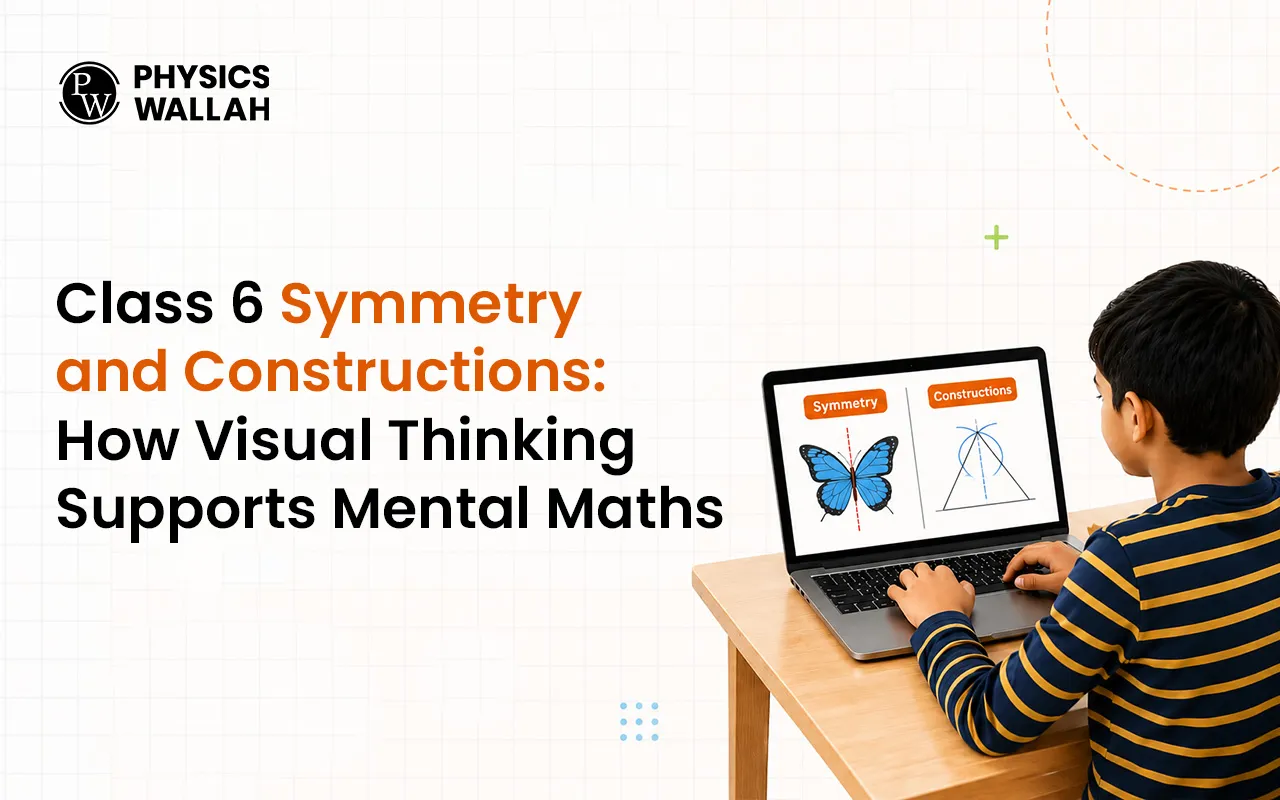
Symmetry is not just an artistic concept; it is a fundamental mathematical tool that helps students simplify calculations. When students learn to find the line of symmetry, they essentially learn how to divide a problem in half. This skill is crucial for developing a strong foundation in mental maths geometry Class 6 concepts.
The following list highlights the key symmetry ideas that directly improve quick mental calculations:
-
Line of Symmetry: Finding the exact line that divides a shape into two identical halves allows students to calculate total dimensions by measuring just one side.
-
Rotational Balance: Understanding how a shape looks when turned helps students predict angle measurements without using a protractor.
-
Reflection Properties: Recognising that points on either side of a symmetrical axis are equidistant makes coordinate geometry much simpler to grasp.
Benefits of Learning Class 6 Symmetry and Constructions Mental Maths
Constructions involve drawing accurate geometric shapes using a compass, ruler, and protractor. While this sounds like a purely physical task, it relies heavily on mental planning. Before drawing, a student must mentally map out where lines will intersect and how angles will relate to one another.
Students learn to predict outcomes, connecting physical drawing with Class 6 symmetry and mental maths principles. For instance, the construction of a perpendicular bisector always has two symmetrical halves. Recognizing this relationship means students can immediately work out missing lengths in their heads.
The table below shows how specific construction tasks translate directly into mental mathematics shortcuts:
|
Construction Task |
Geometric Property Revealed |
Mental Maths Shortcut |
|
Bisecting an Angle |
Creates two equal angles |
Divide the total angle measure by 2 |
|
Perpendicular Bisector |
Finds the exact midpoint |
Divide the total line length by 2 |
|
Constructing a Square |
Four equal sides and $90^{\circ}$ angles |
Multiply one side by 4 for the perimeter |
|
Drawing an Equilateral Triangle |
Three identical sides and angles |
Multiply one side by 3 or divide $180^{\circ}$ by 3 |
Read More - Why Class 6 Marks a Big Academic Shift and How to Help Your Child Cope
To get better at geometry without always drawing things out, students need regular mental workouts. These exercises train the brain to see shapes moving, folding, and turning in the mind's eye.
The following practices help improve visual skills for Class 6 maths students:
-
The Paper Folding Mental Test: Imagine folding a shape along a specific line and predict whether the edges will match perfectly.
-
Angle Halving Calculations: Practice looking at sharp or blunt angles and mentally dividing them into two equal parts.
-
Shape Completion Drills: Look at a drawing of half a shape across an axis and describe the missing half from memory.
Read More - How to Help Your Class 6 Child Stay Organised With Multiple Subjects
Why Spatial Reasoning Is Important for Class 6 Symmetry and Constructions Mental Maths?
Mastering these visual techniques independently can be tricky for many young learners. Structured guidance helps students bridge the gap between physical drawings and abstract mental calculations. Enrolling in Class 6 geometry online tuition provides interactive tools and expert feedback that make abstract geometric properties easier to see and understand.
Online learning environments use dynamic software where shapes can be dragged, flipped, and divided on screen. This immediate visual response reinforces how lines of symmetry work and how constructions create equal proportions. With consistent practice, these digital visualizations transform into mental habits, allowing students to solve geometry problems with speed and confidence.
How to Improve Angle and Shape Bisection Skills
Breaking down geometric figures without using physical tools requires a clear mental framework. When students can visualize the exact steps of a construction, they can calculate missing degrees and lengths instantly. This systematic approach transforms abstract diagrams into simple equations that can be solved entirely in the mind.
Here is the step-by-step mental process for calculating angles and lines using symmetry:
-
Identify the Base Measure: Look at the total given angle or line segment value first.
-
Locate the Central Axis: Imagine a line cutting directly through the center of the shape or angle.
-
Apply the Division Rule: Divide the total value by two to determine the measurement of the new, symmetrical halves.
-
Verify by Reversing: Mentally multiply the half-measure by two to ensure it perfectly matches the original dimensions.
How Does CuriousJr Help with Class 6 Symmetry and Constructions Mental Maths?
Building strong geometric intuition requires a learning approach that goes beyond textbooks. Interactive online class 6 mental maths classes that focus on step-by-step visual training allow students to master Class 6 symmetry and constructions, mental maths naturally. Discover engaging learning journeys designed to boost spatial reasoning and calculation speed by visiting the CuriousJr Class 6 Mental Maths Course.




Class 6 Symmetry and Constructions: How Visual Thinking Supports Mental Maths FAQs
How does symmetry help in solving mental maths problems?
What is the easiest way to find the line of symmetry in Class 6 geometry?
Why is constructing shapes important for mental mathematics?



Get Free Counselling Today
and Clear up all your Doubts
 Live & recorded classes available at easeDashboard for progress trackingLakhs of practice questions

