
Spot the Odd One Out Mental Maths Tricks for Class 2
 Nikita Aggarwal29 May, 2026
Importance of Spot the Odd One Out Mental Maths Tricks
Using spot the odd one out mental maths tricks teaches children how to compare and sort information. Instead of only memorising answers, children learn how to think step by step.
-
Better Observation Skills: Children learn to notice small differences in numbers, shapes, and patterns.
-
Stronger Thinking Skills: Children first find the rule of a group and then look for the item that breaks the rule.
-
Less Fear of Maths: When maths feels like a game, children enjoy learning more and feel less pressure during tests.
-
Faster Brain Activity: Switching between different rules and groups helps children think quickly and stay active mentally.
-
Better Focus: Children pay more attention because they must carefully check every option before answering.
How to Practice Spot the Odd One Out Mental Maths Tricks?
Many children guess answers too quickly. Teaching them a simple method helps them solve odd one out questions more easily.
-
Look Carefully – Tell children to slowly look at all the numbers, shapes, or objects.
-
Find the Common Rule – Help children notice what most items have in common.
-
Find the Different Item – Ask children which item breaks the pattern.
-
Explain the Answer – Encourage children to explain why the item is different.
This step-by-step process improves both maths understanding and logical thinking.
Spot the Odd One Out Mental Maths Tricks with Even and Odd Numbers
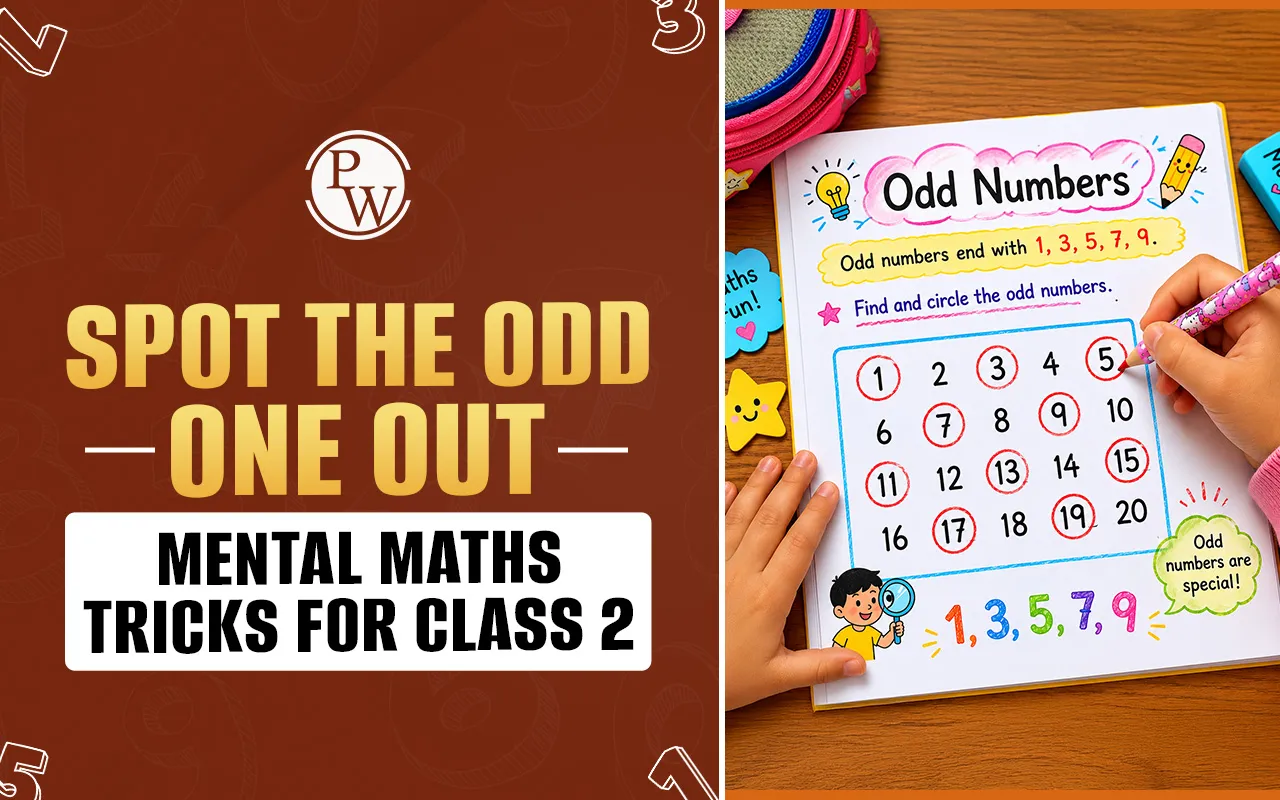
Learning even and odd numbers is one of the easiest ways to practise 'odd one out' for class 2.
Example
4, 6, 9, 10
The number 9 is the odd one out because it is odd. The other numbers are even.
Children slowly learn to look at the last digit of a number to quickly decide if it is odd or even.
More Practice
2, 8, 11, 14
Here, 11 is the odd one out because it is an odd number.
These small exercises help children improve speed in number sorting.
Spot the Odd One Out Mental Maths Tricks with Skip Counting
Children in Class 2 learn skip counting by 2s, 5s, and 10s. These patterns are perfect for spot-the-odd-one-out activities.
Example
5, 10, 15, 19, 25
The number 19 is the odd one out because it does not follow counting by 5s.
Children begin understanding number patterns better through these simple games.
Another Example
2, 4, 6, 9, 10
The number 9 breaks the counting by 2s pattern.
These activities improve number pattern recognition and faster thinking.
Read More - Mental Division Tricks for Class 2
Spot the Odd One Out Mental Maths Tricks Using Addition
Addition puzzles are another great way to build kids mental maths tricks.
Example
-
4 + 6
-
3 + 7
-
5 + 4
-
2 + 8
The odd one out is 5 + 4 because its answer is 9. The other sums all equal 10.
Children practise many sums together while also checking number patterns.
This method improves both addition speed and concentration.
Spot the Odd One Out Mental Maths Tricks Using Subtraction
Subtraction activities also help improve class 2 mental maths.
Example
-
9 - 4
-
6 - 1
-
8 - 3
-
7 - 1
Children solve each subtraction:
-
9 - 4 = 5
-
6 - 1 = 5
-
8 - 3 = 5
-
7 - 1 = 6
The odd one out is 7 - 1 because the answer is different.
This activity helps children practise many subtraction sums at one time.
Read More - Speed Maths Test for Class 2 (Try Now)
Spot the Odd One Out Mental Maths Tricks with Shapes
Shapes and geometry are also important parts of maths learning.
Children can compare shapes by:
-
Corners
-
Sides
-
Curved lines
-
Straight lines
Example
Triangle, Square, Circle, Rectangle
The circle is the odd one out because it has no corners and uses curved lines.
The other shapes have straight sides and corners.
These activities improve visual learning and shape understanding.
Spot the Odd One Out Mental Maths Tricks with Letters
Children can also practise with letters and line patterns.
Example
A, T, S, M
The letter S is the odd one out because it has curved lines.
The other letters use only straight lines.
This activity improves observation and pattern thinking skills.
How to Learn Spot the Odd One Out Mental Maths Tricks at Home?
Parents can easily create fun odd one out games at home.
Kitchen Game
Place:
-
Spoon
-
Fork
-
Knife
-
Toy Car
The toy car is the odd one out because it is not a kitchen item.
Clothes Game
Place:
-
Socks
-
Shoes
-
Gloves
-
Toothbrush
The toothbrush is the odd one out because it is not clothing.
These activities make children think carefully while having fun.
Spot the Odd One Out Mental Maths Tricks with Place Value
Place value games help children understand tens and ones.
Example
51, 54, 58, 25
The number 25 is the odd one out because the number 5 is in the ones place.
In the other numbers, 5 is in the tens place.
This simple trick improves place value understanding in an easy way.
Daily Practice Using Spot the Odd One Out Mental Maths Tricks
Children improve faster with short daily practice sessions.
Parents can spend 10 to 15 minutes every day doing:
-
Number games
-
Shape sorting
-
Addition puzzles
-
Skip counting
-
Odd one out questions
Small daily learning builds strong maths confidence over time.
Children also stop feeling stressed during school maths activities.
Spot the Odd One Out Mental Maths Tricks with Visual Learning
Many children learn better when they can see pictures and objects.
Teachers and parents can use:
-
Flashcards
-
Colour blocks
-
Shape cards
-
Number charts
-
Counters
Visual learning helps children understand maths patterns more clearly.
For example, children can quickly notice which shape looks different when using picture cards.
This makes learning easier and more enjoyable.
How to Learn Spot the Odd One Out Mental Maths Tricks with CuriousJr
CuriousJr helps children learn spot the odd one out mental maths tricks through fun and easy online learning.
-
Interactive Maths Games – Children solve puzzles and pattern games that improve thinking speed.
-
Simple Step-by-Step Lessons – Lessons slowly move from easy maths ideas to harder concepts.
-
Fun Visual Learning – Children learn with pictures, shapes, colours, and number patterns.
-
Friendly Teacher Support – Teachers help children understand mistakes and improve confidence.
-
Better Mental Maths Skills – Children learn faster, solving methods, and slowly stop using finger counting.