Grammar For Class 2 English - A Complete Overview
 Shivam Singh30 May, 2026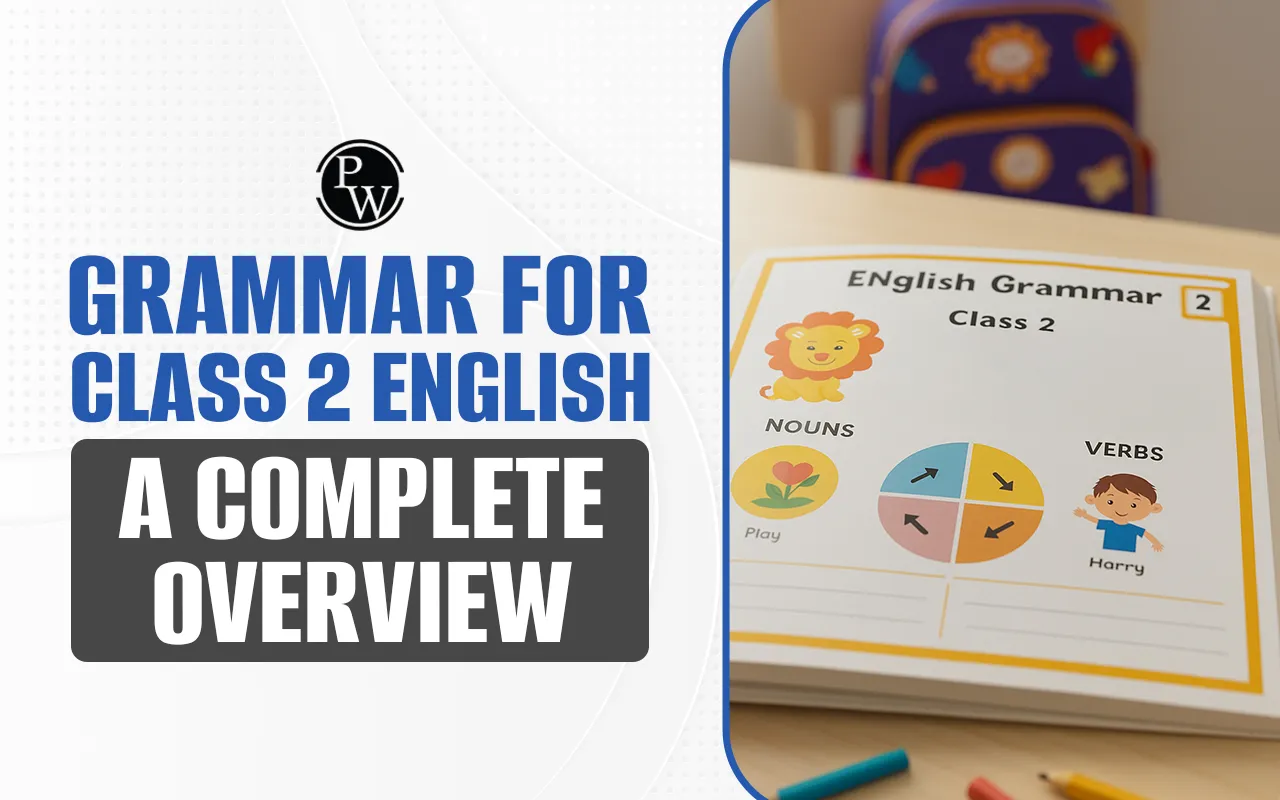
Grammar For Class 2 English
Grammar is the backbone of effective communication. Students in Class 2 should study grammar because it provides them with the basis on which they can clearly and correctly communicate their ideas. At this level, children start to construct the full sentences and comprehend the language structure.
Class 2 English Grammar is the first subject that will expose them to such simple things as nouns, verbs, adjectives, punctuation, and sentence structure. Such concepts are explained in an interesting and entertaining manner to enable the students have confidence and fluency in using English. Students should check a detailed explanation of CBSE Class 2 English Grammar, covering important topics, examples, and more below.
Read More: Mood in English Grammar
CBSE Class 2 English Grammar
CBSE Class 2 English Grammar syllabus can be described as well designed and planned to enable young students to gain a good knowledge of the fundamental language. It is centered on easy explanations, practical examples and interactive activities that consolidate fundamental grammar knowledge.
It aims at making the students appreciate the major components of language in order to be able to speak and write English effectively. The key areas of Class 2 English grammar are the following:
1. Nouns
A noun is a word that names a person, place, animal, or thing.
Examples of Nouns:
-
Person: teacher, doctor, friend
-
Place: school, park, market
-
Animal: dog, elephant, tiger
-
Thing: book, pencil, chair
Types of Nouns:
-
Common Nouns: These are general names for things, like "boy" or "city."
-
Proper Nouns: These are specific names, like "Rahul" or "Delhi."
-
Singular and Plural Nouns: Singular refers to one (e.g., cat), and plural refers to more than one (e.g., cats).
-
Gender Nouns: Nouns can be male (king), female (queen), or neutral (table).
2. Pronouns
A pronoun is a word that replaces a noun in a sentence.
Examples of Pronouns:
-
I, he, she, it, we, you, they
Usage:
-
Example 1: Ravi is a boy. He is my friend.
-
Example 2: The dog is barking. It is hungry.
3. Verbs
A verb is a word that shows action or state of being.
Examples of Verbs:
-
run, eat, play, is, are, was
Usage:
-
Example 1: She runs fast.
-
Example 2: They are happy.
4. Adjectives
An adjective is a word that describes a noun or pronoun. It tells us more about a person, place, thing, or idea.
Examples of Adjectives:
-
big, red, happy, tall
Usage:
-
Example 1: The red ball is mine.
-
Example 2: He is a tall boy.
5. Articles
Articles are words used before nouns to specify whether they are definite or indefinite.
Types of Articles:
-
Definite Article: "the"
-
Indefinite Articles: "a," "an"
Examples:
-
Example 1: A cat is on the roof.
-
Example 2: An apple a day keeps the doctor away.
-
Example 3: The book is on the table.
Read More: Abstract Nouns
6. Prepositions
A preposition is a word that shows the relationship between a noun or pronoun and another word in the sentence.
Examples of Prepositions:
-
in, on, under, behind, near
Usage:
-
Example 1: The book is on the table.
-
Example 2: The cat is under the chair.
7. Conjunctions
A conjunction is a word that connects two words, phrases, or sentences.
Examples of Conjunctions:
-
and, but, or, because
Usage:
-
Example 1: I like apples and bananas.
-
Example 2: She is tired but happy.
8. Sentences
A sentence is a group of words that expresses a complete thought.
Types of Sentences:
-
Statement: "I am going to school."
-
Question: "Are you coming with me?"
-
Command: "Close the door."
-
Exclamation: "What a beautiful flower!"
9. Punctuation
Punctuation marks are symbols that help us understand the meaning of sentences.
Common Punctuation Marks:
-
Full Stop (.): Used at the end of a sentence.
-
Question Mark (?): Used at the end of a question.
-
Exclamation Mark (!): Used to show strong feelings.
-
Comma (,): Used to separate items in a list.
Examples:
-
"I have a pen, a pencil, and a ruler."
-
"Wow! That’s amazing!"
10. Capital Letters
Capital letters are used at the beginning of sentences, and for proper nouns like names of people, places, and days of the week.
Rules for Using Capital Letters:
-
Start every sentence with a capital letter.
-
Capitalize names of people, places, and days of the week.
Examples:
-
"My name is Anjali."
-
"We went to Agra on Monday."
Read More: Capital Letters in English
11. Tenses (Introduction)
Tenses tell us when an action takes place. They help us know whether something is happening now, happened in the past, or will happen in the future.
Types of Tenses Introduced in Class 2:
-
Present Tense: Describes an action happening now (e.g., I play).
-
Past Tense: Describes an action that already happened (e.g., I played).
This basic introduction helps students understand how to change verbs to show different times of action.
12. Vocabulary Building
In Class 2, students are encouraged to learn new words to build their vocabulary. This is an important part of basic English grammar for Class 2.
Ways to Build Vocabulary:
-
Picture-word association: Linking pictures to words to make learning fun.
-
Synonyms and Antonyms: Learning words that have similar or opposite meanings.
-
Word Families: For example, “play,” “player,” “playing.”
13. Comprehension and Composition
Comprehension involves reading short passages and answering questions about them. Composition involves writing short paragraphs on topics like "My Family," "My School," or "My Pet."
Also Read: Tongue Twisters
Boost Your Child's English Skills with PW CuriousJr Online Classes
PW CuriousJr offers engaging online English classes designed to help young learners develop their reading, writing, speaking, and listening abilities. The classes are held in small groups, ensuring each child receives personalized attention and support, making learning both fun and effective.
The courses follow internationally recognized standards like the Cambridge English Scale and CEFR, aligning with global learning levels. Each lesson is tailored to the child’s current abilities, making sure they’re challenged without feeling overwhelmed. Plus, the one-day course structure ensures that lessons are manageable for young learners, allowing them to progress at a steady pace.
In addition to live sessions, PW CuriousJr provides video lessons that reinforce the material covered, giving children the opportunity to review and learn at their own pace. This combination of live and recorded content supports consistent improvement and boosts your child’s confidence in English.




Grammar For Class 2 English FAQs
What is the English grammar in Class 2?
What are the top 20 rules of grammar?
What to teach a student in Class 2 in English?
How is a sentence in Class 2 English grammar?

Get Free Counselling Today
and Clear up all your Doubts
 Live & recorded classes available at easeDashboard for progress trackingLakhs of practice questions