Abstract Nouns: Definition, Types, How to Identify, and Examples
 Jasdeep Singh19 Jan, 2026
Abstract Nouns
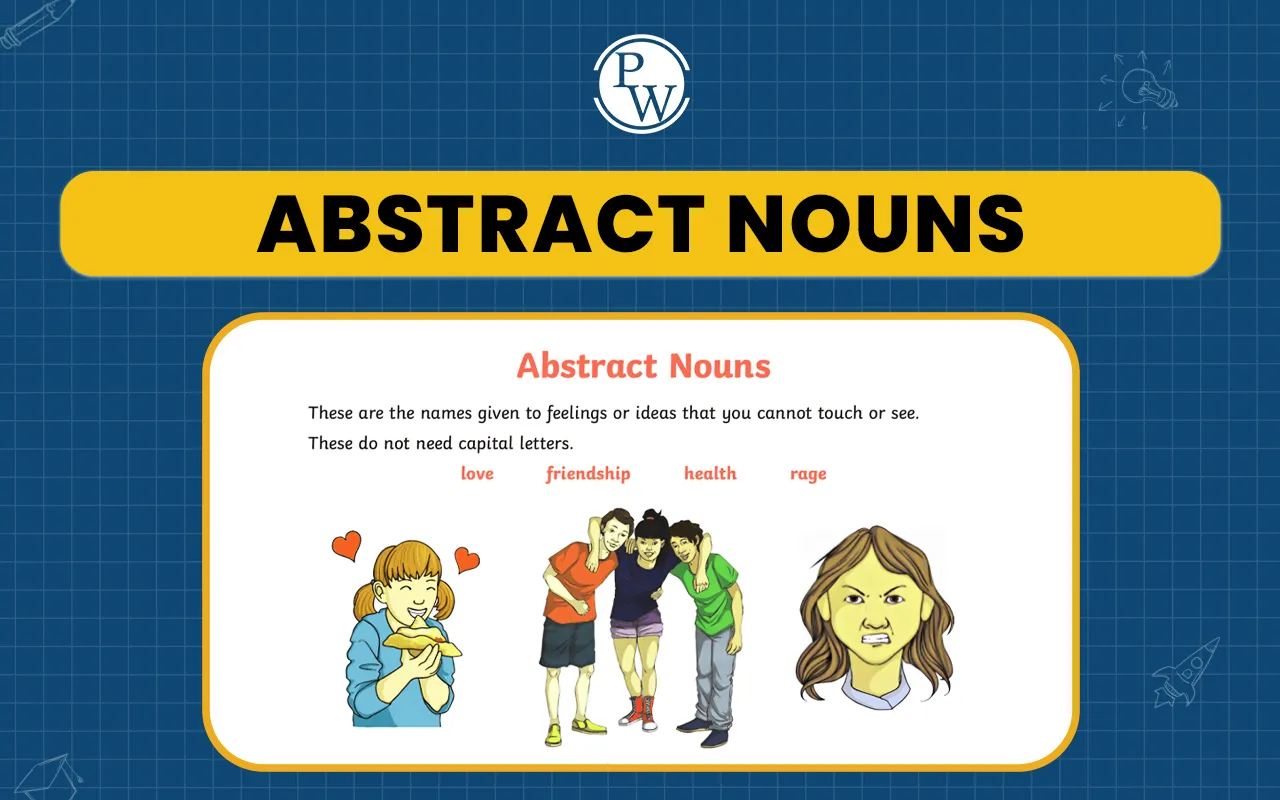
Abstact Nouns are words that help us talk about emotions, ideas, and qualities we experience but can’t see or touch, like joy, courage, and friendship! These words are powerful because they allow us to express what we feel inside, bringing feelings and thoughts to life.
Ever wanted to describe the feeling of kindness or the value of honesty? Abstract nouns make it easy to share these ideas with others.
They let us communicate things like hope, bravery, and peace, making conversations richer and more meaningful.
Read More - English Grammar
What is Abstract Noun?
We call an abstract noun a noun that denotes a concept, idea, quality, or state that cannot be perceived by any of the five senses (i.e., seeing, smelling, touching, tasting, hearing).
If you have ever wondered, “What is an abstract noun?” — it simply refers to something you cannot touch or see, only feel or think about.
When we think of concrete nouns, they refer to things that exist physically, and that we can interact with. On the other hand, abstract nouns are intangible and exist only in our minds either as feelings, qualities, or ideas.
Happiness, freedom, and courage are examples of such abstract nouns. They cannot be touched or seen, yet we can interpret and experience them.
Therefore, in language and literature, the concept of abstract nouns emerges as a key tool for articulating thoughts, feelings, and ideas.
Read More - Demonstrative Pronouns
Definition of Abstract Noun
According to the Oxford Learners Dictionary, an abstract noun definition is: a noun that refers to an idea or a general quality, not to a physical object. If you want to know what is abstract noun? then it represents something that cannot be seen or touched but is experienced mentally or emotionally. These nouns refer to things like emotions, ideas, qualities, or conditions.
In contrast, concrete nouns refer to things that are tangible, such as a dog , table , or book - objects that can be seen, touched, or perceived by the senses.
Abstract Nouns vs. Concrete Nouns
The key difference between abstract nouns and concrete nouns is based on whether something can be experienced through the senses:
- Concrete Nouns : Represent objects or things that can be perceived by the senses. For example, book , flower , car , dog , chair .
- Abstract Nouns : Represent ideas, feelings, or qualities that cannot be touched, seen, or physically perceived. For example, happiness , honor , justice , love.
For instance, while you can see and touch a rose (concrete noun), you cannot physically touch beauty (abstract noun meaning), even though beauty can be observed or perceived in different contexts.
Types of Abstract Nouns
Let’s explore the main types of abstract nouns and see how they enrich our language.
Emotions and Feelings
These abstract nouns capture what we feel inside, even though we can’t see or touch them. Emotions and feelings describe the invisible ways we respond to people, events, or situations around us.
These words help us express happiness, sadness, excitement, and more, making our conversations richer. Examples:
- Happiness: The feeling of joy or contentment.
- Sadness: The feeling we have when something makes us unhappy.
- Anger: The emotion that arises when we feel wronged or upset.
- Fear: The feeling of being afraid or worried.
- Surprise: The reaction when something unexpected happens.
Ideas and Beliefs
These abstract nouns describe concepts and philosophies that influence our thinking and values. They represent the principles people live by, often guiding decisions and shaping behavior.
These ideas and beliefs are fundamental to society and to how we view the world.
Abstract Noun Examples:
- Freedom: The idea of being able to make choices without restriction.
- Democracy: The belief that people should have a say in who governs them.
- Wisdom: The concept of having experience, knowledge, and good judgment.
- Justice: The idea of fairness and making sure people are treated equally.
Qualities and Traits
Qualities and traits are abstract nouns that describe characteristics or behaviors in people. These words give us ways to describe someone’s personality or nature, helping us explain what makes a person kind, brave, or honest. Qualities and traits are often valued and admired in society.
Abstract Noun Examples:
- Courage: The quality of being brave, even in difficult situations.
- Kindness: The trait of being caring and helpful toward others.
- Honesty: The quality of telling the truth and being trustworthy.
- Loyalty: The quality of being faithful to someone or something.
States and Conditions
States and conditions describe abstract ideas that are part of our well-being, health, and general state of existence. Unlike physical states, these are conditions we experience within us or that describe how things are. They can refer to personal states or larger conditions affecting groups or society.
Abstract Noun Examples:
- Peace: A state of calmness and lack of conflict.
- Health: The condition of being physically and mentally well.
- Strength: The condition of being strong, both physically and mentally.
- Success: The state of achieving a goal or accomplishing something important.
Read More - Possessive Pronouns
How to Form Abstract Nouns
Abstract nouns in English can often be formed by adding specific suffixes to adjectives or verbs. Here's how:
-
From Verbs: achieve → achievement, decide → decision.=
-
From Adjectives: happy → happiness, brave → bravery.
In many grammar guides on abstract noun in English, you’ll find similar word formation patterns.
Converting Verbs to Abstract Nouns
Verbs can be converted into abstract nouns by adding suffixes such as -ment, -tion, -ance, -ence , and others. Examples include:
- Achieve → Achievement
- Agree → Agreement
- Decide → Decision
- Develop → Development
- Judge → Judgment
Converting Adjectives to Abstract Nouns
Similarly, adjectives can be converted into abstract nouns by adding suffixes like -ness, -ity, -ance, -ship , etc. Examples include:
- Happy → Happiness
- Brave → Bravery
- Strong → Strength
- Weak → Weakness
- Real → Reality
In some cases, abstract nouns are formed directly from adjectives without changing their form:
- True → Truth
- Free → Freedom
- Possible → Possibility
Abstract Nouns Examples in Sentences
Here are a few sentences using abstract nouns:
- Love is essential for building strong relationships.
- Courage is required to face difficult situations.
- She showed great honesty when explaining the mistake.
- His happiness knew no bounds when he received the news.
- The beauty of the landscape took my breath away.
In these examples, love , courage , honesty , happiness , and beauty are all abstract nouns, representing emotions, qualities, or experiences that cannot be physically touched or seen.
How Can We Use Abstract Nouns Effectively?
Using abstract nouns is a great way to express emotions, qualities, and ideas in writing and speaking.
However, since abstract nouns refer to concepts we can’t see or touch, they can sometimes feel a bit unclear or vague.
To make these ideas stronger and more relatable, it’s helpful to pair abstract nouns with specific examples that give context.
For example, instead of simply saying, “She showed kindness ,” you could say, “She showed kindness by helping her friend with homework.”
By adding details, we understand how she was kind, making the abstract noun “kindness” feel more meaningful and relatable .
Importance of Abstract Nouns in Language
Abstract nouns help in:
- Expressing emotions : Words like joy , anger , and love allow us to talk about our feelings.
- Describing qualities : Abstarct noun list like integrity , wisdom , and honesty describe people’s qualities.
- Discussing ideas and concepts : Abstract nouns like freedom , democracy , and justice allow us to express philosophical and societal concepts.
- Clarifying mental and emotional states : They help in describing internal states, such as confusion , trust , or hope.
Without abstract nouns, we would struggle to describe anything beyond physical objects and tangible actions. These nouns enrich our language by enabling us to discuss feelings, ideas, and qualities.
Abstract Nouns Exercises
Try identifying the abstract nouns in the sentences below:
- She has a strong belief in kindness.
- His success is due to hard work and determination.
- Happiness can come from the simplest things.
- They value justice and honesty.
- Fear can be a powerful motivator.
Answers: belief, success, happiness, justice, fear.
Join CuriousJr English Online Tuition Class Now!!
| Articles Related to Abstract Nouns | |
| Pronouns | Antonyms |
| Singular nouns | Synonyms |
| Plural nouns | Conjunctions |
Abstract Nouns FAQs
How can we make abstract nouns easier to understand in sentences?
Can abstract nouns be formed from adjectives or verbs?
Why are abstract nouns sometimes tricky to explain?