What is the SI Unit for Speed?
 Nikita Aggarwal13 Mar, 2026
What is SI Unit for Speed?
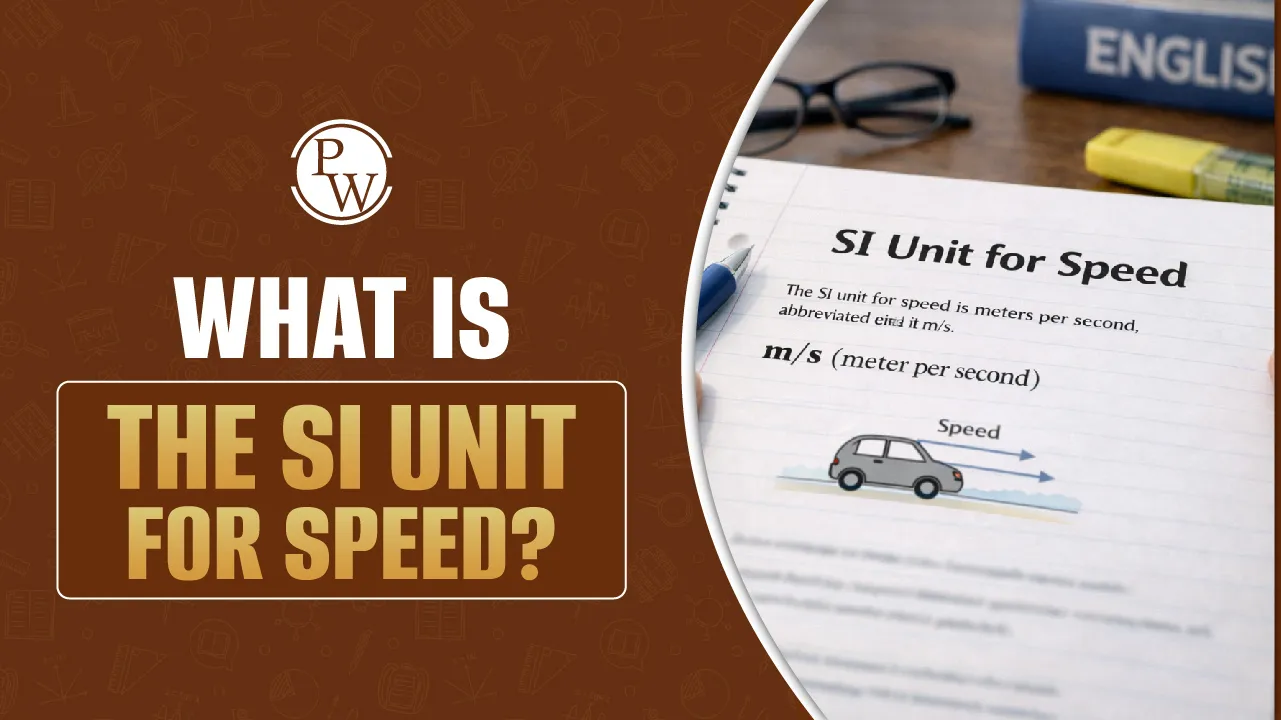
The International System of Units (SI) gives us a consistent way to measure things like length, weight, and time. When we talk about the SI unit of speed, we mean meters per second, which is represented as m/s or ms⁻¹. This unit informs us exactly how many meters an object moves in one second.
Meaning of Speed in Physics
In physics, speed is the rate at which an object moves over a distance. It is a scalar quantity, which means it only informs us "how fast" something is moving and not where it is going. If a dog runs across a yard, the distance it covers divided by the time it took to run that distance gives us its speed. Because it doesn't involve direction, speed is different from velocity, which is a vector quantity.
What is the Basic Unit of Speed
While we see many different units on road signs and treadmill screens, the basic unit of speed is derived from the base units of length and time. In the SI system:
-
The metre (m) is the base unit for distance (length).
-
The base unit for time is the second (s).
When you combine these, you get the SI unit of speed, which is the metre per second. This is the "basic" unit since it uses the most basic form of the metric system to talk about movement.
Why the SI Unit for Speed is Important
For uniformity, it's important to have a universal speed in SI units. Think about what would happen if a scientist in the UK measured speed in miles per hour and a scientist in India recorded speed in kilometres per hour. It would lead to massive confusion! By using m/s, researchers, engineers, and students everywhere can share data accurately. This standardisation makes sure that building bridges, launching rockets, and even timing a race are always accurate and devoid of mistakes.
SI Unit for Speed Formula
You don't need complicated machines to figure out how quickly something is going; you only need to know how far it is and how long it takes. The relationship between these three elements forms the foundation of motion physics.
The formula for speed is straightforward. Distance travelled divided by time taken to travel that distance equals speed.
Speed = Distance / Time
If "s" stands for speed, "d" stands for distance, and "t" stands for time, then the formula looks like this:
s = d / t
How Speed is Measured in Physics
In a physics lab or classroom experiment, speed is measured in a certain way. To begin, you use a measuring tape or a metre stick to measure a certain distance. Then, you use a stopwatch to see how long it takes for something (such a marble or a toy car) to get that far. By plugging these numbers into the formula, you determine the speed in m/s.
Units Used to Measure Speed
Depending on the context, different units are used. Here is a useful breakdown:
|
Type of Measurement |
Unit Name |
Symbol |
|
SI Unit |
Metre per second |
m/s |
|
Large distances (Cars/Planes) |
Kilometre per hour |
km/h |
|
Small distances (Insects) |
Centimetre per second |
cm/s |
|
Maritime/Navigation |
Knot |
kn |
|
Imperial System |
Miles per hour |
mph |
Read More - How to Improve Mental Maths Speed in 30 Days
SI Unit for Speed in Different Measurements
SI units are the best way to measure speed, yet we regularly see different units in our daily lives. Understanding how these relate to m/s is key to solving the What is the unit of speed questions.
Speed Measured in Metres per Second
When we say speed is expressed in metres per second, we are looking at the most granular level of motion. For example, a person walking briskly moves at about 1.4 m/s. This unit is perfect for classroom experiments because it deals with manageable numbers that are easy to track with a stopwatch and a ruler.
Other Common Units of Speed
Outside the lab, we rarely use metres per second.
-
Kilometres per hour (km/h): This is the most common unit for vehicles.
-
Centimetres per second (cm/s): This is used for very slow-moving objects, like a snail or a tectonic plate.
-
Miles per hour (mph): This is used primarily in the United States and the UK for road speeds.
Converting Speed from One Unit to Another
Often, you will need to convert km/h to SI units (m/s).
-
To convert km/h to m/s: Multiply the speed by 5/18.
-
To convert m/s to km/h: Multiply the speed by 18/5.
Example: If a car travels at 36 km/h, what is its speed in m/s?
-
36 × (5/18) = 10 m/s.
SI Unit for Speed with Examples
Understanding the theory is great, but looking at what is the unit of speed examples in the real world helps solidify the concept.
Simple Examples of Speed in Daily Life
-
A cheetah is running fast. A cheetah can run at speeds of roughly 30 m/s.
-
A person walking. The average speed of a person walking is about 1.5 m/s.
-
A cyclist, a casual rider, could go 5 m/s.
-
Sound travels through air at around 343 m/s, which is the speed of sound.
What are the Units of Speed Examples in Physics Problems
Let's look at a typical problem you might find in a textbook:
Problem: A train covers a distance of 200 metres in 10 seconds. What is its speed?
-
Distance: 200 m
-
Time: 10 s
-
Calculation: 200 / 10 = 20
-
Result: The speed of the train is 20 m/s.
Note how we always include the SI unit of speed (m/s) in the final answer. Without the unit, the number 20 has no physical meaning.
Read More - How to Improve Calculation Speed Without a Calculator
SI Unit for Speed Questions for Practice
To master this topic, try answering these questions.
Basic Questions on Units of Speed
-
Which of these is the SI unit of speed? (a) km/h (b) m/s (c) m/min
-
Answer: (b) m/s
-
What two quantities do you need to calculate speed?
-
Answer: Distance and Time.
-
True or False: Speed can be measured in cm/s.
-
Answer: True, though it is not the SI unit.
Practice Problems with Solutions
Q1: An athlete runs 400 metres in 50 seconds. Find the speed in SI units.
-
Step 1: Identify distance = 400 m.
-
Step 2: Identify time = 50 s.
-
Step 3: Use the formula (s = d/t).
-
Step 4: 400 / 50 = 8.
-
Result: 8 m/s.
Q2: A car is moving at 90 km/h. Express this in m/s.
-
Step 1: Multiply 90 by 5/18.
-
Step 2: (90 / 18) = 5.
-
Step 3: 5 × 5 = 25.
-
Result: 25 m/s.
SI Unit for Speed in Physics Concepts
Speed is part of a larger family of concepts in physics. Understanding how it fits in helps you understand motion as a whole.
Relationship Between Speed, Distance, and Time
The three quantities are linked in a "triangle" relationship.
-
If you want Speed, you do Distance ÷ Time.
-
If you want Distance, you do Speed × Time.
-
If you want Time, you do Distance ÷ Speed.
This relationship indicates that speed goes up as distance goes down (if time stays the same) and down as time goes up (if distance stays the same).
Difference Between Speed and Velocity
This is a place where people often become confused.
-
Speed: Tells you how fast (for example, 20 m/s). It is a number.
-
Velocity: Tells you how fast and which way (for example, 20 m/s North). It is a vector.
Both use the same SI units (m/s); however, velocity is employed when direction is important, like in navigation or advanced physics.
Make Maths Simple and Enjoyable with CuriousJr
At CuriousJr, we help children overcome their fear of maths and build strong confidence in numbers with a solid learning foundation. Our Mental Maths Online Classes for students from Classes 1 to 8 focus on improving speed, accuracy, and logical thinking through simple methods and interactive lessons.
With our unique dual-mentor system, students attend engaging live classes and receive dedicated support to clear their doubts after every session. Animated explanations, fun activities, and exciting challenges make maths concepts easier to understand and more enjoyable for children.
Parents receive regular progress updates and can also join review sessions to stay involved in their child’s learning journey. Book a demo class today and discover how CuriousJr makes maths learning simple, engaging, and confidence-building for your child.