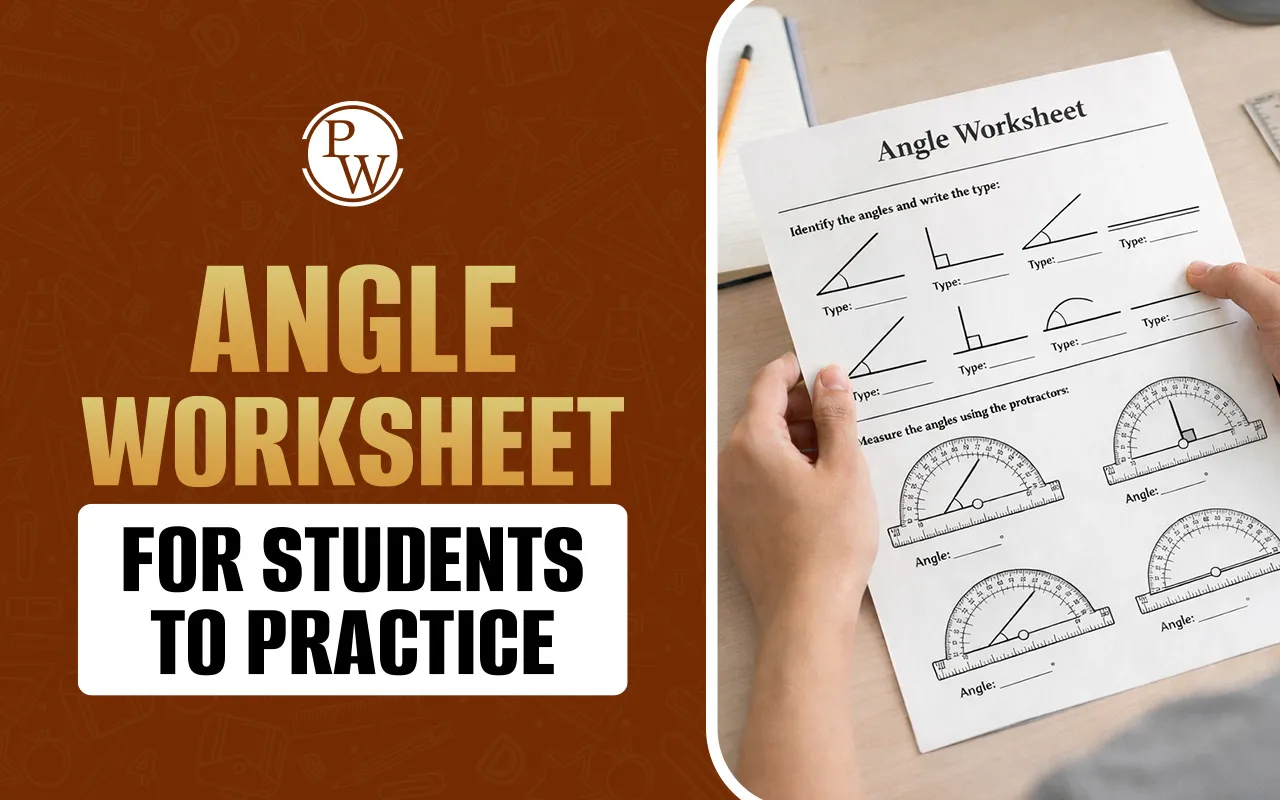
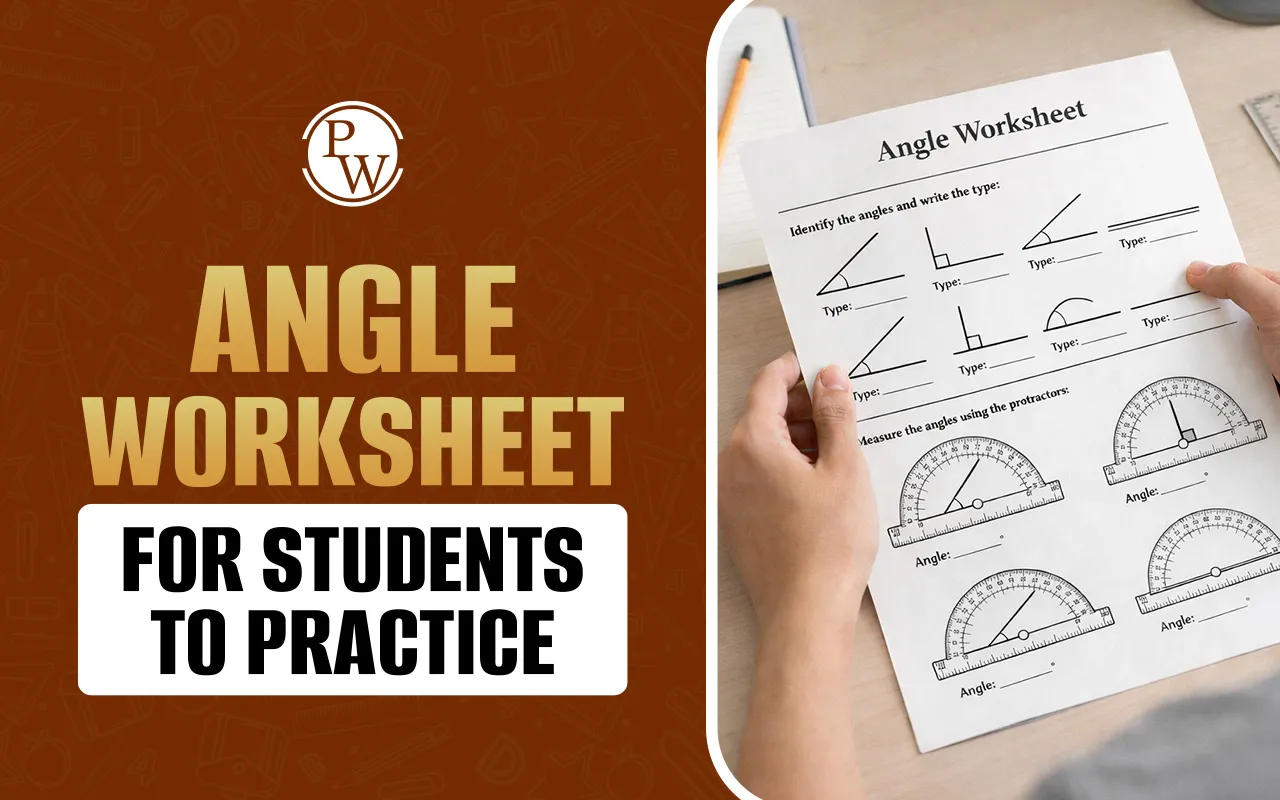
What is an Angle Worksheet?
An angle worksheet is an organised way for pupils to practise how two rays meet at a point. In geometry, just reading about shapes isn't usually enough.Students need to see how lines intersect and learn to calculate the space between them. A worksheet on angles provides the repetitive practice necessary to move from basic recognition to advanced calculation.
Why Students Should Practice with an Angle Worksheet
Many students find it hard to visualise degrees and rotations. This is where a worksheet is quite useful. It fills in the gaps between what a teacher says and what a student can do on their own. If you practise often, words like "vertex," "arms," and "degrees" will become second nature. When students work on a worksheet, they're not simply completing math; they're also teaching their brains to better understand how things are related in space.
Angle Classification Table
The table below displays many kinds of angles, their degree measures, pictures of them, and some common examples from real life:
|
Angle Type
|
Degree Measure
|
Visual Description
|
Common Example
|
|
Acute
|
Less than 90°
|
Sharp and narrow
|
A slice of pizza
|
|
Right
|
Exactly 90°
|
Perfect 'L' shape
|
Corner of a window
|
|
Obtuse
|
90° to 180°
|
Wide and open
|
A reclining chair
|
|
Straight
|
Exactly 180°
|
A flat line
|
A ruler edge
|
|
Reflex
|
180° to 360°
|
The "outer" bend
|
Hands of a clock at 8:00
|
Angle Worksheet Questions and Answers
This part is meant to be your main study tool. It includes identification, measurement, and calculation to make sure you know everything there is to know about the topic.
Part 1: Angle Identification Worksheet
For each question on the angles worksheet, question, write down what kind of angle it is.
-
Angle measuring 42°: ____________________
-
Angle measuring 90°: ____________________
-
Angle measuring 125°: ____________________
-
Angle measuring 180°: ____________________
-
Angle measuring 210°: ____________________
-
Angle measuring 89°: ____________________
-
Angle measuring 360°: ____________________
Answers for Part 1:
-
Acute | 2. Right | 3. Obtuse | 4. Straight | 5. Reflex | 6. Acute | 7. Complete
Part 2: Class 5 Measuring Worksheet
Use these angles worksheet for class 5 problems to practice with your protractor.
-
Visual Check: Draw a 110° angle. Is this larger or smaller than a right angle?
-
The Clock Question: What is the angle between the hour and minute hands at 3:00 PM?
-
Alphabet Search: Look at the letter 'V'. What type of angle does it show?
Answers for Part 2:
-
Larger (Obtuse) | 2. 90° (Right Angle) | 3. Acute
Read More - Number Patterns Worksheet for Maths Practice
Part 3: Class 6 Missing Angle Worksheet
Use geometry rules to solve these angles class 6 worksheet problems.
-
Linear Pair: Two angles on a straight line add to 180°. If one is 60°, what is $X$?
-
Complementary: Two angles add to 90°. If one is 40°, what is $X$?
-
Around a Point: Three angles around a point are 120°, 130°, and $X$. Find $X$.
-
Triangle Sum: A triangle has angles of 50° and 70°. What is the third angle $X$?
-
Vertically Opposite: Two lines cross. If the left angle is 80°, what is the right angle?
Answers for Part 3:
-
120° ($180 - 60$) | 2. 50° ($90 - 40$) | 3. 110° ($360 - 250$) | 4. 60° ($180 - 120$) | 5. 80° (They are equal)
Part 4: Advanced Worksheet on Angles
Test your skills with these mixed angles worksheet examples.
-
Angle Bisector: If a 120° angle is cut exactly in half, what is the measure of each new angle?
-
Linear Pair Challenge: If three angles on a straight line are $X$, $X$, and $X$, what is the value of $X$?
-
The Square Corner: If you divide a right angle into three equal parts, what is the measure of each?
-
Reflex Calculation: If the interior angle of a shape is 60°, what is the exterior reflex angle?
-
Rotation: How many degrees do you turn if you spin around one and a half times?
-
Polygon Prep: If a triangle is "Equilateral," what are its three angles?
-
Tool Check: Which side of the protractor do you read if the angle opens to the left?
Answers for Part 4:
-
60° | 2. 60° ($180/3$) | 3. 30° | 4. 300° ($360-60$) | 5. 540° ($360+180$) | 6. 60°, 60°, 60° | 7. Outer Scale
Read More - Division Worksheet for Students
Benefits of Using an Angle Worksheet for Learning
Consistent use of these resources builds a bridge between theory and practical application.
Improving Geometry Understanding
Geometry is a visual branch of mathematics. A worksheet forces students to look closely at how space is occupied. This improves their ability to visualise 3D objects and understand architectural layouts. By consistently answering questions, students develop the "spatial intelligence" required for engineering and design.
Building Strong Problem-Solving Skills
Solving for a "missing angle" is a great way to develop deductive reasoning. Students learn to take what they know (the rules of geometry) to find out what they don't know (the value of angle X). These logic skills transfer to every other area of maths and science. Whether it is an angles worksheet for class 5 or a more complex high school sheet, the logic remains the same.
Tips for Solving Angle Worksheet Questions
-
Check the Scale: Protractors have two rows of numbers. Always start from the 0 mark that sits on your line.
-
Keep it Sharp: Use a sharp pencil. A thick lead line can change a reading by 2 or 3 degrees, leading to incorrect answers on your worksheet.
-
Logical Check: If you measure an angle that looks small (acute) but your reading says 120 degrees, you are likely reading the wrong scale! An acute angle must be less than 90°.
Make Maths Easy and Enjoyable with CuriousJr
At CuriousJr, we help children overcome their fear of maths and develop strong confidence in numbers through a solid learning foundation. Our Mental Maths Online Classes for students from Classes 1 to 8 are designed to enhance speed, accuracy, and logical thinking using simple methods and interactive learning techniques.
With our unique dual-mentor system, students participate in engaging live classes and also receive dedicated support to resolve their doubts after every session. Animated explanations, fun activities, and interactive challenges make it easier for children to understand maths concepts while keeping the learning process enjoyable.
Parents receive regular progress updates and can join review sessions to stay involved in their child’s learning journey. Book a demo class today and discover how CuriousJr makes maths learning simple, engaging, and confidence-building for your child.