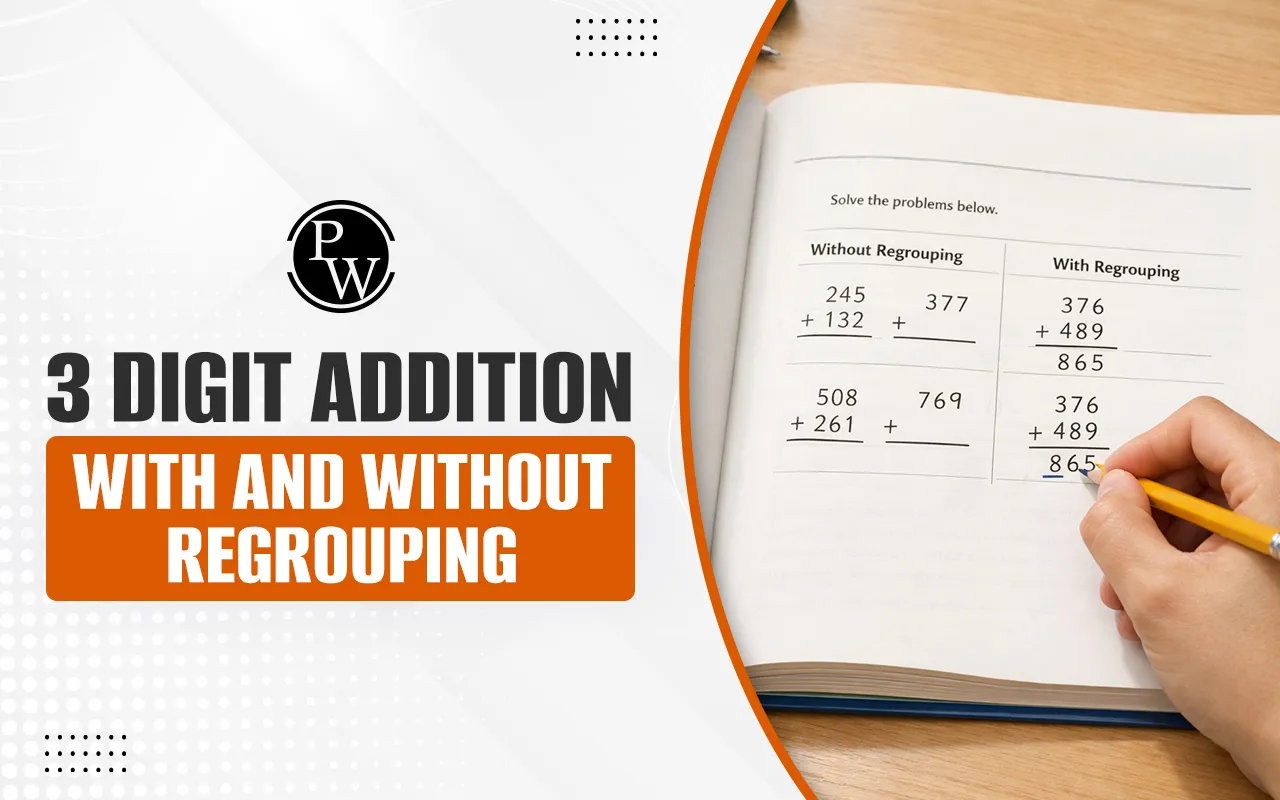
3 Digit Addition With and Without Regrouping
 Nikita Aggarwal13 Mar, 2026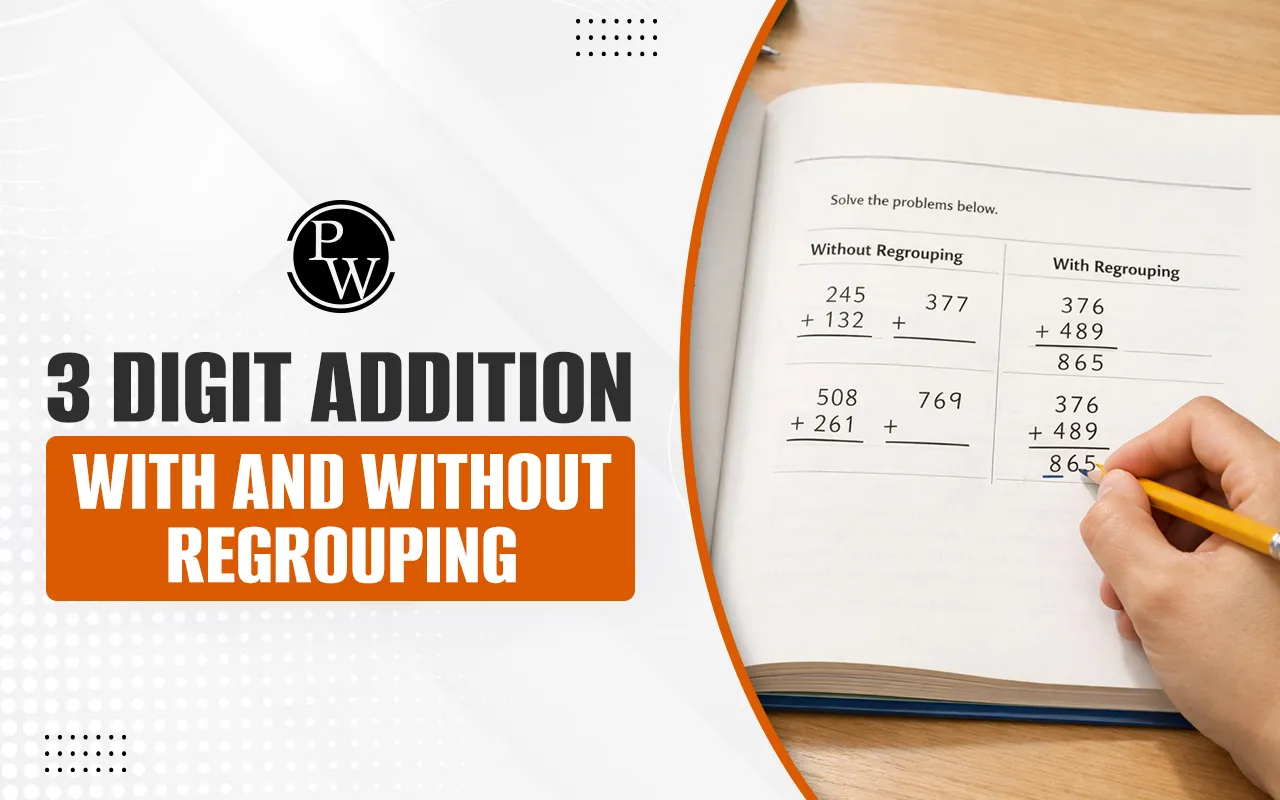
What is 3 Digit Addition in Maths?
It is the process of adding together two or more three-digit numbers to get a total. These numbers range from 100 all the way up to 999. In this kind of maths, we add up the hundreds, tens and ones to get the final amount.
Concept of 3 Digit Numbers
There are three specific places in a 3-digit number. In the number 456, for instance, the 4 stands for hundreds, the 5 stands for tens, and the 6 stands for ones. The key to getting your addition right every time is to understand this framework.
How Three Digit Addition Works
The "Column Method" is what makes three-digit number addition work. We put the numbers on top of each other, making sure that the ones are on top of the tens, the tens are on top of the hundreds, and so on. We always start with the smallest unit (ones) and work our way up to the largest.
Place Value in Three Digit Addition
Place value is the foundation of all large-scale addition. Without it, numbers are just a string of digits. When we add three-digit numbers, we look at three specific places:
-
Ones Place: The numeral on the right is the ones place.
-
Tens Place: The middle digit is in the tens place.
-
Hundreds Place: The number on the left side.
3 Digit Addition Without Regrouping
This is the simplest form of adding three-digit numbers. It happens when the total of the digits in each column (ones, tens, and hundreds) is 9 or less. This means that you don't have to move any numbers to the next column.
Steps to Solve Three Digit Addition Without Regrouping
-
Make the numbers line up: Place the numbers in a vertical line so that the place values match.
-
Put the Ones together: First, add the numbers in the ones column.
-
Add the tens: Go to the middle column and add those numbers.
-
Add the Hundreds: Finally, add the numbers in the hundreds place.
Solved Examples
For example, let's look at 423 + 152.
-
Step 1 (Ones): 3 + 2 = 5. Put 5 in the ones place.
-
Step 2 (Tens): 2 + 5 equals 7. Put the number 7 in the tens slot.
-
Step 3 (Hundreds): 5 equals 4 + 1. Put 5 in the hundreds position.
-
The total is 575.
Tips to Solve Addition Without Carrying
-
Check your work by quickly adding up each column again to be sure you didn't leave out a digit.
-
Use grid paper as they help you keep your columns straight if you have trouble doing so.
-
If the numbers are too big for you to handle, block out the other columns with your finger and focus on one column at a time.
3 Digit Addition With Regrouping
We employ a method called "carrying" or "regrouping" when the total of a column is 10 or more. It is necessary because a single column can only hold one digit (0–9).
What is Regrouping in Addition?
Regrouping involves moving a number from one column of place values to the next highest one. If your ones column adds up to 12, you put down the 2 and "regroup" or "carry" the 1 (which stands for ten) into the tens column.
Steps for Three Digit Addition With Regrouping
-
Add the Ones: If the total is 10 or more, write the ones digit below and move the tens digit to the tens column.
-
Add the tens: Add the numbers in the tens column and any number you carried over. If this number is 10 or more, move the 1 to the hundreds column.
-
Add the hundreds: To get the final answer, add the digits in the hundreds column to the number that was carried over.
Solved Examples
Let's solve 567 + 285:
-
Ones Column: 7 + 5 = 12. Write 2 in the ones place and carry 1 to the tens column.
-
Tens Column: 6 + 8 + 1 (carried) = 15. Write 5 in the tens place and carry 1 to the hundreds column.
-
Hundreds Column: 5 + 2 + 1 (carried) = 8. Write 8 in the hundreds place.
-
Final Answer: 852.
3 Digit Addition Examples for Students
Practising different types of examples is the best way to get comfortable with the process.
Easy three digit number addition Problems
-
341 + 215 = 556 (No regrouping)
-
602 + 197 = 799 (No regrouping)
-
450 + 230 = 680 (No regrouping)
Word Problems Based on Three Digit Addition
-
Problem: A school library has 438 science books and 275 history books. How many books are there in total?
-
Solution: 438 + 275.
-
8 + 5 = 13 (Write 3, carry 1)
-
3 + 7 + 1 = 11 (Write 1, carry 1)
-
4 + 2 + 1 = 7.
-
Total: 713 books.
Step-by-Step Solved Examples
Consider the sum of three numbers: 123 + 245 + 311.
-
Ones: 3 + 5 + 1 = 9.
-
Tens: 2 + 4 + 1 = 7.
-
Hundreds: 1 + 2 + 3 = 6.
-
Answer: 679.
Read More - Adding Exponent: Definition, Rules, Steps, and Examples
3 Digit Addition Worksheet for Practice
To get better, you need worksheet strategy. Here are some curated problems for you to solve.
Printable 3 Digit Addition Worksheet
You can copy these into your notebook for a quick practice session:
-
124 + 342 = ___
-
567 + 123 = ___
-
889 + 110 = ___
-
456 + 456 = ___
Practice Questions on 3 digit number addition
These practice questions on three-digit number addition help students learn how to add three-digit numbers correctly:
|
Problem |
Type |
Expected Answer |
|
213 + 472 |
No Regrouping |
685 |
|
555 + 666 |
Regrouping |
1221 |
|
109 + 201 |
Regrouping |
310 |
|
742 + 135 |
No Regrouping |
877 |
Fun Activities to Learn Three Digit Addition
-
Dice Game: Roll three dice to create two 3-digit numbers and add them up.
-
Grocery Shop: Look at receipts or price tags and try adding two items that cost between £1.00 and £9.99 (ignoring the decimal for practice).
Read More - 2 Digit Addition - With Regrouping
3 Digit Addition Tips for Students
How to Avoid Common Addition Mistakes
Most errors in three digit number addition come from messy handwriting. If your "6" looks like a "0", or if your columns are slanted, you will likely add the wrong digits. Keep your work neat and always double-check your "carried" numbers.
Importance of Place Value in Addition
Remember that "carrying a 1" actually means you are moving 10 ones into the tens column or 10 tens into the hundreds column. Visualising these as blocks can help you understand why the numbers move the way they do.
Simple Tricks to Solve Addition Faster
-
Break it down: Add the hundreds first, then the tens, then the ones mentally (e.g., 200 + 100, then 30 + 20, then 4 + 5).
-
Rounding: Round numbers to the nearest ten to estimate the answer first. If your estimate is 500 and your answer is 800, you know you've made a mistake.
Make Maths Easy and Fun with CuriousJr
At CuriousJr, we help children overcome their fear of maths and build strong confidence in numbers through a solid learning foundation. Our Mental Maths Online Classes for students from Classes 1 to 8 are designed to improve speed, accuracy, and logical thinking using simple techniques and interactive lessons.
With our unique dual-mentor system, students attend engaging live classes and also get dedicated support to clear their doubts after every session. Animated explanations, fun activities, and exciting challenges make maths concepts easier to understand and enjoyable for children.
Parents receive regular progress updates and can also participate in review sessions to stay involved in their child’s learning journey. Book a demo class today and see how CuriousJr makes maths learning simple, engaging, and confidence-boosting for your child.