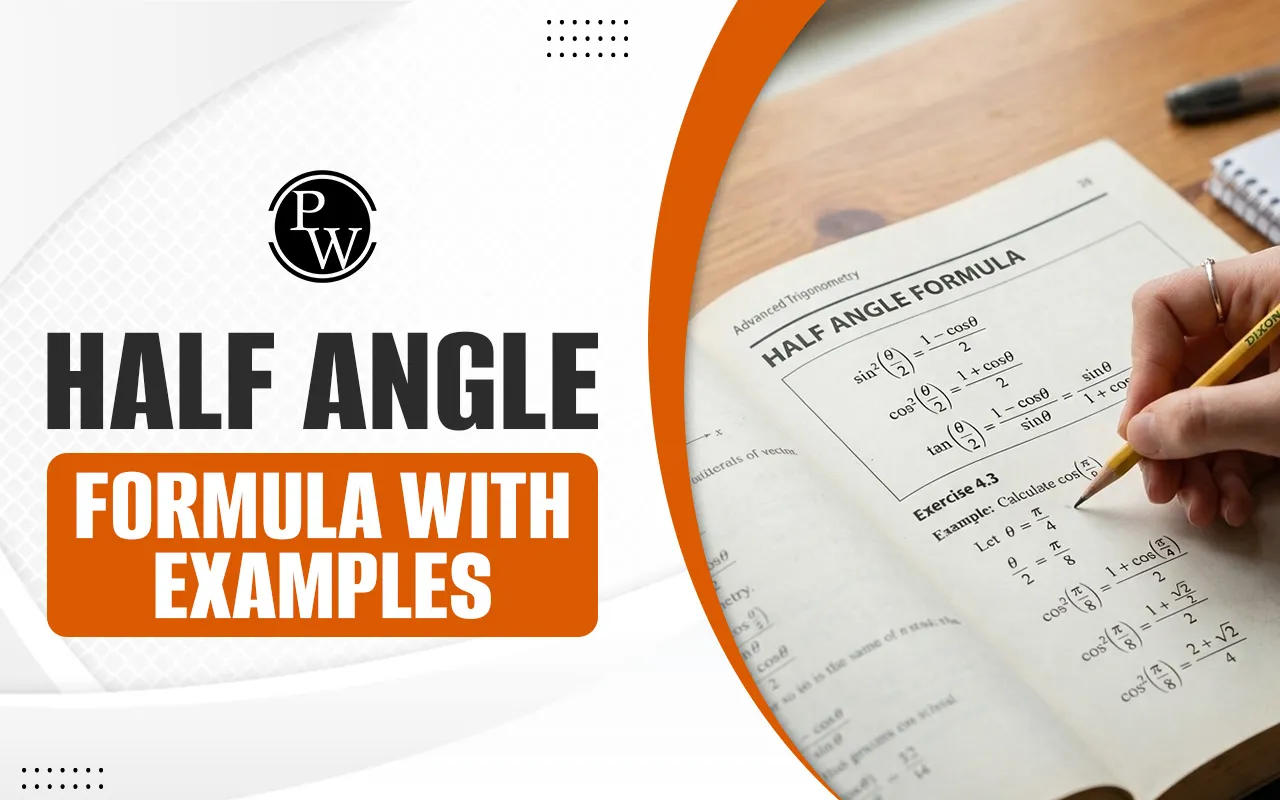
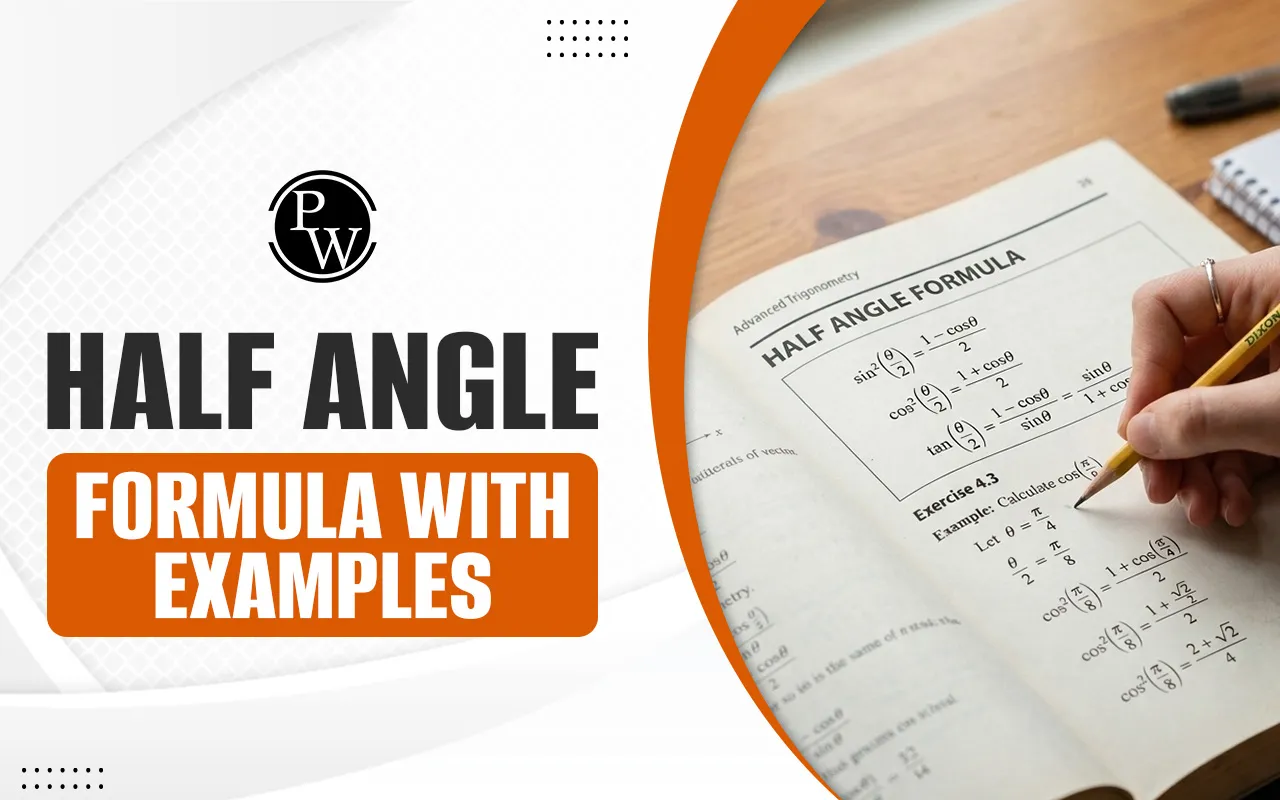
What is Half Angle Formula in Trigonometry?
It is a collection of formulas that explain how to write the trigonometric functions of an angle (let's call it theta/2) in terms of the functions of the original angle (theta).
To "half angle" means to divide an angle by two. If you know what cos(60) is, you can use these formulas to get the sine, cosine, or tangent of 30. The formulas use square roots and the quadrant of the half-angle to decide if the solution is positive or negative.
Why It is Important in Trigonometry
These formulas are very important because they let mathematicians:
-
Find the exact values of non-standard angles without using a calculator.
-
Simplify complicated integration problems in calculus.
-
Make trigonometric equations easier to solve by changing their form.
-
Help with figuring out how different circular functions are related to each other.
When to Use the Formula
You should reach for the formula whenever you encounter an angle that is half of a "special" angle (like 30, 45, 60, or 90 degrees). They are also used when you are given the value of cos(theta) and need to find the value of sin(theta/2) or cos(theta/2) to solve a geometry problem or prove an identity.
Half Angle Formula for Sin, Cos, and Tan
The three primary identities are built upon the cosine double-angle identity. Below is a summary table for quick reference:
|
Function
|
Half Angle Formula
|
|
Sin (theta/2)
|
+/- sqrt[(1 - cos theta) / 2]
|
|
Cos (theta/2)
|
+/- sqrt[(1 + cos theta) / 2]
|
|
Tan (theta/2)
|
+/- sqrt[(1 - cos theta) / (1 + cos theta)]
|
Formula for Sin
The formula for sine is used to find the vertical component of a half-angle. It is expressed as:
sin(theta/2) = +/- sqrt[(1 - cos theta) / 2]
The plus or minus sign is chosen based on which quadrant theta/2 falls into. For example, if theta/2 is in the first or second quadrant, sine is positive.
Formula for Cos
The cosine version is very similar to the sine version, but it uses addition:
cos(theta/2) = +/- sqrt[(1 + cos theta) / 2]
In this case, the result is positive if the half-angle is in the first or fourth quadrant.
Formula for Tan
The tangent formula is the ratio of the sine and cosine formulas. While the square root version is common, there are also rational versions that don't require the +/- sign:
-
tan(theta/2) = sin theta / (1 + cos theta)
-
tan(theta/2) = (1 - cos theta) / sin theta
Half Angle Formula of Sin Proof
It is rooted in the double-angle identity for cosine.
Step-by-Step Proof of the Formula of Sin
-
The double angle identity says that cos(2A) = 1 - 2sin^2(A).
-
Set theta equal to 2A. This suggests that A is equal to theta divided by 2.
-
Put these into the formula: cos(theta) = 1 - 2sin^2(theta/2).
-
To get the sine term by itself, change the equation to 2sin^2(theta/2) = 1 - cos(theta).
-
To get sin^2(theta/2), divide by 2: sin^2(theta/2) = (1 - cos theta) / 2.
-
Take the square root of both sides: sin(theta/2) = +/- sqrt[(1 - cos(theta)) / 2].
The reasoning for this is that you can lower the square of a trigonometric function to a linear power of a function with twice the angle. We can find the half-angle by using the opposite of this approach. This relationship shows how closely related all the parts of trigonometry are.
Read More - Angles in Daily Life - Types & Applications
Half Angle Formula of Cos Proof
It goes along almost the same road as the sine proof, except it uses a different version of the cosine double-angle identity.
Derivation of the Formula of Cos
-
Start with the identity: cos(2A) = 2cos^2(A) - 1.
-
Replace 2A with theta, making A = theta/2.
-
The formula becomes: cos(theta) = 2cos^2(theta/2) - 1.
-
Add 1 to both sides: 1 + cos(theta) = 2cos^2(theta/2).
-
Divide by 2: cos^2(theta/2) = (1 + cos theta) / 2.
-
Square root both sides: cos(theta/2) = +/- sqrt[(1 + cos theta) / 2].
Simplifying the Cos Half Angle Identity
This derivation is particularly useful because it shows that cosine only depends on the cosine of the original angle. This makes it a very efficient tool for calculations where you only have one piece of information.
Half Angle Formula of Tan Derivation
It is simply an application of the basic definition of tangent.
Derivation of the Formula of Tan
Since tan(x) = sin(x) / cos(x), we can say:
tan(theta/2) = sin(theta/2) / cos(theta/2)
By substituting the sine and cosine half-angle formulas:
tan(theta/2) = sqrt[(1 - cos theta) / 2] / sqrt[(1 + cos theta) / 2]
The "2" in the denominators cancels out, leaving:
tan(theta/2) = +/- sqrt[(1 - cos theta) / (1 + cos theta)]
Relation Between Tan and Other Half Angle Identities
Tangent is unique because you can also derive versions that don't use square roots by multiplying the numerator and denominator by (1 + cos theta) or (1 - cos theta). This links tangent directly to the "sin over cos" relationship in a very clean way.
Half Angle Formula Examples
Let's look at some examples to see these identities in action.
Example 1: Solving a Problem Using the Half Angle Identity
Question: Find the exact value of sin(15 degrees).
Solution:
-
Use the formula of half angle for sine with theta = 30 degrees.
-
Formula: sin(15) = sqrt[(1 - cos 30) / 2].
-
We know cos(30) = sqrt(3)/ 2.
-
Substitute: sin(15) = sqrt[(1 - sqrt(3)/2) / 2].
-
Simplify: sin(15) = sqrt[(2 - sqrt(3)) / 4] = sqrt(2 - sqrt(3)) / 2.
Example 2: Trigonometric Simplification Using Half Angle Identity
Question: Simplify the expression 2cos²(x/2) - 1.
Solution:
-
Recognise the structure from the formula of cos derivation.
-
We know that 2cos²(A) - 1 = cos(2A).
-
Here, A = x/2.
-
Therefore, 2cos²(x/2) - 1 = cos(x).
Example 3: Finding the Value of an Angle Using the Formula of Half Angle
Question: If cos(theta) = 1/2 and theta is in the first quadrant, find cos(theta/2).
Solution:
-
Use the formula cos(theta/2) = sqrt[(1 + cos theta) / 2].
-
Substitute 1/2 for cos(theta): cos(theta/2) = sqrt[(1 + 1/2) / 2].
-
Calculate: cos(theta/2) = sqrt[(3/2) / 2] = sqrt(3/4) = sqrt(3)/ 2.
Read More - Reflex Angle - Definition, Degree, Examples
Applications of the Formula of Half Angle in Trigonometry
These formulas are utilised in a number of advanced math domains, not merely to calculate values for certain angles.
Using the Formula of Half Angle in Trigonometric Identities
A lot of the time, you'll have to show that one side of an equation is equal to the other. The formula helps turn squares of sine and cosine into linear terms, which is typically the key to solving the proof.
Practical Uses of Formulas in Mathematics
-
Calculus: This is how you add functions like sin²(x) or cos²(x).
-
Engineering: Necessary for processing signals and figuring out how waves interfere with each other.
-
Physics: Helps figure out the parts of vectors and forces that are acting at certain angles.
Make Maths Simple and Engaging with CuriousJr
At CuriousJr, we help children overcome their fear of maths and build strong confidence in numbers through a solid learning foundation. Our Mental Maths Online Classes for students from Classes 1 to 8 focus on improving speed, accuracy, and logical thinking using easy techniques and interactive learning methods.
With our unique dual-mentor system, students attend engaging live classes and also get dedicated support to clear their doubts after every session. Animated explanations, fun activities, and interactive challenges help children understand maths concepts more easily while keeping learning enjoyable.
Parents also receive regular progress updates and can participate in review sessions to stay connected with their child’s learning journey. Book a demo class today and see how CuriousJr makes maths learning simple, interactive, and confidence-building for your child.