Debate - Definition, Types, Importance, Examples
 Nikita Aggarwal16 Mar, 2026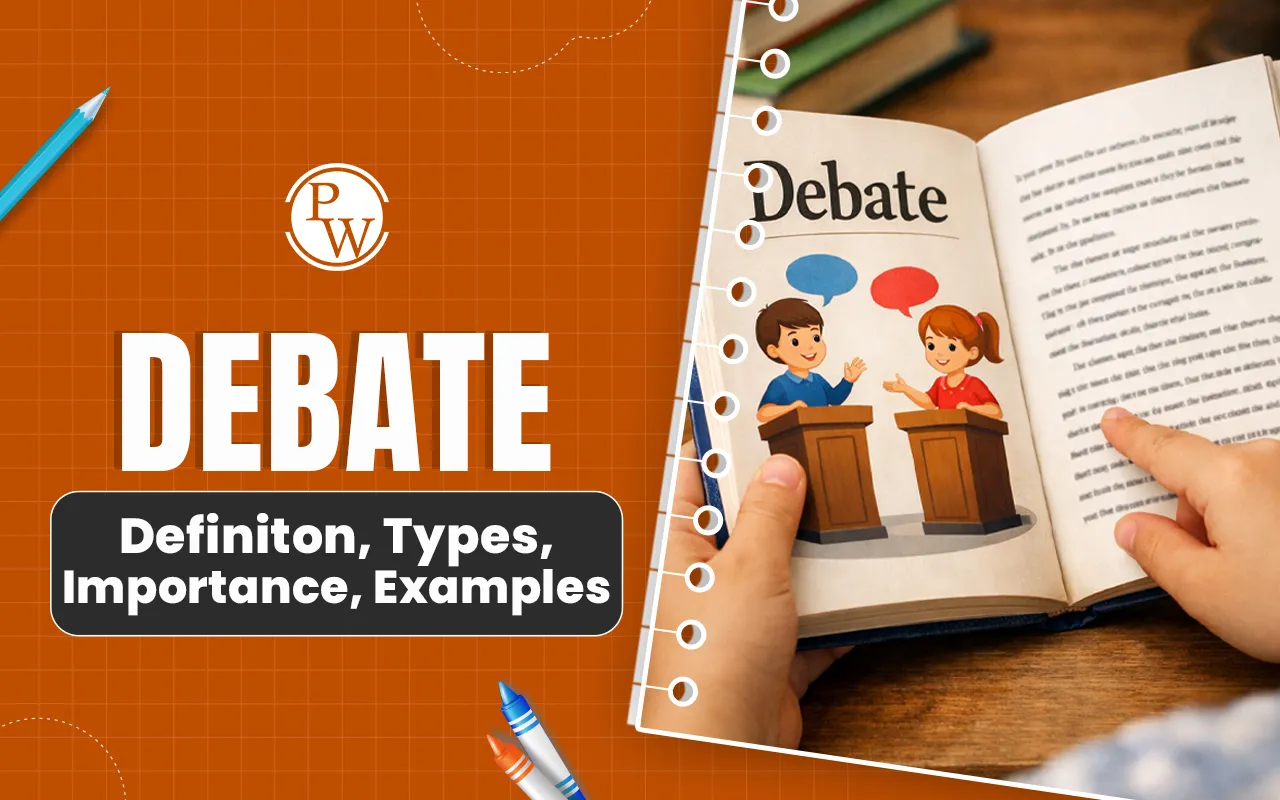
What is Debate?
At its core, it's a formal conversation on a certain issue. People in public discussions usually talk about one main topic, which is commonly called a "motion" or a "resolution."
Debate Definition
It is characterised as a procedure that entails formal discussion over a specific subject. In this situation, two or more speakers make their case and try to show how the other side's logic is wrong. It is a competition of ideas where the goal is to persuade an audience or a judge that your viewpoint is the most valid one.
You may call it a "game of words and logic." The Affirmative side agrees with a notion, whereas the Negative side disagrees with it. Both sides utilise stories, facts, and numbers to show that they are right. It is a manner to disagree that is organised and polite.
Key Elements
There are a few things that any argument needs to stay organised:
-
The Topic: A straightforward statement that can be argued from both sides, such as "School uniforms should be banned."
-
The Teams: There are usually two groups: the Proposers, who are in favour of the topic, and the Opponents, who are against it.
-
The Evidence: Facts, studies, or examples that support your claims.
-
The Rebuttal: This is where you say why the opposing team's argument is wrong or weak.
-
The Judge: A person or group that decides whether side made the better case.
Debate Types and Their Features
Not all arguments look the same. The regulations may be different depending on where they are, such in a classroom, a courtroom, or a parliament. Knowing the different sorts can help you to ready for the style you might see.
Formal vs. Informal Debate
The following table highlights the key differences between the two primary ways people engage:
|
Feature |
Formal |
Informal |
|
Setting |
Schools, Parliaments, or Courts. |
At home, with friends, or in the playground. |
|
Rules |
Strict rules and specific time limits. |
No set rules; anyone can speak at any time. |
|
Preparation |
Requires deep research and evidence. |
Usually based on personal opinions or feelings. |
|
Goal |
To win a competition or pass a law. |
To reach an agreement or share a view. |
|
Judge |
A neutral panel or audience decides. |
No official judge; usually ends in a compromise. |
Debate Popular Formats Used in Schools
Schools often use specific structures to help students learn. Each format meets different objectives:
-
Lincoln-Douglas: A one-on-one style focusing on values and ethics (what is "right" or "wrong").
-
Public Forum: A team-based style that focuses on current events and is easy for a general audience to follow.
-
Policy Public Discussion: A fast-paced style where students argue for or against a specific government change.
Debate Importance in Education and Communication
Why do schools spend so much time on this? It stretches far beyond just winning a trophy. It prepares you for real-world challenges.
Importance for Students
For a student, participating is like a workout for the brain. It builds confidence. When you stand up and speak, you learn to manage your nerves. It also teaches you to be organized, as you have to plan what you are going to say before you say it.
How Public Discussion Improves Critical Thinking
Critical thinking is the ability to think clearly and rationally. You cannot just say "because I feel like it." You must find proof. This makes you think about what you're reading, check for biases, and figure out why each statement was made. It helps you become someone who isn't easily fooled by false information.
Role of Argument in Communication Skills
Great communication isn't just about talking; it’s about listening. To win, you must listen closely to what the other side says so you can respond to it. This improves your "active listening" skills and helps you speak more clearly and persuasively in any situation.
Read More - Daily Use English Words with Meaning and Examples
Objectives of Debate for Students
When teachers organize these activities, they have specific goals in mind. These goals make sure that the activity is more than just a conversation.
-
Getting better at research: Students have to look through books and the internet to locate proof.
-
Promoting Empathy: There are instances when you have to advocate for a side that you don't agree with. This helps you see things from other people's points of view.
-
Improving Logic: The goal is to stop having emotional outbursts and start thinking logically.
Skills Students Learn from Formal Discussion
-
Note-taking: You learn to jot down the most important points quickly.
-
Public Speaking: You overcome the fear of a large audience.
-
Teamwork: You learn to coordinate with your partner so you don't repeat the same points.
Benefits of Formal Discussion Participation
Students who participate often see an improvement in their grades. This is because it improves reading comprehension and writing. When you learn how to structure a verbal argument, writing a school essay becomes much easier.
Debate Examples
Seeing how an argument works in practice makes it much less intimidating. Let’s look at some examples that are perfect for beginners.
A simple argument might look like this:
-
Topic: "Should homework be abolished?"
-
Side A (Affirmative): Homework takes away from family time and causes stress.
-
Side B (Negative): Homework helps students practice what they learned in class and builds a sense of responsibility.
School Arguments Topic Examples
If you are looking for examples to practice at home or in class, try these:
-
Should students be allowed to use mobile phones in school?
-
Is online learning better than traditional classroom learning?
-
Should junk food be banned in school canteens?
-
Are video games good for your brain?
Short Debate Sample Structure
A typical school argument follows this flow:
-
Introduction: State your name and whether you are for or against the motion.
-
Point 1: Give your strongest reason with a fact.
-
Point 2: Give another reason with a story or example.
-
Rebuttal: Mention something the other side said and explain why it’s wrong.
-
Conclusion: Summarise your points and give a final "punchy" statement.
Read More - Basic English Words for Kids
Tips for Effective Debate Participation
To succeed, you need more than just a loud voice. You need a strategy.
How to Prepare for a Public Discussion
-
Research Both Sides: Even if you are on the "Yes" side, study the "No" side. This helps you predict what they will say.
-
Write Flashcards: Don't write a full script. Just write down keywords to remind you of your points.
-
Practice Out Loud: Record yourself or speak in front of a mirror to check your body language.
Tips to Present Strong Arguments
-
Use the PEEL Method: Point, Evidence, Explanation, Link.
-
Stay Calm: If the other side says something you don't like, don't get angry. Stay focused on the facts.
-
Eye Contact: Look at the judge or the audience, not just at your notes.
Common Mistakes to Avoid
-
Personal Attacks: Never insult the person you are debating. Focus on their ideas, not them.
-
Making Up Facts: If you get caught lying about a statistic, you will lose credibility instantly.
-
Speaking Too Fast: If the judge can't understand you, they can't give you points.
Build Your Child’s Confidence in English with CuriousJr
Does your child feel shy while speaking English or struggle to form correct sentences? This can affect their classroom participation and slowly reduce their confidence. CuriousJr’s English Online Classes help children learn English in a simple, interactive, and engaging way. Our program focuses on building strong grammar basics, improving pronunciation, expanding vocabulary, and developing basic writing skills. Through live interactive sessions, children get regular speaking practice with the guidance of trained mentors. Fun learning activities like storytelling, games, and creative writing make English learning enjoyable and effective for young learners.