
Floating and Sinking: Easy Examples and Science
 Shivam Singh28 Sept, 2026
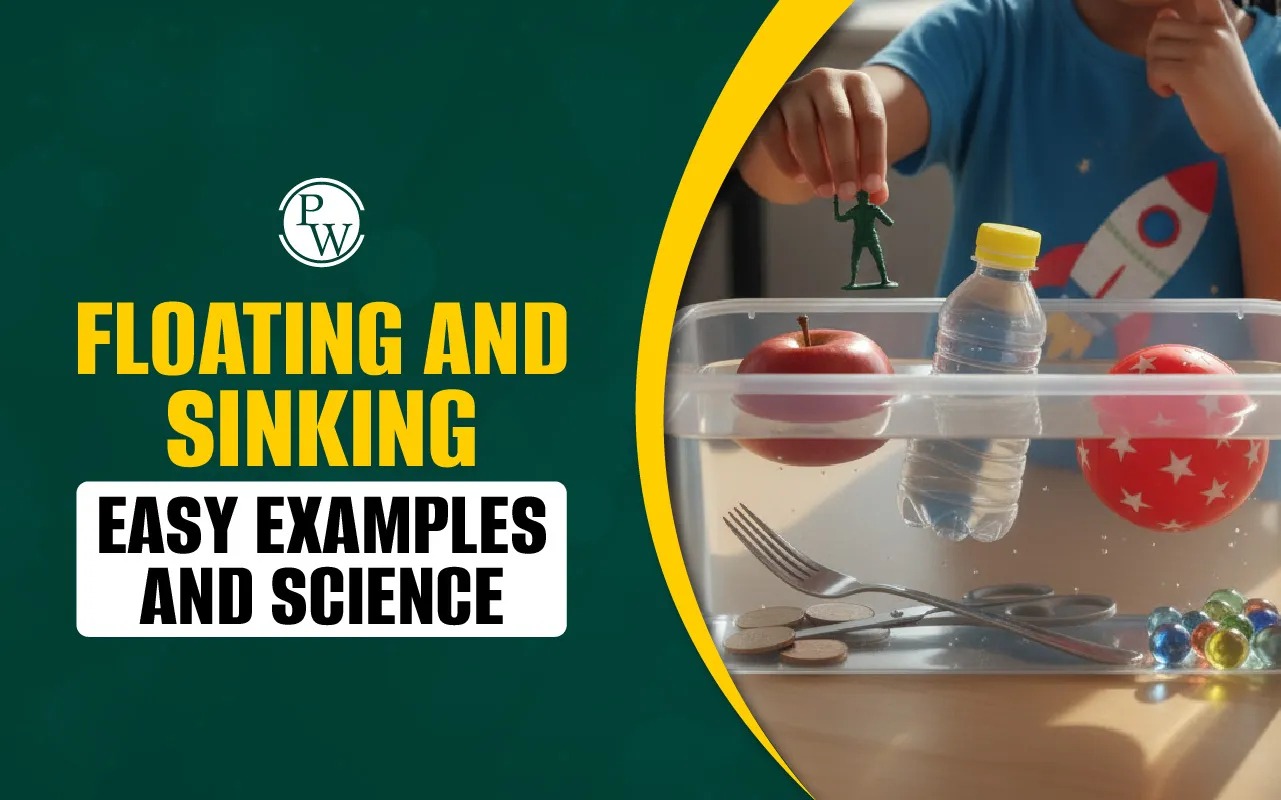
Floating and sinking describe what happens when an object is placed in a liquid such as water.
-
Floating means an object stays on the surface of the water.
-
Sinking means an object moves downward through the water and settles below the surface.
-
Whether an object floats or sinks depends mainly on its density and the buoyant force acting on it.
For example, a piece of wood usually floats in water, while a coin usually sinks. A large metal ship can also float even though metal itself is denser than water because the ship's overall shape contains air and allows it to displace enough water.
What Is Floating?
Floating is the condition in which an object remains at or near the surface of a liquid instead of sinking to the bottom.
For example:
-
A leaf floats on water.
-
A wooden stick usually floats.
-
A rubber duck floats in a bathtub.
-
An empty sealed plastic bottle can float.
An object floats when the upward buoyant force from the liquid can support its weight.
Floating Definition for Kids
Floating means staying on the surface of water or another liquid without sinking to the bottom.
What Is Sinking?
Sinking is the movement of an object downward through a liquid because the forces acting on it do not support its weight.
For example:
-
A coin sinks in water.
-
A metal key usually sinks.
-
A stone sinks.
-
A marble sinks.
Sinking Definition for Kids
Sinking means moving downward through water or another liquid and going below the surface.
Floating and Sinking Definition
The simple difference is:
| Floating | Sinking |
| The object stays on or near the surface. | The object moves downward in the liquid. |
| Its average density is usually less than the liquid. | Its density is usually greater than the liquid. |
| Buoyant force can support its weight. | Its weight is greater than the buoyant force while it is moving downward. |
| Example: wood | Example: coin |
Also, check: Components of Environment: Types, Examples and Importance
Why Do Things Float or Sink?
The main ideas behind floating and sinking are density and buoyancy.
1. Density
Density tells us how much mass is packed into a given amount of space.
In simple terms, an object with more mass packed into the same amount of space has a higher density.
For an object placed in water:
-
If its average density is less than water, it tends to float.
-
If its average density is greater than water, it tends to sink.
-
If its average density is equal to water, it can remain suspended in the water.
This is why we cannot simply say that heavy objects sink and light objects float. The size and volume of an object also matter.
2. Buoyancy
Buoyancy is the upward force exerted by a liquid on an object placed in it.
When an object enters water, it pushes some water out of the way. The displaced water produces an upward force called the buoyant force.
If the buoyant force can support the object's weight, the object floats. If the object weighs more than the buoyant force can support, it sinks.
How Does Buoyancy Help Objects Float?
Imagine placing a ball in water.
The ball pushes some water aside. Water pushes upward against the ball. This upward push is the buoyant force.
An object floating at rest has reached a balance where the upward buoyant force supports its weight.
This explains why a ship made mainly of metal can float. Its hollow shape allows the ship to displace a large volume of water, making its average density as a whole low enough for it to float.
Students can explore density, buoyancy, and other science concepts through interactive learning resources on CuriousJr.
Floating and Sinking Objects Examples
Many everyday objects can be classified by observing what happens when they are placed in water.
Examples of Floating Objects
Some common objects that usually float in water include:
-
Wooden stick
-
Cork
-
Dry leaf
-
Rubber duck
-
Foam piece
-
Empty sealed plastic bottle
-
Ping-pong ball
-
Ice cube
-
Dry sponge
-
Some types of fruit
The result can depend on the material, shape, size, and whether the object contains trapped air.
Examples of Sinking Objects
Some common objects that usually sink in water include:
-
Coin
-
Metal key
-
Stone
-
Marble
-
Metal spoon
-
Metal nail
-
Glass bead
-
Steel bolt
-
Ceramic piece
-
Dense metal object
These are everyday examples, but an object's behavior should be tested when its material or construction is unknown.
10 Things That Sink in Water
Here are 10 common examples of objects that usually sink in water:
| Object | Usually floats or sinks? |
| Coin | Sinks |
| Metal key | Sinks |
| Stone | Sinks |
| Marble | Sinks |
| Metal nail | Sinks |
| Steel bolt | Sinks |
| Glass bead | Sinks |
| Metal spoon | Sinks |
| Ceramic piece | Sinks |
| Metal washer | Sinks |
10 Things That Float on Water
Here are 10 common examples of objects that usually float:
| Object | Usually floats or sinks? |
| Cork | Floats |
| Wooden stick | Floats |
| Dry leaf | Floats |
| Rubber duck | Floats |
| Foam piece | Floats |
| Ping-pong ball | Floats |
| Ice cube | Floats |
| Empty sealed plastic bottle | Floats |
| Dry sponge | Floats |
| Some types of fruit | Floats |
The exact result can change depending on the object's material, construction, and condition.
Also, check: Parts of a Plant: Names, Functions and Their Importance
Why Does a Metal Ship Float but a Metal Nail Sink?
A common question is: If metal sinks, why does a metal ship float?
The answer is the ship's overall shape and average density.
A solid metal nail has a small volume compared with its mass, so its density is greater than that of water and it sinks.
A ship is mostly hollow. Its large shape encloses air and allows it to displace a large amount of water. As a result, the average density of the entire ship can be less than that of water, allowing it to float.
So, the material alone does not always determine whether an object floats or sinks.
Does Shape Affect Floating and Sinking?
Shape can affect how much water an object displaces and therefore how buoyant force acts on it.
For example, consider a small piece of metal and the same metal shaped into a hollow boat. The solid piece may sink, while the hollow boat can float.
However, shape does not change the density of the material itself. What changes is the object's overall volume and average density, along with the amount of water it displaces.
Floating and Sinking in Water: A Simple Rule
For an object placed in water, remember this basic comparison:
Average density of object < density of water → object tends to float
Average density of object > density of water → object tends to sink
Average density of object = density of water → object can remain suspended
This rule helps explain many floating and sinking examples.
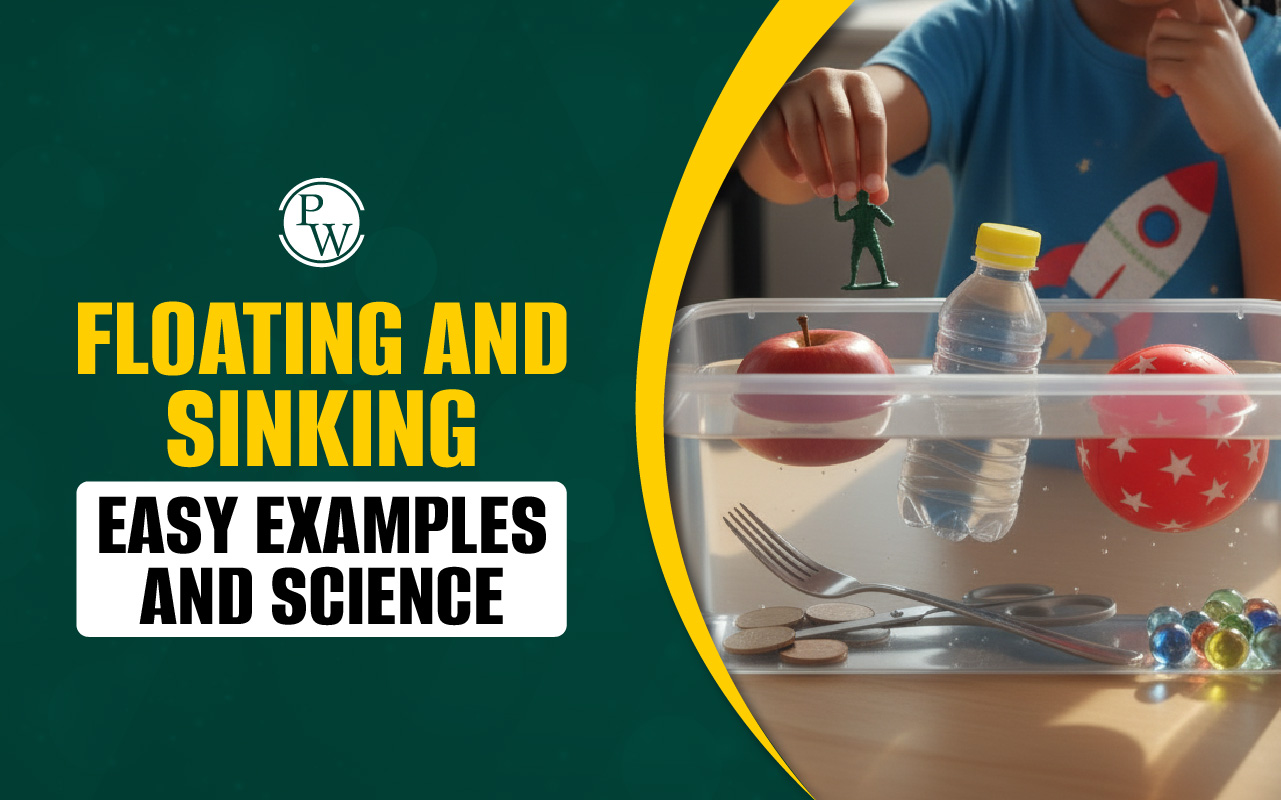
Floating and Sinking Experiment
You can perform a simple float or sink experiment at home or in the classroom.
Materials Needed
-
A transparent bowl, tub, or bucket of water
-
Coin
-
Small stone
-
Wooden stick
-
Cork
-
Rubber eraser
-
Metal spoon
-
Plastic bottle with its cap closed
-
Sponge
-
Marble
-
Small fruit such as an apple
Steps
-
Fill the container with water.
-
Place one object in the water at a time.
-
Observe whether it floats or sinks.
-
Record your observation in a table.
-
Compare the objects that floated with those that sank.
-
Think about their material, size, shape, and average density.
Observation Table
| Object | Prediction | Observation |
| Coin | Sink | Sink |
| Wooden stick | Float | Float |
| Cork | Float | Float |
| Marble | Sink | Sink |
| Sponge | Float | Usually floats |
| Metal spoon | Sink | Usually sinks |
| Sealed empty plastic bottle | Float | Float |
The experiment shows that objects do not all behave in the same way in water.
Can You Make a Sinking Object Float?
Sometimes, yes.
There are several ways to change the conditions so that an object that previously sank can float.
Add Salt to Water
Adding salt increases the density of water. In sufficiently salty water, an object may float more easily than it does in fresh water.
This helps explain why it can be easier for a person to float in seawater than in freshwater.
Change the Shape
Changing the shape of an object can increase its volume without adding much mass.
For example, a solid piece of metal may sink, while the same material formed into a hollow boat can float because the boat displaces more water and has a lower average density.
Does Oil Float on Water?
Oil generally floats on water because most common oils have a lower density than water and do not mix with it.
When oil and water are placed together, the oil forms a layer above the water.
This is another everyday example of how density affects the position of substances in liquids.
Why Do Some Fruits Float and Others Sink?
Different fruits have different densities and structures.
A fruit may float if its overall density is lower than water. It may sink if its overall density is greater than water.
The amount of air space, water content, skin, seeds, and other parts of the fruit can affect its average density.
This is why a simple float or sink experiment can be useful when comparing different fruits.
Floating and Sinking for Class 8
At a school level, floating and sinking can be understood using three main ideas:
-
Density: how much mass is packed into a given volume.
-
Buoyant force: the upward force exerted by a liquid.
-
Displacement: the amount of liquid pushed aside by an object.
These ideas help explain why a coin sinks, why a piece of wood floats, and why a large hollow ship can stay on water.
Floating and Sinking: Quick Summary
-
Floating means an object stays on or near the surface of a liquid.
-
Sinking means an object moves downward through the liquid.
-
Density is an important factor in deciding whether an object floats or sinks.
-
Buoyant force is the upward force exerted by a liquid.
-
An object with average density less than water tends to float.
-
An object with average density greater than water tends to sink.
-
Shape can affect the amount of water displaced and the object's average density.
-
A hollow metal ship can float even though solid metal is denser than water.
-
Salt water is denser than fresh water, which can make floating easier.
-
Simple experiments can help children observe these ideas directly.
Floating and Sinking FAQs
What is floating and what is sinking?
What are some examples of floating objects?
What are some examples of objects that sink in water?
Why does a heavy ship float while a small coin sinks?
Can an object that sinks in water be made to float?