Clauses in English – Meaning and Definition
 Shivam Singh20 Jan, 2026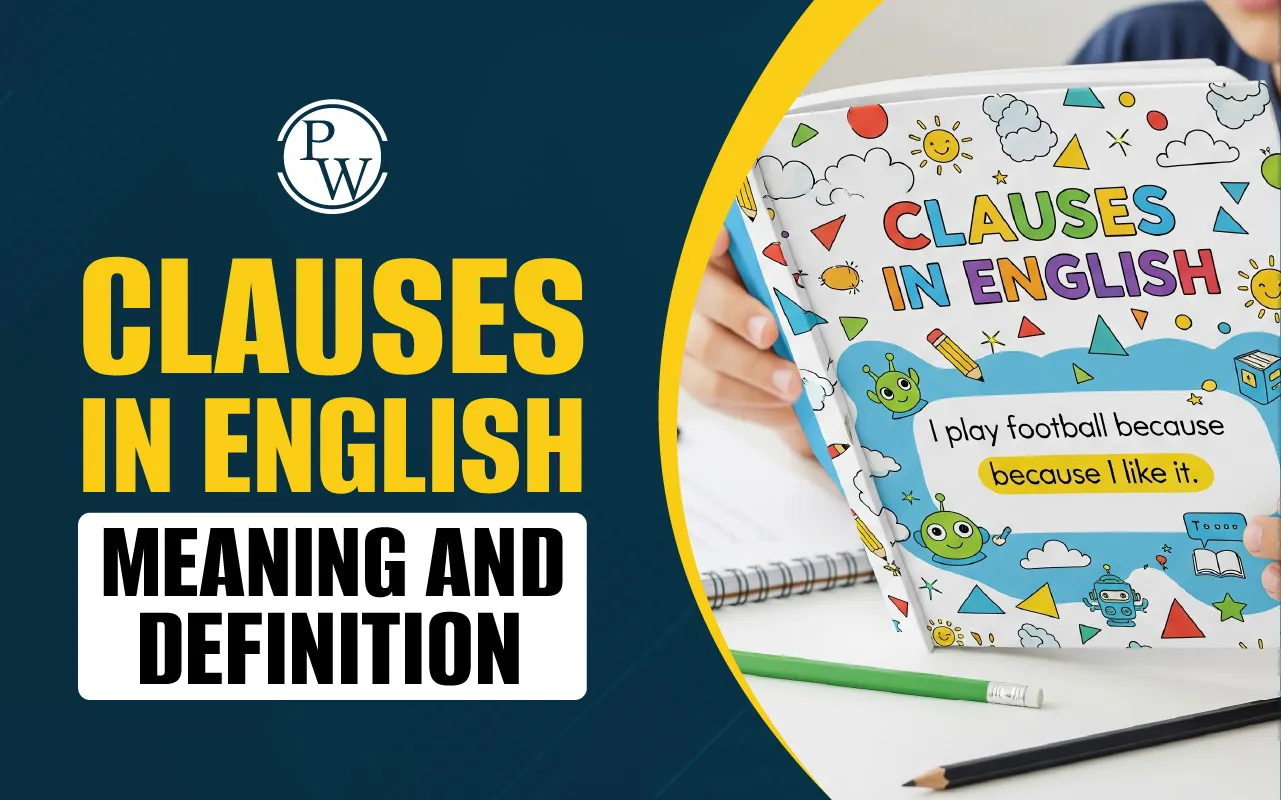
Clauses in English grammar are important components to structure the sentences properly and communicate the information with more clarity and justification. We often use clauses to describe what happens and when, and to explain reasons, responses, and circumstances.
Understanding English clauses can help your child write more precise and clearer sentences for academic content, reports, or speeches. We will explain the main types of clauses and their appropriate uses through various examples, to help your child identify and use them effectively in their writing and speaking.
Read More: Comprehension
What is a Clause?
A clause is a group of words containing a subject and a predicate (verb). Clauses help to structure the sentences meaningfully and conveying the message vividly. Clauses can be used to express a complete thought, or they can be incomplete, dependent on the other clause.
Based on their nature, English clauses are classified as main or independent clauses and dependent or subordinate clauses. The subordinate clause is connected to a dependent clause with a subordinate conjunction and clarifies or explains a situation by providing more information.
Types of Clauses
There are primarily two types of clauses typically used in sentence construction. We will discuss them in detail as follows:
Independent Clause
An independent clause is a part of the sentence but it carries a meaning independently. In other words, it can be used as a standalone sentence, which makes sense.
Dependent Clause
A dependent clause is a part of the sentence that doesn’t make sense but must be combined with the main clause. Identifying dependent clauses in a complex sentence is easy because they start with a subordinating conjunction.
Let’s look at the following sentence:
We could not see anything because it was totally dark outside
In this sentence, ‘We could not see anything’ is the independent clause, which carries a meaning. The other clause, ‘because it was totally dark outside,’ is the dependent clause connected to the main clause with the conjunction ‘because’ and provides additional information.
Read More: Degree of Comparison
Subtypes of Dependent Clauses
The dependent clauses can take various forms and used in different ways as mentioned below:
Noun Clauses
A noun clause acts as a noun. It can function as a subject, object, or complement. These clauses typically begin with words like that, what, who, which, where, whatever, etc.
Examples:
What you said shocked me.
Here, ‘what you said’ is subject to the verb ‘shocked.
I don’t know where she lives.
Here, ‘where she lives’ is the object of the verb ‘know’.
I wish him success in whatever he does.
Here, the clause ‘in whatever he does’ complements the action ‘I wish him success’.
Adjective Clauses
An adjective clause describes a noun or pronoun in the independent clause. It is also called a relative clause. It typically begins with a relative pronoun and is placed within the independent clause.
Examples:
The man who lives downstairs is my tenant.
Here, who lives downstairs is an adjective clause used with an independent clause: the man is my tenant.
The lady whom we met yesterday was my science teacher.
Here, whom we met yesterday is an adjective clause used with an independent clause. The lady was my science teacher.
The player, who scored 92 runs, was declared the man of the match.
Here, who scored 92 runs is an adjective clause used with an independent clause, the player was declared man of the match.
Read more: List of Tricky Words in english
Adverb Clauses
An adverb clause modifies a verb, adjective, or adverb and tells under what conditions something happens. These clauses often start with subordinating conjunctions like because, although, when, if, since, until, etc.
Examples:
-
I left early because I was feeling unwell.
-
Unless you think positively, you will suffer a lot.
-
Although he worked hard, he could not pass the exam.
How Clauses Work in Sentences?
Clauses can help structure the sentences in different ways, as explained below:
Sentence Starting with an Independent Clause
Sentences may start with an independent clause followed by a dependent clause. Both are connected by a subordinating conjunction.
-
I could not attend the online class because the internet connectivity was poor.
-
Make sure you put on your seat belt whenever you drive.
-
We will start trekking if the weather is good.
-
They could not move out because it was raining heavily.
Sentence Starting with a Dependent Clause
These sentences start with a subordinating conjunction and a dependent clause, followed by the independent clause.
-
As soon as I reach home, I will inform you.
-
If you meet Mr. Roy, please tell him to contact me.
-
Although it was very cold, we enjoyed camping together.
Two independent clauses joined by a conjunction
-
I love coffee, but I also enjoy tea.
-
I was late for the office because I was stuck in a traffic jam.
Two independent clauses and one dependent clause
-
After you finish your work, we will go to a movie, and I will drop you off at home.
-
If the rain doesn’t stop, I will book a cab and reach your place.
Read More: Top 10 Longest Words in English
Independent and Dependent Clauses Examples
Here are a few examples of independent and dependent clauses used in English sentences in different ways:
The cricket match was cancelled because it was raining.
Independent: The cricket match was cancelled
Dependent: because it was raining
While my daughter enjoys Indian cuisine, my son prefers Chinese dishes.
Independent: My son prefers Chinese dishes
Dependent: While my daughter enjoys Indian cuisine
If the weather doesn’t improve, we have to postpone the trip.
Independent: We have to postpone the trip
Dependent: If the weather doesn’t improve
Although it was a long journey, we enjoyed it.
Independent: We enjoyed it.
Dependent: Although it was a long journey
The book, which I just finished reading, is a bestseller.
Independent: The book is a bestseller.
Dependent: which I just finished reading
Don’t stop learning because life never stops teaching.
Independent: Don’t stop learning
Dependent: because life never stops teaching
When we heard the news, we were shocked.
Independent: We were shocked.
Dependent: When we heard the news
I will call you when I am free.
Independent: I will call you
Dependent: When will I be free
Read More: Letter Writing
Important Points About Using Clauses
When we use English clauses in sentences, some important points must be taken into consideration to structure the sentence, as mentioned below.
-
A complex sentence includes at least one independent clause and one dependent clause.
-
Always put a subordinating conjunction in the beginning of the dependent clause.
-
When the sentence starts with the dependent clause, we must use a comma after the independent clause, before writing the dependent clause.
-
If the sentence starts with an independent clause, no comma is placed between the clauses.
-
The relative clause is used between the independent clause, enclosed by commas on both sides.
Why Learning Clauses is Important for Students?
Learning clauses meaning in grammar can help to improve the language skills of your child and enhance their sentence constructions. A knowledge of various types of clauses can help them in the following ways:
-
Construct engaging sentences without grammatical errors
-
Enhance sentence structure and communication quality
-
Communicate information, ideas, and thoughts more clearly
-
Improve writing and speaking style
Clauses improve the quality and clarity of English communication by allowing multiple ideas and expressions to incorporate in a sentence. With a fair idea of clauses' meaning and definition, and the types of clauses in English grammar with examples, your child will be able to write and speak with greater accuracy and confidence.
Also read: No vs. Not: Difference, Rules & Examples
Boost Your Child’s English Skills with CuriousJr English Classes
Good communication opens the door to better learning, brighter opportunities, and long-term success. Children who develop reading, writing, speaking, and listening skills early are better prepared for school, exams, and the challenges of the future.
At CuriousJr, we offer English Online classes for children aged 6 to 14, with four progressive levels that guide them step by step from simple concepts to advanced grammar, vocabulary, and confident communication.
Each session introduces new words, improves sentence use, and encourages children to practice English in a way that feels natural. Activities and writing tasks make grammar easier to understand, while regular speaking opportunities help children become more fluent and self-assured.
What makes our classes unique?
-
Encourages curiosity and love for the English language
-
Builds problem-solving and critical thinking through language activities
-
Promotes teamwork and collaboration with group exercises
-
Introduces practical scenarios for using English in real-life situations
Over time, parents notice clear progress, as children perform better in school and express themselves with greater confidence in everyday life. With regular updates, parents stay closely connected to their child’s growth and development.
Now is the time to give your child an advantage that will last a lifetime. Why wait for them to catch up later when they can excel today? Book a demo class now and see your child become a confident English speaker.