Prepositions of Time: Definition, Rules, Uses, Examples
 Nikita Aggarwal20 Jan, 2026
Prepositions of Time
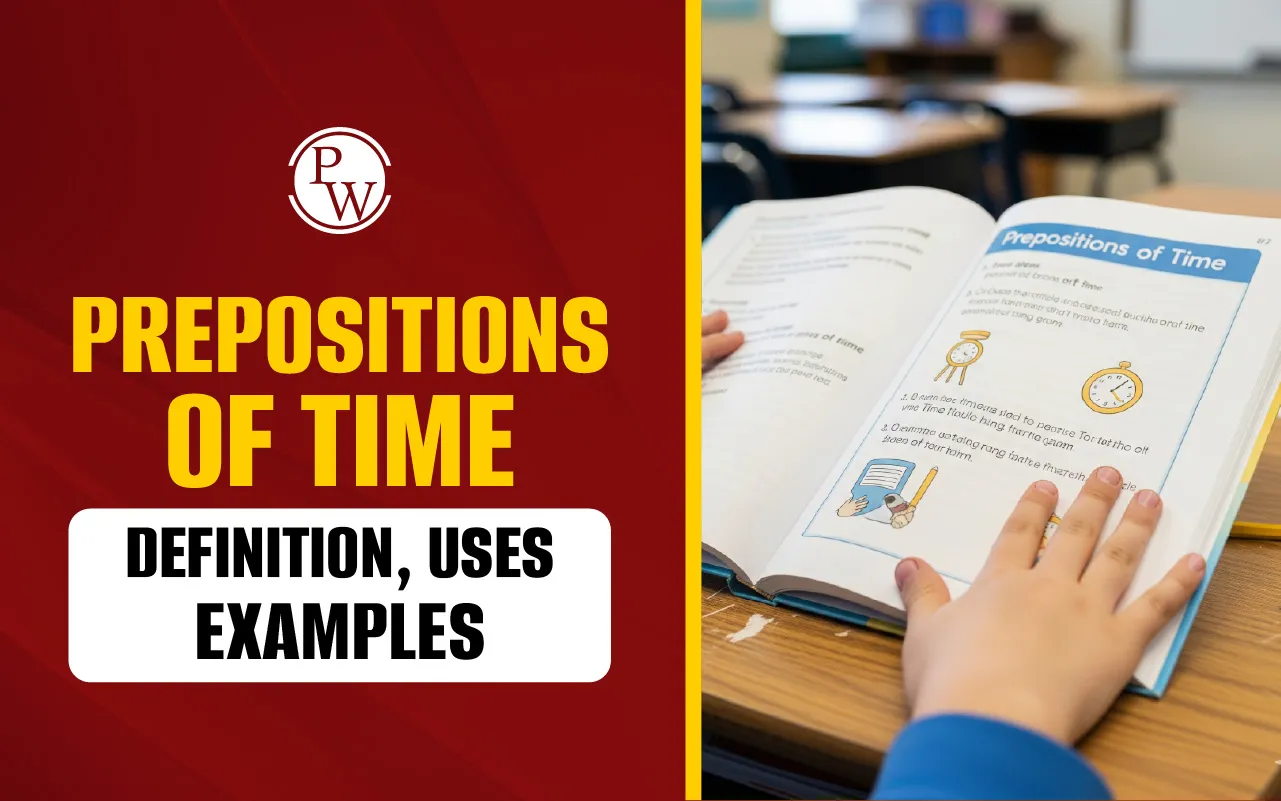
Prepositions of time are an important part of English Grammar. They help us connect an action or event to a time, date, or duration. The most common prepositions of time we use in English are in, on, and at. Using them in a correct manner makes our sentences more clear and easier to read.
Generally, at is used for a specific time, on for days and dates, and in for months, years, or longer periods. Other prepositions, such as before, after, during, for, since, and until, are also used to show time in a sentence. Learning what is a preposition of time helps us avoid common mistakes while writing or speaking in English about time.
Read More: What are Compound Words
Prepositions of Time Definition
According to the prepositions of time definition, these are words that help us write or talk about when something takes place or how long it lasts. These words make sentences more meaningful by giving clear information about time.
For example, words like at, on, in, before, after, and during are prepositions of time. So, the prepositions of time definition in simple words is: words that link an action or event to a point or period of time.
Use of Prepositions of Time
As we learned, prepositions of time help us show when something happens. The most common prepositions of time are at, on, and in, and each is used in a different way. Let's understand the use of prepositions of time one by one:
-
At is used for a specific time (I wake up at 7 a.m.).
-
On is used for a day or date (My birthday is on Sunday, or We have a holiday on May 25th).
-
In is used for a longer period of time, like a month, a year, or a season. (We go on vacation in December, or She was born in 2010).
-
Before shows something happening earlier than a time or event (Wash your hands before dinner).
-
After is used to show something happening later than a time or event (We went out after lunch).
-
During shows something happening in the middle of a time or event. (It rained during the night).
-
For is used to show how long something lasts (I have lived here for three years).
-
Since shows when something started (She has studied English since 2015).
-
Until is used to show up to a certain time (I will wait until 6 p.m.).
Learning the use of prepositions of time helps you speak and write clearly in English about time.
Read more: Direct and Indirect Speech
Preposition of Time Examples
Let's go through some examples for preposition of time that show how we can talk about exact times, days, months, or longer periods clearly. By practicing these preposition of time examples, you can make your English sentences more correct and easier to understand.
1. AT: We use for a specific time or moment
-
I will wake up at 6 a.m. (shows the exact time)
-
We eat lunch at noon (shows a particular time of the day).
-
She called me at night (shows a general time)
-
He is busy at the moment (shows the current moment).
2. ON: We use for a day or date
-
The picnic is on Sunday (shows the day
-
My birthday is on May 10th (shows the date).
-
We have football practice on Saturdays (shows a repeated day).
-
I will meet you on Monday morning (shows a day and time together).
IN: We use for a longer period, like months, years, seasons, or parts of the day
-
We go on holiday in December (shows the month).
-
It is hot in summer (shows the season).
-
She was born in 2012 (shows the year).
-
I will call you in the evening (shows part of the day).
Other common examples for prepositions of time:
-
BEFORE: Wash your hands before dinner.
-
AFTER: We went out after lunch.
-
DURING: It rained during the night.
-
FOR: I have studied for two hours.
-
SINCE: She has lived here since 2015.
-
UNTIL: I will wait until 5 p.m.
Also read: Abstract Nouns
Prepositions of Time Questions
Fill in the blanks with the correct prepositions of time:
-
I was born ___ July.
-
The train leaves ___ 9:00 a.m.
-
We have a holiday ___ Monday.
-
She has been reading ___ two hours.
-
They will arrive ___ the evening.
Answers:
-
in
-
at
-
on
-
for
-
In
Read More: Figures of Speech
Build Your Child’s Confidence in English with CuriousJr
Many parents worry that their child struggles with English grammar, vocabulary, or speaking confidently. Without the right guidance, children may find it hard to write correct sentences or express themselves clearly.
CuriousJr's Online English Classes help your child learn foundational English step by step in an easy and fun way. Children get live classes where teachers guide them through grammar, sentence building, vocabulary, and pronunciation. It also offers:
-
Simple Grammar Lessons: Children learn grammar in ways that make writing and speaking sentences easy.
-
Live Interactive Classes: Teachers practice examples and exercises with children to strengthen their skills.
-
Vocabulary and Pronunciation: Along with grammar, children improve their word knowledge and speak clearly.
-
Fun Activities: Games, writing tasks, and speaking exercises keep learning enjoyable.
-
Progress Reports: You receive updates to see how your child is improving in English.
Strong English skills help children read, write, and speak confidently. Book a demo class today and give your child a solid foundation in English with CuriousJr.