Right Circular Cone - Definition, Formula, Properties, Examples
 Nikita Aggarwal1 Apr, 2026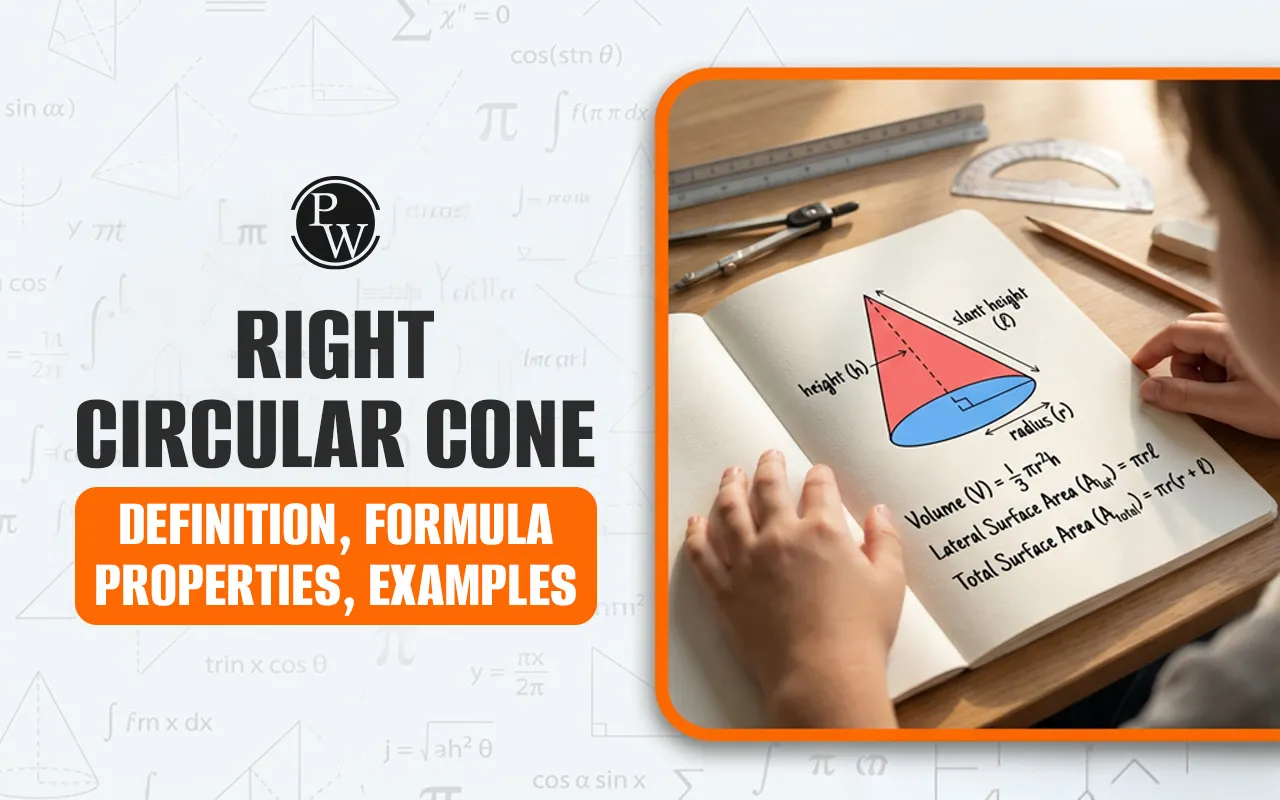
Right Circular Cone Definition
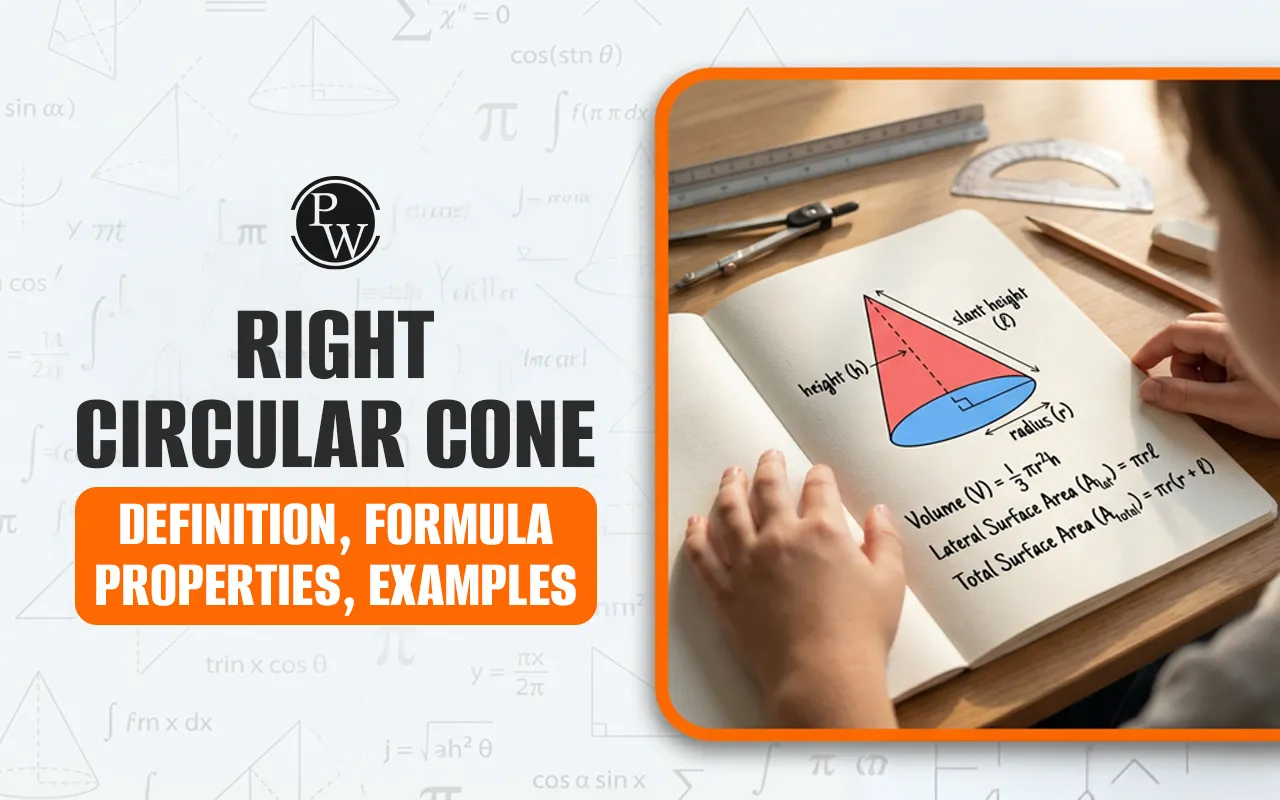
It is a solid that comes from turning a right-angled triangle around one of its legs. It has a flat, round base and a curving surface that gently narrows to a point called the apex or vertex.
Key components include the following:
-
Radius (r): The distance from the centre of the circular base to any point on its boundary.
-
Height (h): The perpendicular distance from the vertex (apex) to the centre of the circular base.
-
Slant Height (l): The distance from the vertex to any point on the edge of the circular base.
Right Circular Cone Properties
Before diving into the math, it's useful to understand the characteristics that define this shape. These features distinguish it from other three-dimensional solids like cylinders and pyramids.
-
Axis Alignment: The cone's axis travels through the middle of the circular base at a 90-degree angle.
-
Symmetry: It is axially symmetric, which implies that if you cut it in half along the axis, the two pieces will be the same.
-
Vertex: There is only one vertex, and it is right above the middle of the base.
-
Cross-section: The form will always be a circle if you cut the cone parallel to the base.
-
Equal Slant Height: The distance from the vertex to every point on the base's edge is the same.
Right Circular Cone vs Oblique Cone
It can be hard to tell them apart on tests. Here's a short comparison:
|
Feature |
Cone with a perpendicular Axis |
Oblique Cone |
|
Axis |
Perpendicular to base |
Not perpendicular |
|
Symmetry |
Symmetrical |
Not symmetrical |
|
Vertex Position |
Directly above centre |
Tilted |
|
Cross-section (vertical) |
Isosceles triangle |
Irregular triangle |
Read More - Cone: Formula, Properties, Types, Examples
Right Circular Cone Formula
To figure out the size of a cone, you need to know three things: the radius (r), the height (h), and the slant height (l). These three numbers make a right-angled triangle, therefore we can apply the Pythagorean theorem to find any side that is missing.
1. Slant Height Formula
The slant height is the "tilted" side of the cone.
Formula: l = Square Root of (r^2 + h^2)
2. Curved Surface Area (CSA)
The curved surface area refers only to the area of the side of the cone, excluding the circular base.
Formula: CSA = pi × r × l
3. Total Surface Area (TSA)
To find the total area, we add the area of the circular base to the curved surface area.
Formula: TSA = (pi × r × l) + (pi × r^2)
Simplified: TSA = pi × r (l + r)
4. Volume of a Cone with Perpendicular Axis
The volume represents the total space occupied inside the cone. It is exactly one-third of the volume of a cylinder with the same radius and height.
Formula: Volume = (1/3) × pi × r^2 × h
|
Parameter |
Symbol |
Formula |
|
Radius |
r |
Distance from centre to edge of base |
|
Height |
h |
Vertical distance from apex to base centre |
|
Slant Height |
l |
l = √(r² + h²) |
|
Base Area |
B |
pi × r² |
|
Curved Surface Area |
CSA |
pi × r × l |
|
Total Surface Area |
TSA |
pi × r (l + r) |
|
Volume |
V |
(1/3) × pi × r² × h |
Read More - Volume of Cone – Formula, Derivation, Steps & Examples
How to Solve Circular Cone Problems?
The most typical mistake people make when they see these questions on tests is to mix up the vertical height (h) with the slant height (l). Always look to see which one is in the question.
Scenario A: Finding the Slant Height
If a cone has a radius of 3 cm and a height of 4 cm:
-
Square the radius: 3 × 3 = 9
-
Square the height: 4 × 4 = 16
-
Add them: 9 + 16 = 25
-
Take the square root: √25 = 5 cm.
The slant height is 5 cm.
Scenario B: Finding the Volume
If a cone has a radius of 7 cm and a height of 9 cm:
-
Calculate base area: (22/7) × 7 × 7 = 154 sq cm.
-
Multiply by height: 154 × 9 = 1386.
-
Divide by 3: 1386 / 3 = 462 cubic cm.
Right Circular Cone Examples
To help you understand better, let's look at some real-world challenges.
Example 1: Calculating Surface Area
The birthday hat is a right circular cone with a radius of 5 cm and a height of 10 cm. Find the curved surface area of the cone.
-
Solution: Since we do not need the base, we calculate the CSA.
-
First, find the slant height:
-
l = √(5² + 10²) = √125 ≈ 11.18 cm
-
Now, CSA = πrl
-
CSA = 3.14 × 5 × 11.18 ≈ 175.5 cm²
Example 2: Finding Total Surface Area
Find the total surface area of a solid cone with a radius of 6 cm and a height of 8 cm.
-
Solution: First, find the slant height.
-
l = √(6² + 8²) = √100 = 10 cm
-
Now use the TSA formula:
-
TSA = πr(l + r)
-
TSA = π × 6 × (10 + 6)
-
TSA = 96π ≈ 301.71 cm²
Example 3: Finding Volume with Given Slant Height
Radius = 3 cm, slant height = 5 cm
-
Find height: h = √(25 − 9) = 4
-
Volume = (1/3) × π × 9 × 4 = 12π ≈ 37.68 cubic cm
Example 4: Relationship-Based Problem
If height = 2r, find volume:
-
V = (1/3)πr²(2r)
-
V = (2/3)πr³
Cross-Sections of a Circular Cone
After you examine 3D shapes, it can help you understand them better if you can picture how they look after they are chopped. When you cut a circular cone, it takes on multiple shapes.
-
If you cut the cone straight to its base, the cross-section will always be a circle. This is because the circular shape stays the same for every horizontal slice, but the radius gets less as you go up.
-
If you cut the cone vertically through its axis (from top to bottom), the cross-section looks like an isosceles triangle. The two equal sides of the triangle show the slant heights, while the base shows the cone's diameter.
-
These cross-sections are crucial for tests, especially for questions that need you to use visual reasoning and mensuration to figure out what shapes are made when you cut a solid.
Right Circular Cone Use Cases
We encounter the shape of a circular cone frequently in everyday life. It extends beyond textbooks; engineers and designers utilise it as well.
-
Architecture: Many towers and steeples have conical roofs that quickly shed rain and snow.
-
Traffic Safety: The design of traffic cones ensures they are stable and easy to stack.
-
Food Industry: Waffle cones and funnels are shaped like circular cones to allow liquids to flow easily or to hold particles.
Circular Cone Common Mistakes to Avoid
-
Confusing Height and Slant Height: Always remember that 'h' is the straight vertical line, while 'l' is the angled side. If the question says "slant height", use "l". If it says "height", it means "h".
-
Units of measurement: Before you start your calculations, make sure that all of the dimensions are in the same units, such cm or m.
-
Pi Value: If the radius is a multiple of 7, use 22/7 to make the math easier. If not, use 3.14 for decimal answers.
Circular Cone Practice Questions
Now that you know the formulae and ideas, try to solve these problems on your own. These are meant to make you feel more sure of yourself before tests.
-
Question 1: What is the slant height? The height of a cone is 8 cm and the radius is 6 cm. Find out how tall it is.
-
Question 2: Curved Surface Area: What is the curved surface area of a cone that is 7 cm wide and 10 cm tall?
-
Question 3: Find the volume of a cone that is 5 cm wide and 12 cm tall. Find out how much space it takes up.
-
Question 4: Total Surface Area: What is the total surface area of a cone that has a radius of 3 cm and a slant height of 5 cm?
-
Question 5: How high is it? The cone's radius is 5 cm and its slant height is 13 cm. Get the height.
Make Maths Simple and Engaging with CuriousJr
CuriousJr helps children develop a strong foundation in maths by reducing fear and building confidence. Our Mental Maths online classes for students from Classes 1 to 8 focus on enhancing speed, accuracy, and logical thinking through easy techniques and interactive learning.
With a dual-mentor approach, students attend engaging live classes and get dedicated support for doubt-solving after every session. Animated lessons, fun activities, and exciting challenges make maths easy to understand and enjoyable to learn.
Parents receive regular progress updates and review sessions, ensuring complete transparency in their child’s learning journey.
Book a demo class today and see how CuriousJr makes maths simple, engaging, and confidence-building for your child.