Cone: Formula, Properties, Types, Examples
 Nikita Aggarwal20 Jan, 2026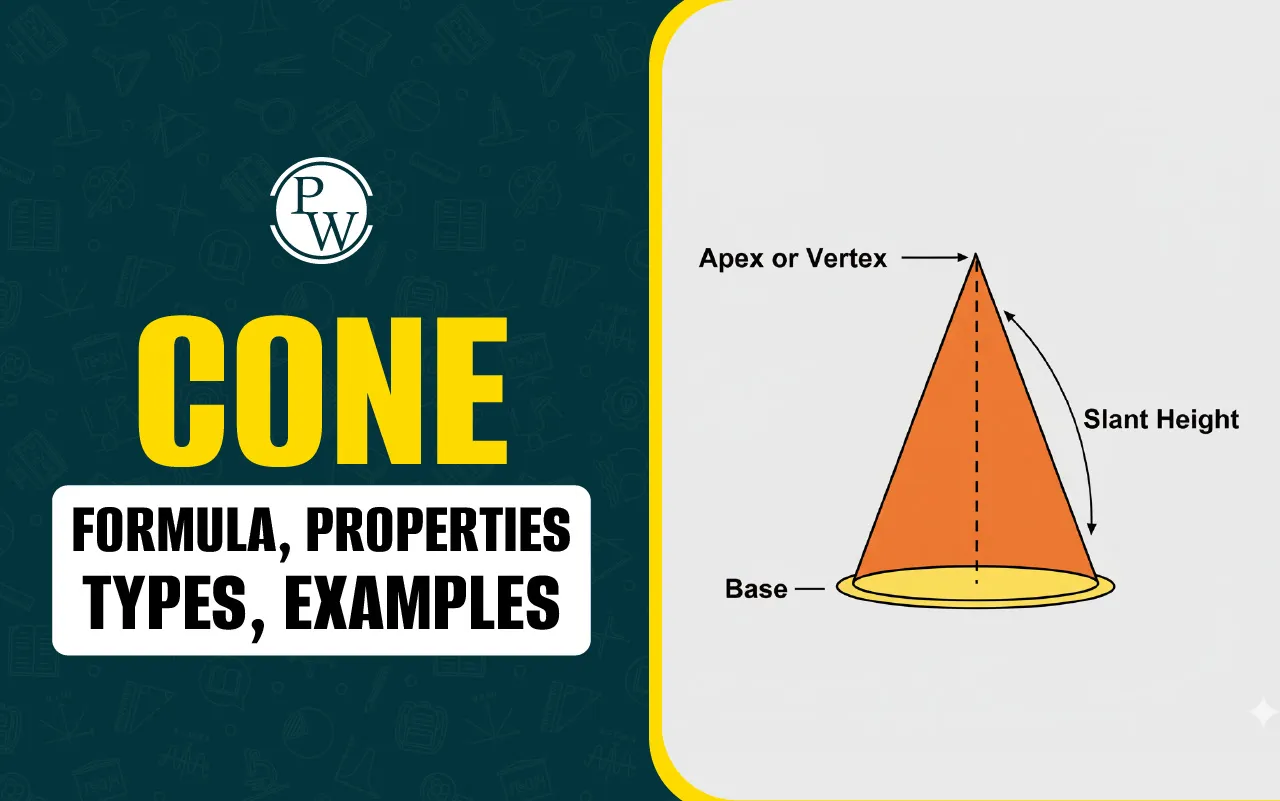
What is a Cone?
Cone is a 3D shape with one circular base and a curved surface that comes to a point called the apex or vertex. The curved surface goes smoothly from the base to the top point. Many objects we use in real life can be cone examples, like an ice cream cone, a traffic cone, or a birthday party hat.
The word “cone” comes from the Greek word “konos,” which means a peak or wedge. The pointed tip of the cone is called the apex, and the flat part is called the base. While learning about cones in maths, we also learn about two types of areas: the curved surface area of the cone and the total surface area of the cone. Understanding the concept of a cone is important for solving different types of questions in maths.
Also read: Transformations
Cone Definition
As per the cone definition in maths, it is a solid shape with a flat circular base and a pointed top called the apex or vertex. It has a curved surface but no edges. A cone is an important shape in geometry and is also used in shaping different real-life objects.
A cone has three main parts: radius, height, and slant height. The radius (r) is the distance from the center of the base to its edge. The height (h) is the straight distance from the apex to the center of the base. The slant height (l) is the distance from the apex to any point on the base’s edge. Using these values, we can find the curved surface area, total surface area, and volume of a cone.
Read More: How to Find the Area of Polygon?
Properties of Cone
As we learned, a cone is a three-dimensional shape with a curved surface and a flat circular base. The main properties of cone, as explained below, make it easy for you to understand the concept and also help with identifying the shape while solving questions:
-
The base of a cone is always circular.
-
A cone has one curved face, one vertex (apex), and no edges.
-
The slant height of a cone is the distance from the apex to any point on the edge of the base.
-
If the apex is directly above the center of the base at a right angle, it is called a right circular cone.
-
If the apex is not directly above the center of the base, it is called an oblique cone.
Cone Formulas
Now that you have understood what a cone is, its definition, and its properties, let's learn about the cone formula. A cone has three important formulas for slant height, surface area, and volume, as explained here.
Cone Formula for Slant Height
The slant height of a cone is the distance from the apex of the cone to any point on the edge of its base. It is like the side length of the cone.
-
The formula for the slant height (l) of a cone is: √(r² + h²)
Here,
-
l = slant height of the cone
-
r = radius of the base
-
h = height of the cone
Curved Surface Area of Cone
The curved surface area of a cone is the area covered by only the curved part of the cone, not including the base. It is like the area of the outside layer of the cone.
-
The formula for the curved surface area of cone is: π × r × l = πrl square units.
Here, π (pi) is a constant, equal to 3.1416 approximately.
We use the curved surface area of cone formula in questions about finding how much space the curved part of the cone covers.
Total Surface Area of Cone
The total surface area of cone is the sum of the area of its flat circular base and the curved surface area. It means we are finding the total area that covers the cone.
-
The formula for the total surface area of cone is: πr² + πrl
The total surface area of cone formula helps in finding the complete surface area, including both the base and the curved part of a cone in maths.
Volume of a Cone
The volume of a cone is the amount of space inside the cone. It tells us how much the cone can hold.
-
The formula for the volume of a cone is: (1/3) × π × r² × h
This means the volume of a cone is one-third of the volume of a cylinder with the same base and height.
Read More: Average Formula in Maths
Types of Cones in Maths
In maths, we generally learn about two types of cones because cones can be shaped differently depending on where the top point (apex) is placed in relation to the base. Here are the two important types of cones:
1. Right Circular Cone: In this cone, the apex or vertex is directly above the center of the base. The height is perpendicular to the base. A common example is an ice cream cone.
2. Oblique Cone: In this cone, the apex is not directly above the center of the base. The height is slanted, not perpendicular to the base.
Read More: Types of Line in Math
Common Real-Life Cone Examples
Cone examples in real life help children connect maths with daily life and understand shapes more easily. Some common cone examples are:
-
Ice cream cone: Used to hold ice cream in a perfect conical shape.
-
Traffic cone: Used to guide vehicles and keep roads safe.
-
Party hat: A fun cone-shaped hat children wear during celebrations.
-
Funnel: Helps pour liquids into narrow containers.
-
Pencil tip: The sharpened end of a pencil forms a cone.
-
Carrot or radish: Some vegetables naturally have a conical shape.
-
Church steeples or temple tops: Many religious buildings have pointed roofs shaped like cones.
-
Tents: Some tents, like army tents, are designed in a conical shape.
-
Pyramids: Though having a square base, pyramids meet at a point and are the same as cones in shape.
Also Read: Fractions
Solved Practice Questions on Cone
Here are some solved cone examples to help you understand how to use cone formulas in actual questions:
Ques. Ananya makes a paper cone for a school project. The radius of the cone is 5 cm and the height is 12 cm. Find the slant height of the cone.
Solution:
Given r = 5 cm, h = 12 cm
Slant height cone formula: l² = r² + h²
l² = 5² + 12²
l² = 25 + 144
l² = 169
l = √169
l = 13 cm
Therefore, the slant height of the cone is 13 cm.
Ques: Rahul has a cone with a radius of 7 cm and a slant height of 15 cm. How can Rahul find the curved surface area of the cone?
Solution:
Formula for curved surface area of cone: π × r × l
Given: r = 7 cm and l = 15 cm
Putting given values in the formula = π × 7 × 15 = 105π cm²
Using π ≈ 3.1416,
Curved surface area = 105 × 3.1416 = 329.87 cm²
Therefore, the curved surface area of the cone is 329.87 cm².
Ques: Priya has a cone with a radius of 6 cm and a slant height of 10 cm. How can Priya find the total surface area of the cone?
Solution:
Formula for total surface area of cone: π × r × (r + l)
Given: r = 6 cm and l = 10 cm
Putting given values in the formula = π × 6 × (6 + 10)
= π × 6 × 16
= 96π cm²
Using π ≈ 3.1416,
Total Surface Area of Cone = 96 × 3.1416 = 301.59 cm²
Also read: Factorial: Meaning, Formula, Values for Numbers 1 to 10
Help Your Child Overcome Doubts With CuriousJr's After-School Online Tuition
Do you see your child often confused while studying at home or leaving homework incomplete? When children have doubts about concepts, it becomes tough for them to learn or solve questions on their own after school hours.
CuriousJr's online tuition classes for maths, science, social studies, and English are curated to solve this problem by giving children the right guidance after school.
-
With organized lessons, personalized attention, and doubt-clearing sessions, your child can study in a way that feels easy and stress-free.
-
These tuition classes include interactive online live sessions, regular homework guidance, and different practice sets made to match your child’s learning pace.
-
Parents also receive regular updates, so you always know how your child is doing and where they need extra support.
So, give your child the learning support they deserve. Book a demo class today and see how CuriousJr's online tuition classes can make after-school studies more fun and effective for your child.