Learn Subtraction without Borrowing (Class 8)
 Nivedita Dar14 May, 2026
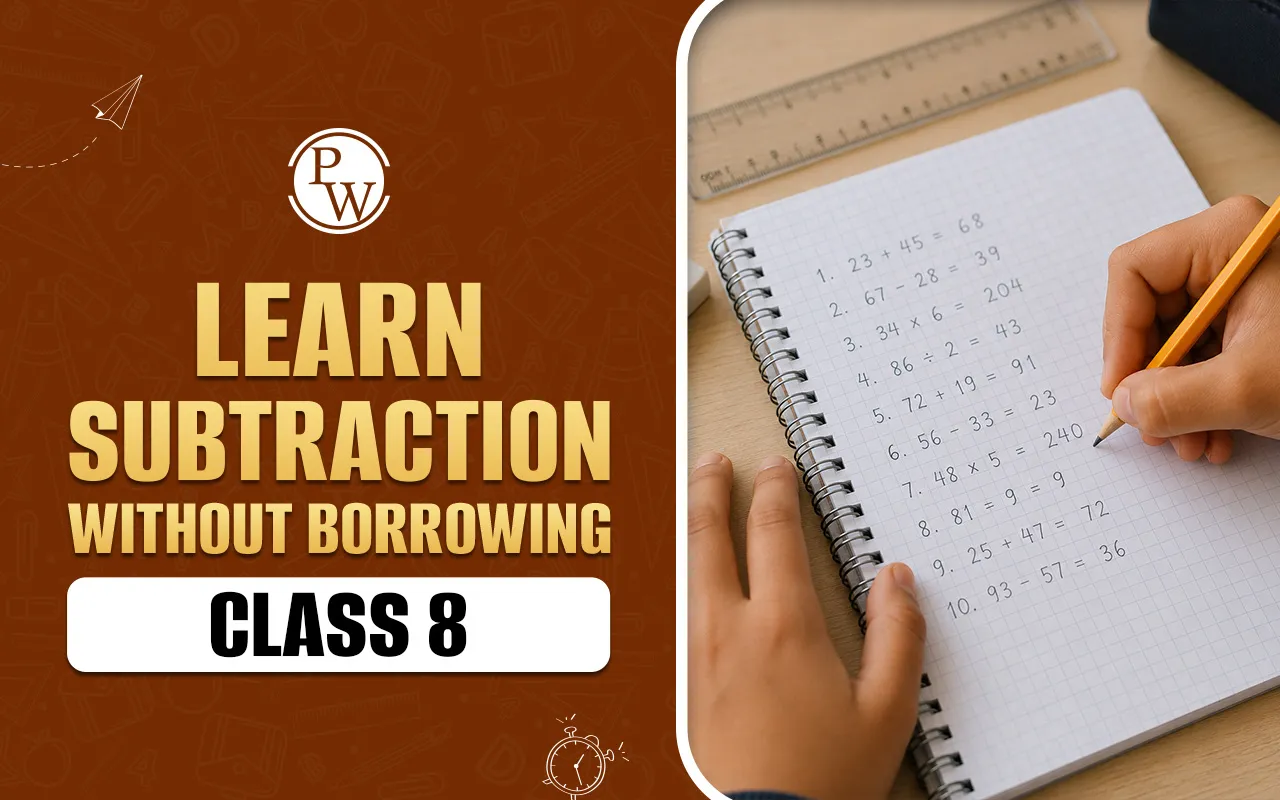
Subtraction is often the first major hurdle students face in middle school mathematics. While addition feels natural, subtraction usually requires "borrowing" or "regrouping," which is where most calculation errors happen. Many Class 8 students struggle with the speed required for competitive exams because they rely on old-fashioned methods. By learning specific subtraction tricks class 8, you can transform the way you look at numbers. Instead of working right-to-left and struggling with carry-overs, these methods allow you to calculate from left-to-right, making maths feel more like a game than a chore.
Why Borrowing Feels Difficult in Subtraction
The way normally taught in primary school is right to left. Mathematically it is correct but not necessarily the most efficient for human brain. This is what makes it challenging for Class 8 students:
-
The Zero Trap: Subtracting from numbers like 1,000 or 10,000 requires multiple steps of borrowing across every single column.
-
Mental Fatigue: Keeping track of "decreased" numbers in your head while performing multiple subtractions is tiring and leads to errors.
-
Right-to-Left Thinking: We read and speak numbers from left to right. Forcing our brains to calculate in the opposite direction feels unnatural during high-pressure exams.
By switching to easy subtraction tricks, you align your calculations with how you naturally process information, making maths feel more like a game and less like a burden.
Easy Subtraction Tricks Class 8
To address these problems we explore mental math subtraction approaches. These strategies focus on "friendly numbers" and logical changes instead than mechanical borrowing.
All from 9 and Last from 10 Trick
This is a famous Vedic subtraction method used specifically for subtracting numbers from powers of 10 (like 100, 1,000, or 10,000).
How it works:
-
Subtract every digit of the number from 9.
-
Subtract the very last digit (on the right) from 10.
Example: 1,000 - 467
-
Step 1: 9 - 4 = 5
-
Step 2: 9 - 6 = 3
-
Step 3 (The last digit): 10 - 7 = 3
-
Result: 533
By using this, you never have to "cross out" zeros again. It is fast, clean, and significantly reduces the chance of making a silly mistake during an exam.
Add to Both Numbers Trick
One of the most effective subtraction tricks involves keeping the difference between two numbers the same by adding the same value to both numbers.
If you have to solve 84 - 38, the "8" in 38 makes it hard.
-
Add 2 to 38 to make it a "friendly" 40.
-
Since you added 2 to the bottom, you must add 2 to the top: 84 + 2 = 86.
-
Now solve: 86 - 40 = 46.
This is much easier to do in your head than borrowing 10 from the 80.
Read More - Why Many Students Face Multiplication Problems in Class 6
Left-to-Right Subtraction Method
Most of us read from left to right, so why do we do maths from right to left? Modern subtraction tricks class 8 encourage calculating from the largest place value first.
Let's try 572 - 258:
-
Hundreds: 500 - 200 = 300.
-
Tens: 70 - 50 = 20. (Current total: 320)
-
Units: 2 - 8 is -6.
-
Final step: 320 - 6 = 314.
This logical flow keeps your brain engaged and prevents the "mental fog" that comes with traditional regrouping.
Using Base and Complements
In Vedic maths, every number has a "complement" relative to 10. For instance, the complement of 7 is 3 (because 7 + 3 = 10). When subtracting, if you see a large number at the bottom, you simply use its complement.
Example: 63 - 28
-
Look at the tens: 6 - 2 = 4.
-
Look at the units: 3 - 8. Instead of borrowing, find the complement of 8, which is 2.
-
Add that 2 to the top digit (3): 3 + 2 = 5.
-
Because we used a complement, we reduce the tens digit by 1.
-
Final Answer: 35.
|
Method Type |
Primary Focus |
Best For |
|
Traditional |
Right-to-left borrowing |
Small, simple digits |
|
Vedic |
Complements and Bases |
Large numbers with many zeros |
|
Mental Adjustment |
Rounding to the nearest 10 |
Quick everyday calculations |
Read More - Why Kids Struggle with Multiplication in Class 7
Benefits of Learning Subtraction Tricks Class 8
Vedic maths subtraction focuses on patterns, number relationships, and mental calculation speed rather than long written steps.
Benefits include:
-
faster calculations
-
fewer borrowing mistakes
-
improved number sense
-
stronger mental maths skills
-
better exam speed
Students gradually become more comfortable solving large sums mentally.
Mental Maths Tips for Faster Subtraction
Speed is the ultimate goal for any Class 8 student. When you are in a timed test, you cannot afford to spend two minutes on a single subtraction problem. Using mental math subtraction allows you to see the answer almost instantly.
-
Start Small: Try it with 2-digit numbers, then 4-digit numbers.
-
Visualisation Use visualisation: Imagine the numbers moving on a number line.
-
Daily Drills: Try these strategies to do 10 subtraction problems every morning for 5 minutes.
Uses of Subtraction Tricks
Maths is not just for textbooks. Whether you are calculating the remaining balance on a gift card or figuring out how much time is left in a sports match, these subtraction tricks come in handy.
The "Subtraction by Addition" Trick:
Instead of taking away, count up. If you buy something for £6.40 and give a £10 note:
-
6.40 to 7.00 is 0.60.
-
7.00 to 10.00 is 3.00.
-
Total change = £3.60.
This "counting up" method is exactly how professional cashiers used to handle money before digital registers, and it remains one of the most reliable ways to avoid errors.
Common Subtraction Mistakes to Avoid
Rushing Through Calculations
Speed improves with practice. Focus on accuracy first.
Forgetting Number Adjustments
When adding or rounding numbers, students sometimes forget to adjust the final answer.
Mixing Place Values
Carefully separate hundreds, tens, and ones during mental calculations.
How CuriousJr Helps Students Learn Subtraction Faster
Developing a strong foundation in calculation is essential for academic success. CuriousJr helps students sharpen their numerical abilities through interactive and engaging learning modules designed specifically for middle school learners. Instead of relying on rote memorization, the platform focuses on logical thinking, speed-building strategies, and practical problem-solving techniques that make subtraction easier to understand.
Class 8 learners may learn advanced subtraction strategies and use them confidently in exams with live interactive sessions, guided practice and personalised mentor help. CuriousJr makes topics such as left-to-right math, subtraction with complements and Vedic subtraction methods easy and student friendly to grasp. The platform also offers consistent doubt clearing, assignment guidance and daily practice tasks to enhance speed and accuracy.
CuriousJr online Mental Maths class combines gamified learning with systematic mental maths training to assist kids gain confidence in mental math subtraction, while making difficult numbers simple and fun.