Order of Adjectives: Definition, Rules, and Examples
 Nikita Aggarwal30 Mar, 2026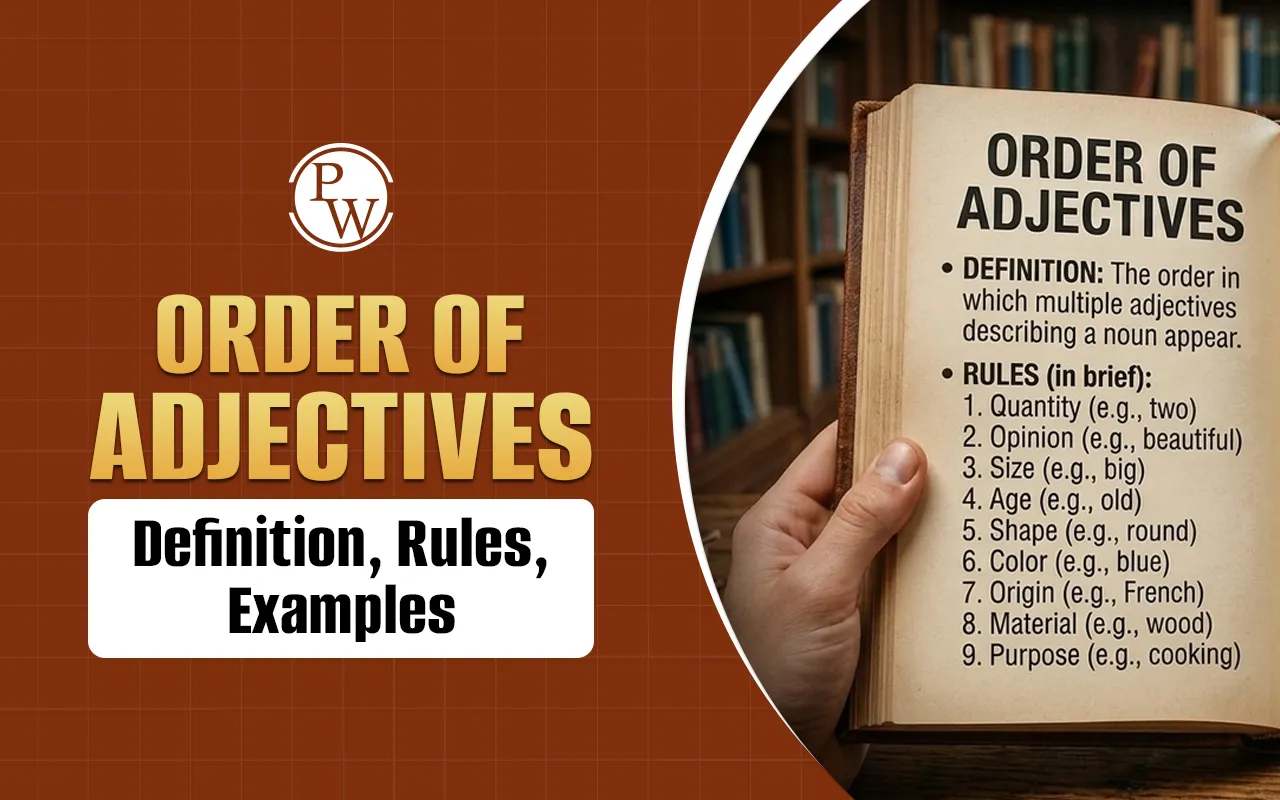
What is Order of Adjectives in English?
It is the standard sequence used when two or more adjectives modify a single noun. While you can technically use as many adjectives as you like, using more than three can make a sentence feel cluttered.
In English, we place adjectives before the noun they describe (attributive adjectives). When multiple words are used, they must follow a specific logical path from the most subjective (your opinion) to the most objective (what the thing actually is).
Order of Adjectives Rules
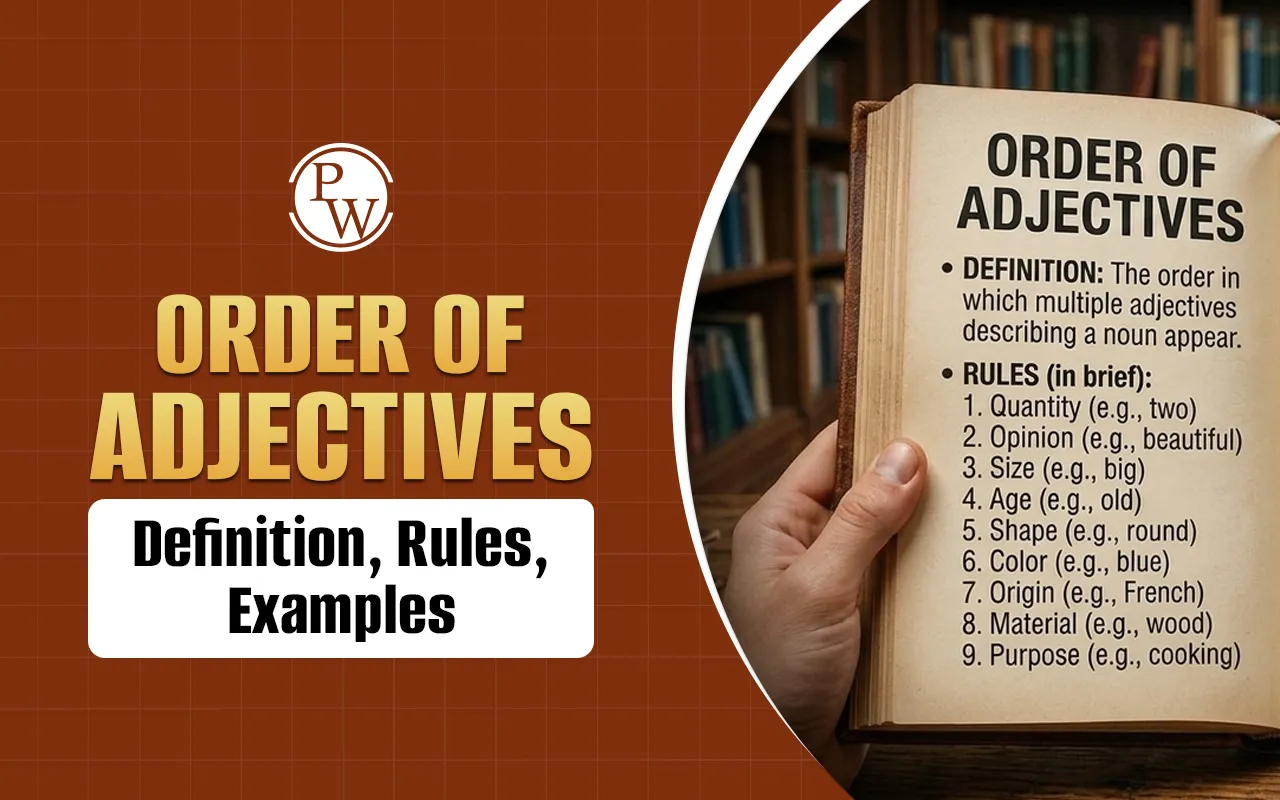
To remember the sequence easily, many students use the acronym OSASCOMP. This covers the eight primary categories of descriptors. Let’s break down the rules step-by-step.
Determiner
Before you even get to the adjectives, you usually start with a determiner. These are words like 'a', 'an', 'the', 'some', 'several', or numbers (one, two).
-
Example: A large house.
Opinion
This is the most subjective part. It describes what you think about something. Others might disagree with your view.
-
Words: Beautiful, ugly, delicious, strange, difficult, wonderful.
Size
Next, you describe how big or small the object is.
-
Words: Huge, tiny, massive, short, tall, little.
Age
This tells us how old the noun is.
-
Words: New, ancient, antique, young, old, teenage.
Shape
Here, you describe the physical form or appearance.
-
Words: Square, round, flat, rectangular, triangular.
Colour
This refers to the hue or shade of the object.
-
Words: Blue, reddish, navy, pitch-black, silver.
Origin
This indicates where the noun comes from. It could be a country, a region, or even a specific era.
-
Words: British, Indian, lunar, southern, French.
Material
This describes what the object is made of.
-
Words: Wooden, silk, plastic, gold, metal, cotton.
Purpose
The final adjective before the noun usually explains what the object is used for. These often end in "-ing."
-
Words: Sleeping (bag), gardening (gloves), frying (pan), running (shoes).
Read More - Proper Adjectives - Definition, Types, Examples
Adjective Order Chart
Using this table will help you visualise the sequence for any examples you might encounter in your studies.
|
Order |
Category |
Examples |
|
1 |
Determiner |
A, The, Five, My |
|
2 |
Opinion |
Lovely, Cool, Boring |
|
3 |
Size |
Big, Miniature, Long |
|
4 |
Age |
Old, Modern, Recent |
|
5 |
Shape |
Circular, Oval, Heart-shaped |
|
6 |
Colour |
Green, White, Crimson |
|
7 |
Origin |
Italian, African, Local |
|
8 |
Material |
Leather, Ceramic, Paper |
|
9 |
Purpose |
Cleaning, Cooking, Writing |
|
Noun |
The Object |
Bag, Table, Student |
Order of Adjectives Examples
Let’s look at how these rules work in real sentences. Seeing the examples in context makes the pattern much easier to recognise.
-
Example 1: She bought a beautiful, small, old, Italian, leather handbag.
-
Breakdown: Opinion (beautiful) + Size (small) + Age (old) + Origin (Italian) + Material (leather).
-
Example 2: I found a huge, round, metal bowl.
-
Breakdown: Size (huge) + Shape (round) + Material (metal).
-
Example 3: They are staying in a wonderful, modern, French villa.
-
Breakdown: Opinion (wonderful) + Age (modern) + Origin (French).
-
Example 4: He wore a stylish, large, black leather jacket.
-
Breakdown: Opinion (stylish) + Size (large) + Colour (black) + Material (leather).
-
Example 5: She adopted a cute, little, brown puppy
-
Breakdown: Opinion (cute) + Size (little) + Colour (brown).
-
Example 6: We visited an amazing, ancient, Egyptian monument.
-
Breakdown: Opinion (amazing) + Age (ancient) + Origin (Egyptian)
-
Example 7: He bought a big, new, red sports car.
-
Breakdown: Size (big) + Age (new) + Colour (red) + Purpose (sports).
-
Example 8: She carried a small, round, wooden box.
-
Breakdown: Size (small) + Shape (round) + Material (wooden).
Notice how shifting the words makes the sentence sound "weird." You wouldn't say "a leather Italian old small beautiful handbag." The OSASCOMP rule keeps the flow predictable.
Cumulative vs. Coordinate Adjectives
It is important to understand the difference between these two types because it affects how you use commas.
Cumulative Adjectives
These are the adjectives we have been discussing. They follow the order and do not need commas between them. Each adjective builds upon the next to define the noun.
-
Correct: A big red bus.
-
Incorrect: A big, red bus.
Coordinate Adjectives
These are adjectives from the same category (e.g., two opinions). You can swap their order, and the sentence still makes sense. These do require commas or the word "and".
-
Example: He is a smart, funny man. (Both are opinions).
Correct vs Incorrect Order of Adjectives
Understanding mistakes helps you learn faster.
-
Correct: A beautiful red dress
Incorrect: A red beautiful dress -
Correct: A small old wooden table
Incorrect: A wooden old small table -
Correct: A lovely big house
Incorrect: A big lovely house
Importance of Order of Adjectives in English
You might wonder why English speakers are so picky about this. It helps the listener process information. By starting with the most subjective details (opinion) and moving toward the most permanent, factual details (material/purpose), you create a clear mental image for the reader.
If you are preparing for exams or looking to improve your creative writing, sticking to the rules will make your work look professional and polished.
How to Practise Using Multiple Adjectives Order
The best way to get used to it is through immersion and practice. Here are a few tips:
-
Describe your room: Pick an object, like your bed or a chair, and try to use four adjectives to describe it using the OSASCOMP rule. (e.g., My comfy, large, new, grey bed)
-
Read aloud: If a sentence feels difficult to say, check if you have mixed up the size and the colour or the material and the origin.
-
Focus on the "Big Three": Most sentences only use two or three adjectives. Focus on mastering the sequence of Opinion, Size, and Colour, as these are the most common.
Read More - Degrees of Adjectives: Positive, Comparative & Superlative
Common Mistakes to Avoid with Order of Adjectives
-
Overusing Adjectives: Just because you know the order doesn't mean you should use eight words to describe a cat. Stick to the most important details.
-
Mixing Material and Purpose: Always put the material (what it's made of) before the purpose (what it does). It’s a "wooden rocking chair", not a "rocking wooden chair".
-
Forgetting the Determiner: Words like "a" or "the" must always come first in the order.
Practice Exercises on Order Of Adjectives
Rearrange the adjectives in the correct order:
-
(wooden / beautiful / old / table)
-
(red / big / balloon)
-
(Italian / leather / stylish / bag)
Answers:
-
A beautiful old wooden table
-
A big red balloon
-
A stylish Italian leather bag
Give Your Child a Global Advantage with CuriousJr’s Cambridge-Certified English Program
Is your child struggling to speak or understand English with confidence in school or daily life? At CuriousJr, we help children aged 6 to 14 build strong English skills through live online english learning classes led by experienced teachers.
Our program is based on international Cambridge standards and is thoughtfully designed for Indian learners. It covers four progressive levels—Pre A1, A1, A2, and B1—where children develop grammar, vocabulary, reading, writing, listening, and speaking skills step by step.
With small class sizes, every child gets the attention and support they need to grow confidently. Our aim is to help children use English comfortably in both academics and everyday communication.
Book a demo session today to see how CuriousJr can support your child’s learning journey.