Number Line : Definition, Types, Examples
 Amit Lingwal19 Jan, 2026
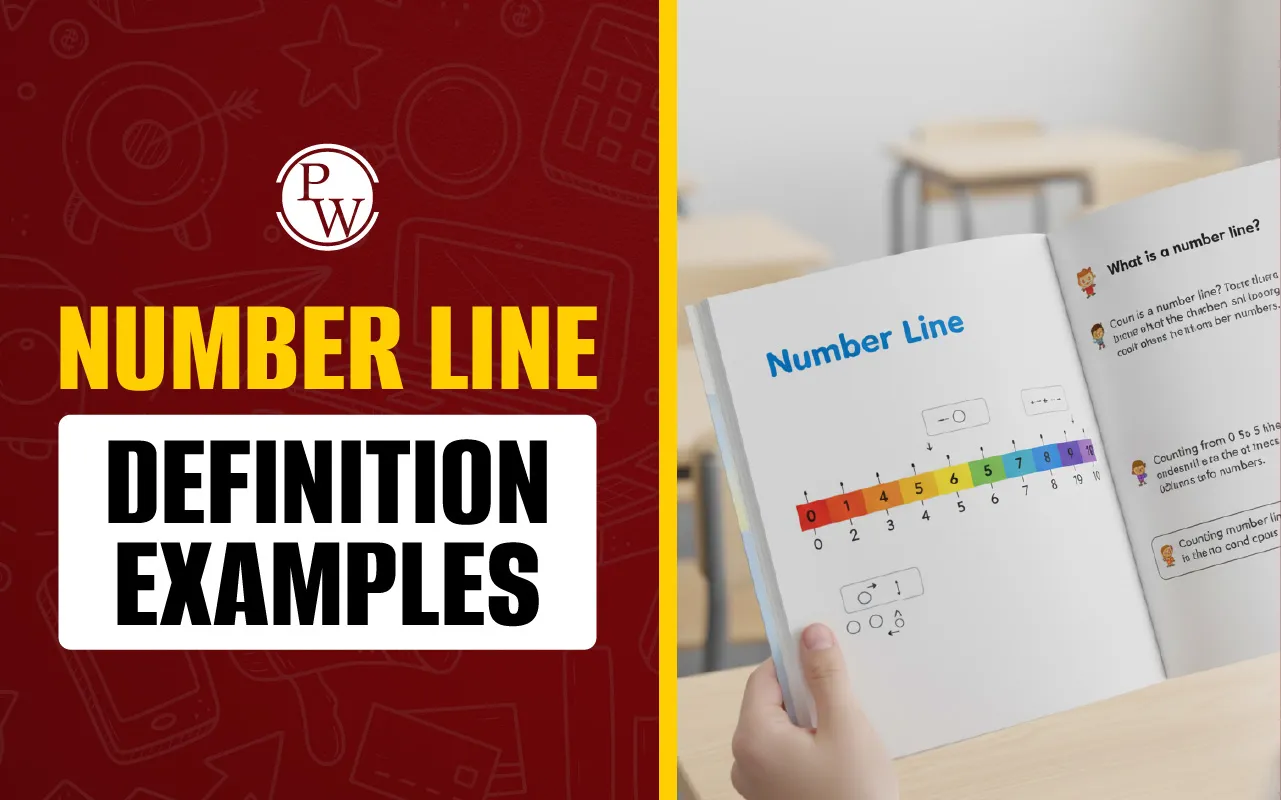
A number line is a method to show numbers in order and understand their value and position. It helps with basic math like counting and addition, and also with more complex ideas such as negative numbers, decimals, and fractions.
For example, using a number line makes it easier to see that –2 is less than 0, or that 0.5 is halfway between 0 and 1.
Number lines are also helpful when comparing money, tracking temperatures, or solving word problems. Here, we will explore how to draw one step by step, the different types of numbers it can show, and a few solved examples to help students understand the concepts be better.
What is a Number Line?
A number line is a straight, horizontal line where numbers are placed at equal intervals. It is used to represent and compare numbers visually. The center point of a number line is usually zero (0).
Numbers to the right of zero are positive, while numbers to the left are negative. This setup helps us understand the position and value of numbers in relation to one another. For example, on a number line, if we have the numbers -4, 0, and 2, we can clearly see their relationship:
-
-4 is to the left of 0, which means it is a negative number and less than zero.
-
0 is the neutral point and is neither positive nor negative.
-
2 lies to the right of 0, which means it is a positive number.
From this, we understand the order: 2 is greater than 0, and 0 is greater than -4.
So, 2 > 0 > -4.
Read more: Brackets in Maths
How to Draw a Number Line?
Here are the steps to help students draw a basic number line accurately:
Step 1: Draw a straight horizontal line: Use a ruler to draw a straight line across your page. Make sure to leave enough space on both ends of the line to add numbers.
Step 2: Mark the center point as zero (0): Find the middle of your line and label it as 0. This is your starting or reference point.
Step 3: Choose equal spacing for each number: Decide how far apart each number will be placed. Keep the spacing the same across the entire line. This helps your number line stay clear and accurate.
Step 4: Add positive numbers to the right: From zero, count and label points to the right as 1, 2, 3, and so on. Keep the spacing equal as you go.
Step 5: Add negative numbers to the left: Go back to zero and label points to the left as -1, -2, -3, and so on. Again, keep the spacing the same.
Step 6: Review number line: Check that numbers are evenly spaced and correctly ordered. Now the number line is complete and ready to use.
Read more: Counting Numbers
Different Types of Number Line
A number line can show many types of numbers, not just whole numbers. Let’s see how each type is placed and used.
Natural Numbers on a Number Line
Natural numbers are the basic counting numbers we begin learning in early math. These include 1, 2, 3, 4, 5, and so on. They go on infinitely and always increase by one at each step.
On the number line, natural numbers are placed at equal intervals to the right of zero.
Example: If you plot the numbers 1, 2, and 3 on a number line, you will see them lined up to the right of 0 in equal spacing.
Whole Numbers on a Number Line
Whole numbers include all natural numbers, but they also include zero. So the set becomes 0, 1, 2, 3, 4, and continues on. On a number line, whole numbers also lie to the right of zero, beginning with 0.
Example: Marking 0, 1, 2, and 3 on the number line shows the whole numbers in order.
Integers on a Number Line
Integers are a larger set that includes positive whole numbers, zero, and negative numbers. Examples include –3, –2, –1, 0, 1, 2, 3, and so on.
Example: On a number line, marking –3, –2, –1, 0, 1, 2, and 3 shows that integers appear on both sides of zero with equal spacing.
Negative and Positive Number Line
A number line that shows both positive and negative values includes numbers on both sides of zero.
-
Positive numbers are placed to the right of 0, such as 1, 2, 3, and 4.
-
Negative numbers are placed to the left of 0, such as –1, –2, and –3.
This layout helps show that –5 is smaller than –2 because it lies further to the left, and that 3 is greater than 0 because it lies further to the right.
Example: To add –2 and 3, start at –2 on the number line and move 3 steps to the right. The result is 1.
Fractions on a Number Line
Fractions show parts of a whole and are placed between whole numbers on a number line. These values are useful for representing measurements and quantities that are not complete numbers.
Example: To place ½ on a number line, divide the space between 0 and 1 into two equal parts. The point in the middle is ½.
Decimals on a Number Line
Decimals show values between whole numbers and are written using a decimal point. They are based on divisions of ten and are often used for accurate measurements.
Example: To place 3.6 on a number line, divide the space between 3 and 4 into ten equal parts. The sixth part from 3 marks 3.6. Another example is 0.25, which is one-fourth of the way between 0 and 1.
Rational Numbers on a Number Line
Rational numbers include all numbers that can be written as a fraction, where the numerator and denominator are both integers and the denominator is not zero. This includes:
-
Integers (for example, 2 can be written as 2⁄1)
-
Fractions (like ¾)
-
Decimals that terminate or repeat (such as 0.5 or 1.666...)
Example: To place -¾ on the number line:
-
Find the space between -1 and 0
-
Divide it into 4 equal parts
-
Move three steps from -1 towards 0
-
Mark the point as -¾
These numbers help describe many real-world situations involving division or measurement.
Irrational Numbers on a Number Line
Irrational numbers are numbers that cannot be written as a fraction. Their decimal form never ends and never repeats. These include famous numbers like √2 and π (pi).
Even though they cannot be precisely marked, they can still be estimated on a number line using their decimal values.
Example: √2 is approximately 1.414, so you can mark a point just a little more than 1.4 and less than 1.5 on the number line. π is approximately 3.14159, so you can locate it a little after 3.14 and before 3.15.
Addition on Number Line
Adding numbers on a number line is a visual way to understand how values combine. When you add a number, you move to the right if the number is positive. If you are adding a negative number, you move to the left.
Addition of Positive Numbers
When two positive numbers are added, the result is always a greater positive number. On a number line, you start at the first number and move to the right by the amount of the second number.
Example: Let’s add 4 and 3.
Start at 4 on the number line. Move 3 steps to the right.
You land on 7. So, 4 + 3 = 7.
Addition of Negative Numbers
When two negative numbers are added, the result is a more negative number. You move left on the number line because both numbers pull you further below zero.
Example: Let’s add -5 and -3.
Start at -5. Move 3 steps to the left. You land on -8.
So, -5 + (-3) = -8.
Addition of Positive and Negative Numbers
If one number is positive and the other is negative, you move right for the positive and left for the negative. The result depends on which number has a larger absolute value.
Example: Let’s add -2 and 6.
Start at -2. Move 6 steps to the right. You land on 4.
So, -2 + 6 = 4.
Read more: Numerator and Denominator
Subtraction on Number Line
Subtraction on a number line means finding the difference between two numbers. In most cases, this involves moving to the left on the number line. You always start at the first number and move back by the second number.
Subtraction of Positive Numbers
When subtracting a smaller number from a larger one, the result is positive. If the first number is smaller, the result is negative.
Example 1: 7 - 2 = 5
Start at 7 and move 2 steps left. You land on 5.
Example 2: 2 - 7 = -5
Start at 2 and move 7 steps to the left. You land on -5.
Subtraction of Negative Numbers
Subtracting a negative number means adding the same positive number instead. On a number line, this is shown by moving to the right, not to the left. The two negative signs turn the operation into addition.
Example: Take the expression 4 − (−3).
Start at 4 on the number line.
Move 3 steps to the right. The result is 7.
So, 4 minus negative 3 equals 7.
This happens because subtracting a negative number is the same as increasing the value. Every time a negative number is subtracted, the total becomes larger.
Also read: Math Quotes
Number Line Examples
Example 1: Compare –12 and 6 using a number line
Solution: Locate –12 and 6 on the number line.
–12 is to the left of 6, which means it is smaller.
So, –12 < 6
Example 2: Add – 4 and 9 using a number line
Solution: Start at – 4 on the number line.
Move 9 steps to the right because we are adding a positive number.
The landing point is 5.
So, –4 + 9 = 5
Example 3: Subtract 3 – 7 using a number line
Solution: Start at 3 on the number line.
Move 7 steps to the left because we are subtracting a positive number. The landing point is –4.
So, 3 – 7 = –4
Make Your Child a Math Expert with CuriousJr’s Mental Maths Course
Give your child the confidence to solve maths quickly and accurately with CuriousJr Mental Maths Online Classes. These classes turn screen time into skill time through engaging practice, simple tricks, and fun activities that make learning enjoyable.
CuriousJr Mental Maths Classes help children strengthen calculation skills, improve accuracy, and build confidence step by step. With live sessions, dedicated mentors, regular practice, and progress tracking, every child receives the right support to grow at their own pace.
Parents stay connected through updates, while rewards and encouragement keep children motivated and excited to learn. Book a demo class today