
Direct and Inverse Proportion Simplified for Faster Solving (Class 7)
 Nikita Aggarwal29 May, 2026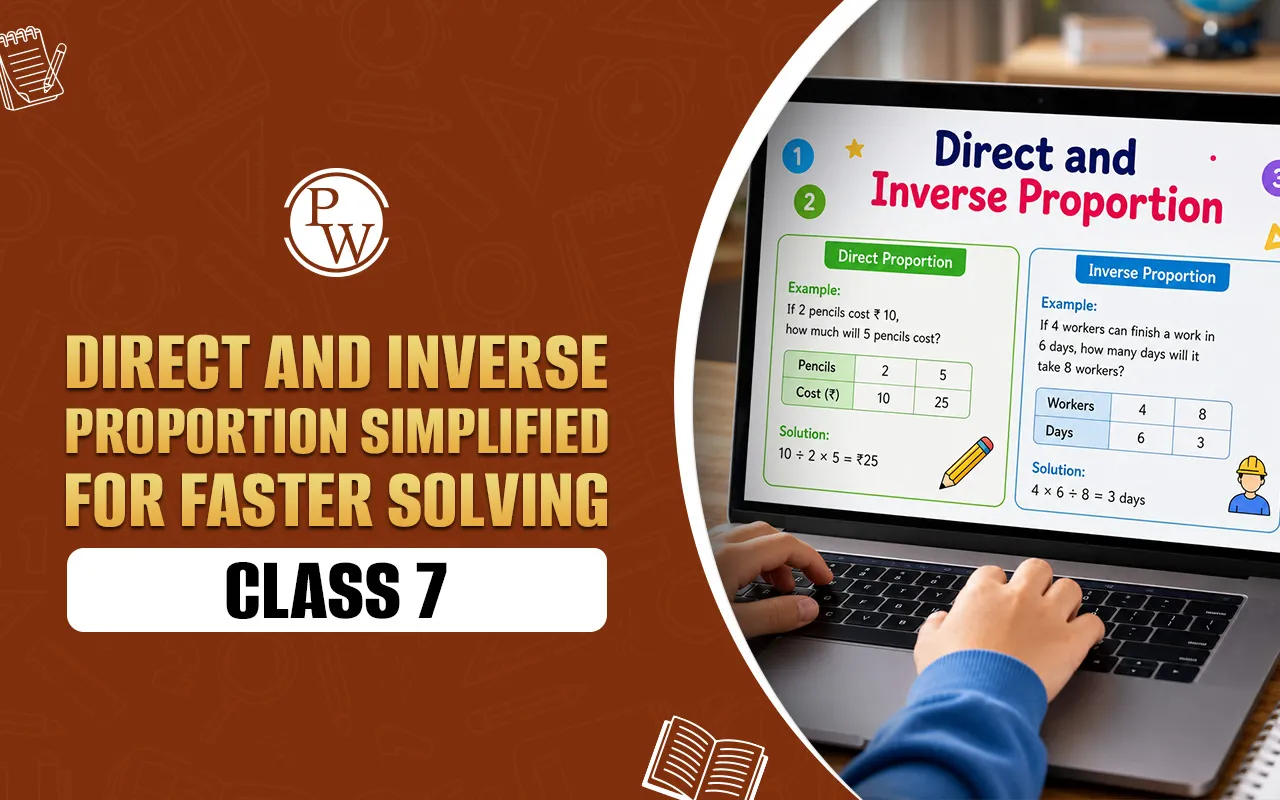
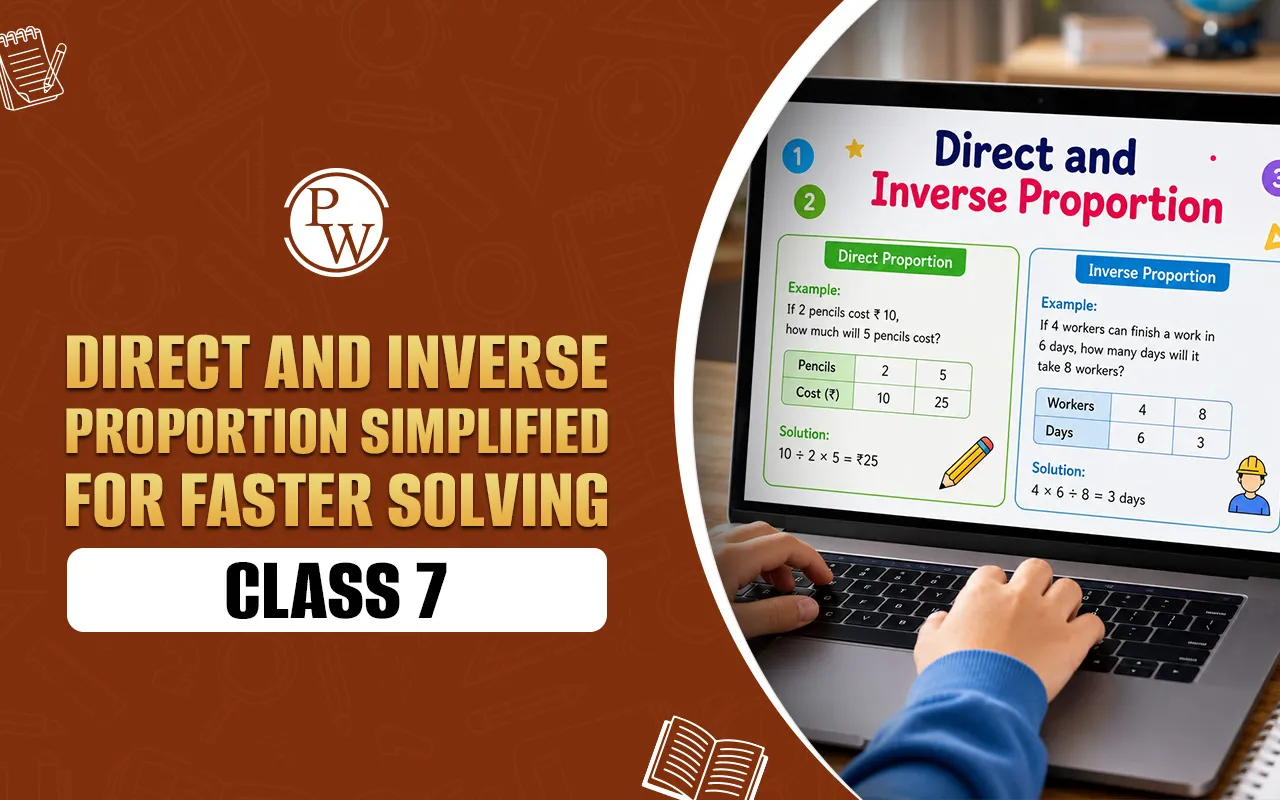
Direct and Indirect Proportion Overview
Direct Proportion
Direct proportion means that two things are changing at the same rate. One value goes up, and the other value goes up. If the first value is down, the second value is down too.
Characteristics of Direct Variation
Both values go in the same direction (up-up or down-down).
The ratio of the two variables is constant.
If one variable goes to zero, the other variable also goes to zero.
Shopping is a prime example of everyday life. The more pens you buy, the more you pay. The total cost decreases if you buy less pens.
Formula Check: Two quantities x and y are directly proportional if x / y = k (k is a constant) Which means for two different situations your equation is:
x_1 / y_1 = x_2 / y_2
Inverse Proportion
A direct inverse relationship works in the exact opposite direction. In inverse proportion, if one quantity increases, the other quantity decreases by the same amount.
Important Characteristics of Inverse Variation
Variables move in opposite directions (up-down or down-up)
The product of the two variables is always constant.
If one variable is doubled, the other variable is halved.
Let’s take a look at a real-life travel scenario. If you go faster on your bicycle you take less time to get to your school. The slower you go, the longer it takes.
Formula Check: If two quantities x and y are in inverse proportion then x times y = k (where k is a constant). If you want to compare two situation the equation become:
x_1 \cdot y_1 = x_2 \cdot y_2
Direct and Inverse Proportion Comparison
This summary table will help you differentiate between the two relationships in a jiffy, to help your mental maths class 7 practise.
|
Feature |
Direct Proportion |
Inverse Proportion |
|
Movement Direction |
Same direction (Both increase or decrease) |
Opposite direction (One increases, one decreases) |
|
Mathematical Relation |
Ratio is constant (x / y = k) |
Product is constant (x \times y = k) |
|
Core Equation |
x_1 / y_1 = x_2 / y_2 |
x_1 \times y_1 = x_2 \times y_2 |
|
Real-life Example |
More items bought = Higher total cost |
More workers hired = Fewer days to finish a task |
|
Graph Shape |
Straight line passing through the origin |
Curved line (rectangular hyperbola) |
Read More - Syllogisms Mental Maths Tricks for Class 7
Direct and Inverse Proportion Tricks for Direct Variation Questions
Writing long unitary steps in traditional methods wastes valuable exam time. Instead , you can use fast solving methods to get the answer immediately .
The Cross-Multiplication Trick
If you have a direct proportion, just set out your terms in a grid and cross-multiply to get your unknown variable by itself.
Example 1: A car consumes 6 litres of petrol for a distance of 90 km. 150 km how much petrol needed?
Step 1: Find the relationship. Less petrol = less distance . More petrol = more distance . This is a straight-line variation.
Step 2: Create your columns.
Petrol (x_1) = 6 litres \to Distance (y_1) = 90km
Petrol (x_2) = ? Distance (y_2) = 150 kilometres
Step 3: Apply the formula x_1/y_1 = x_2/y_2 6/90=x_2/150
Step 4: Multiply crosswise to get x_2 x_2 = (6 \times 150) / 90x_2 = 900 / 90 = 10 litres
Scaling Factor Method
Look for multiplicative relationships between numbers to solve equations in your head.
Example 2: 5 identical notebooks cost 20 Rupees. How much do 25 notebooks cost?
Note the relation between the quantities: 1/5 \times 25 = 5, so 5 notebooks is precisely 1/5 of 25 notebooks.
Scale the cost up by the same factor: 20 \text{ Rupees} \times 5 = 100 \text{ Rupees}.
Direct and Inverse Proportion Tricks for Inverse Variation Questions
Cross multiplication does not work here. Inverse problems often trick students. You want a dedicated shortcut for inverse equations.
The Horizontal Product Quick Path
Since the product of variables is always constant in an inverse relationship, multiply across your rows instead of diagonally.
Example 1: If 6 workers can complete a wall painting in 4 days, how many days will it take 8 workers to complete the same wall painting?
Step 1: Find the variation. More workers will get the job done faster (in fewer days). This is an inverse proportion.
Step 2: Sort your rows.
Situation 1: Workers (x_1) 6 Days (y_1) 4
Situation 2: Workers x_2=8, Days y_2=?
Step 3: Apply the constant product rule x_1 \times y_1 = x_2 \times y_2.6 × 4 = 8 \times y_2 24 = 8 \times y_2
Step 4: Divide to find the missing value. y_2 = 24/8=3 \text{ days}
Method of Inverse Ratio
When the number of workers or machines is scaled by some factor, the time taken is scaled by the inverted flipped factor.
Example 2: 4 uniform taps fill a water tank in 12 hours. What if you increase the number of active taps to 8? How long will it take?
Double the number of taps. ( 4 \times 2 = 8 ) .
Reverse the operation for time: original hours over 2.
12 \text{ hours} / 2 = 6 \text{ hours} New time
Real World Word Problems Solved in a Jiffy
Let us mix these direct and inverse proportion tricks to solve mixed practice problems easily.
Case 1. Space Occupied by Objects (Direct)
If 2 boxes of cardboard occupy 500 cm^3 of space what is the volume of space occupied by 200 boxes of the same size?
Analysis: More boxes will obviously require more space for storage. This is a direct variation .
Setup:
2 / 500 = 200 / x
Execution:
2 \times x = 200 \times 500 2x = 100,000 x = 50,000 \text{ cubic centimetres}
Case 2: Food and Men (Inverse) Provisions
A school hostel has sufficient food for 35 students for 8 days. If 20 students are left back during the holidays, in how many days will the same provisions last?
Analysis: The food will last longer since there are fewer students eating it. This is an inverse relationship.
Set Up:
35 \times 8 = 20 \times y Execution: 280 = 20y y = 280 / 20 = 14 \text{ days}
Read More - Binary Logic Mental Maths Tricks for Class 7
Direct and Inverse Proportion Formulas Summary
For your quick homework revisions and mental maths drill sessions, remember these two basic equations:
Equation of direct variation:
x1/y1 = x2/y2
Equation for Inverse Variation:
x_1 y_1 = x_2 y_2
How CuriousJr Helps Students Learn Direct and Inverse Proportions Faster
Building strong proportion-solving skills becomes much easier when students practise through interactive activities instead of memorising formulas. Many Class 7 students struggle with ratio and proportion chapters because they often confuse direct and inverse relationships during exams.
CuriousJr online mental maths class helps students improve direct and inverse proportion tricks through engaging mental maths exercises, logical reasoning activities, and practical problem-solving sessions. The platform focuses on calculation speed, ratio concepts, algebra basics, percentages, and quick-solving strategies that make maths easier and more enjoyable for students.
Through fun online practice sessions, live guidance, interactive quizzes, and regular doubt support, students gradually improve mental calculation speed, logical thinking, and exam confidence. CuriousJr also uses small-batch learning and step-by-step teaching methods to help students build strong maths foundations for higher classes.




Direct and Inverse Proportion Simplified for Faster Solving (Class 7) FAQs
How do I quickly spot direct and inverse proportions in word problems?
What is the constant of proportionality in proportion concepts maths called?
Is cross multiplication possible for inverse relationships?
What are some common real life examples of direct inverse relationships?
Why do my answers go wrong in math tricks for time and work Class 7?




Get Free Counselling Today
and Clear up all your Doubts
 Live & recorded classes available at easeDashboard for progress trackingLakhs of practice questions

