Compound Interest Problems Made Easy With Steps (Class 8)
 Nikita Aggarwal29 May, 2026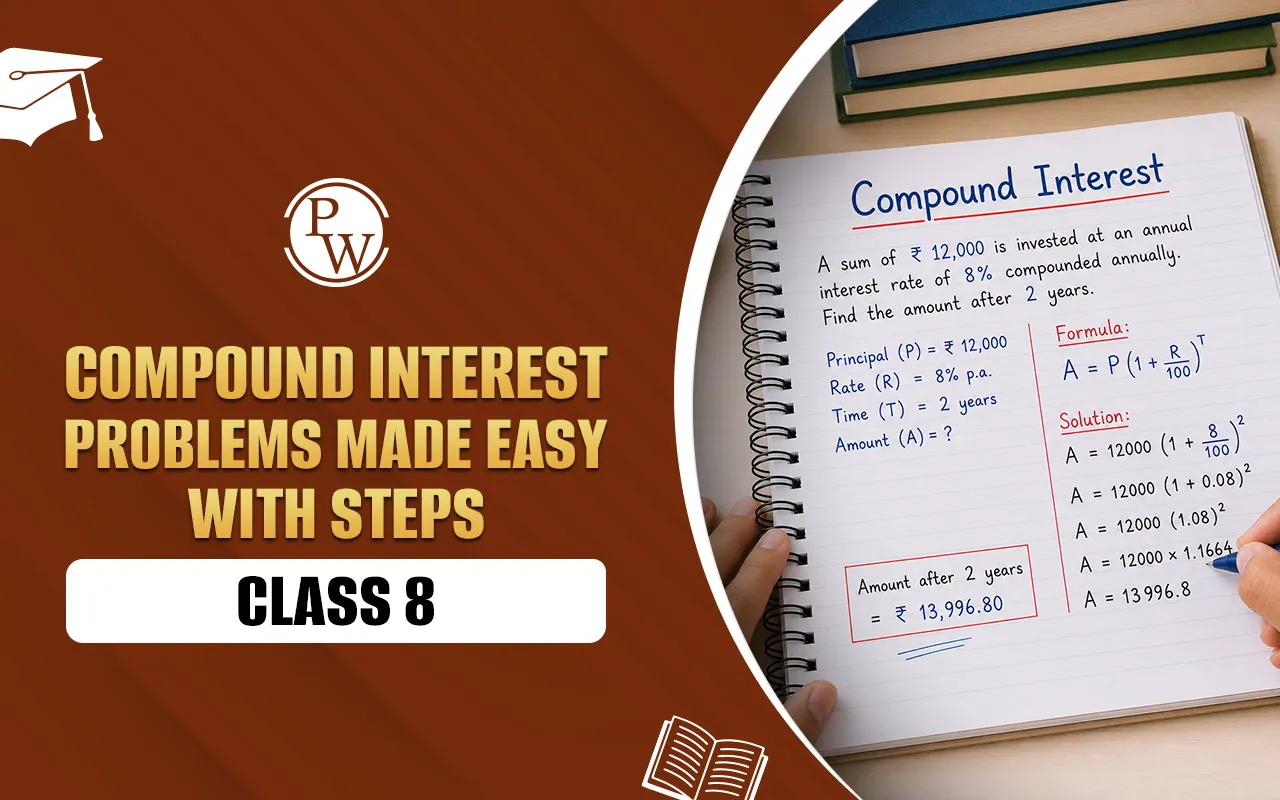
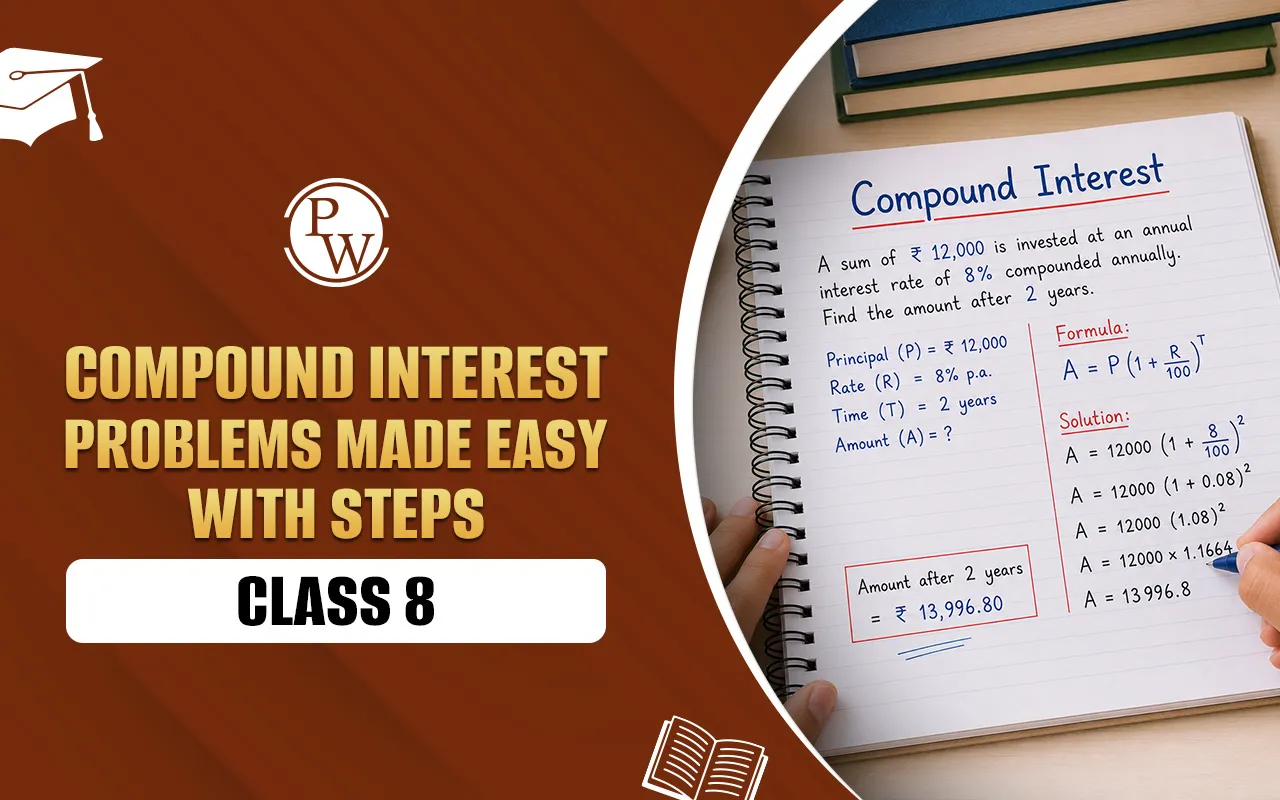
What is Compound Interest ?
Before we get into the shortcut shortcuts, you need to understand how compound interest (CI) works. Interest is only paid on the original principal with simple interest. Compound interest is different in that it is interest calculated on the original principal plus interest accumulated in previous periods.
Think of it as “interest on interest.” This is the cumulative building that is the reason why money grows so much faster in a compound system than a simple system.
Basic Formulas For Compound Interest
First you need to know the standard compound interest formulas to make good use of shortcuts. The standard mathematical equation to calculate the total accumulated amount is:
A = P (1 + r/100)^n
From this final amount, the actual interest earned can be calculated using the following step:
Compound Interest (CI) = Amount (A) – Principal (P)
Here is what each letter stands for in these equations:
P = Principal (the original sum of money borrowed/invested)
r = Annual interest rate (as a percentage)
n = number of years money is borrowed or invested
Simple Interest vs Compound Interest: Main Differences Features
Simple Interest (SI)
Compound Interest (CI)
Main basis
Stays the same every year.
Changes every year . Adds previous interest .
Interest Returns Linear, slow growth.
High, exponential growth.
Used formulae
SI = P * r * t / 100
A = P * ( 1 + r/100 )^n
Compound Interest Problem Tricks
In competitive exams or classroom tests, while calculating interest steps, using the full calculation power of exponents can save a massive amount of time. Instead, use these direct methods.
1. The Successive Percentage Method (Best for 2 Year)
If you want to work out compound interest for exactly two years, don't multiply the formula out twice. Rather use this quick formula to work out the effective net percentage rate:
Net Effective Rate = x + y + (x * y) / 100
replacing both x and y with your given rate (r) since the interest rate is the same for both years
Effective Rate for 2 years = 2r + r^2/100
Say you have a rate of 10% a year. Then your effective interest rate over two years is:
2(10) + (10^2)/100 = 20 + 1 = 21%
Now , just calculate 21 % of your principal amount to get your total interest .
2. Ratio Method for Quick Calculations
The ratio method does not require calculation of long exponentials. Learn these ratios of specific structures for common time horizons:
2 Years Time Period 2 : 1 3 Years Time Period 3 : 3 : 1
How to use the Ratio Trick step-by-step:
Find the percentage rate of the original Principal. ( Set the value to X )
Find the same percentage rate of your new value , X . (Let this be value Y)
If you calculate for 3 years you can find the same percentage rate of Y value. (set value Z)
Multiply the step values you found by the position in the ratio line. Add them.
Read More - Ranking and Ordering Mental Maths Tricks for Class 8
3. The Tree Diagram Trick
If you have a complex question and want to see exactly the difference between simple and compound values at any point, a tree diagram is the best way to go.
Year 1: Compute the basic interest on Principal (Value A).
Year 2: Deliver Value A again on the principal and calculate the interest rate on the Value A of the previous year (Value B).
This visual layout makes numbers small and easy to handle without large sets of formulas.
Compound Interest Problems Tricks With Examples
Let us test our tricks of CI calculation on standard questions in school books and test papers.
Problem 1: Horizon of Two Years
Question: A student invests a principal sum of £10,000 at a compound interest rate of 5% p.a. for 2 years. Compute total interest earned.
Step 1: Apply the successive percentage trick: 2r + (r^2)/100
Step 2: Add the 5% rate: 2(5) + (5^2)/100 = 10 + 0.25 = 10.25%
Step 3: Calculate 10.25% of £10,000 principal:
Interest = 10,000 * 10.25/100 = £1,025
Problem 2: Three-year time horizon with ratio method
Calculate the compound interest on £8,000 for 3 years at 10% per annum, compounding annually.
Step 1: Remember the structure of 3 year ratio formula 3:3:1
Step 2: Work out 10% of £8,000 = 800 (This is our first value)
Step 3: 10% of 800 = 80 (This is our second value)
Step 4: 10% of 80 = 8 (This is our third value)
Step 5: Multiply across the ratio positions:
3 * 800 = 2,400
3 * 80 = 240
1 * 8 = 8
Step 6: Sum the products: 2,400 + 240 + 8 = £2,648
Read More - Logical Deductions Mental Maths Tricks for Class 8
Compound Interest Problems Tricks for Competitive Exams
Questions on interest compounded semi-annually or quarterly are frequently asked in banking exams. Make these changes of strategy to keep computations efficient.
Compounding Semi-Annually (Half Yearly)
If the interest is compounded semi-annually, change your variables before applying any formulas:
New Rate (r') = The annual rate given / 2
New Time periods (n’) = Years given x 2
Quarterly compounding
Change your variables for quarterly compounding:
New Rate (r') = Given Annual Rate / 4
New Time periods (n') = 4 x (given years)
Mental Maths Compound Interest Problems Tricks for Class 8
Get quicker with simple numbers and you'll automatically find class 7 and class 8 mental maths techniques simpler.
Percentage Fractions Explained Be aware that 10% is 1/10, 20% is 1/5, and 25% is 1/4. Turning percentages into fractions makes multiplying simple and instant.
Memorise Perfect Squares: Memorise the squares of numbers 1 to 30. This makes the processing of the (1+r/100)^2 part of the formulas faster.
Memorise Perfect Cubes: Memorise perfect cube values of numbers from 1 to 15 to help you clear 3 year problems quickly.
Apply Split Method: 1. For example, to find 15% of a number mentally. First find 10%, then cut that value in half to get 5%, then add the two parts together.
Round Off Values Roughly : For multiple choice questions, round the values to get an approximate close answer and save time on the exact decimal work.
Learn Compound Interest Problems Tricks With CuriousJr
Building strong percentage calculation and mental maths skills becomes much easier when students practice through interactive learning instead of memorising lengthy formulas. Many Class 8 students struggle with interest-based calculations because repeated percentage conversions and multi-step multiplication feel confusing during exams.
CuriousJr Mental Maths Class 8 helps students improve compound interest problems tricks through engaging activities, shortcut methods, and practical problem-solving exercises. The platform focuses on mental maths speed, percentage calculations, algebra basics, logical reasoning, and fast calculation techniques that make Class 8 maths easier and more enjoyable. Students also get regular practice sessions, interactive quizzes, and guided learning support that gradually improve accuracy, confidence, and exam performance.





Compound Interest Problems Made Easy With Steps (Class 8) FAQs
Tips for compound interest problems for 2 years?
What are the compound interest formulae half yearly compounded?
Can I use CI calculation tricks in my school exams?

Get Free Counselling Today
and Clear up all your Doubts
 Live & recorded classes available at easeDashboard for progress trackingLakhs of practice questions