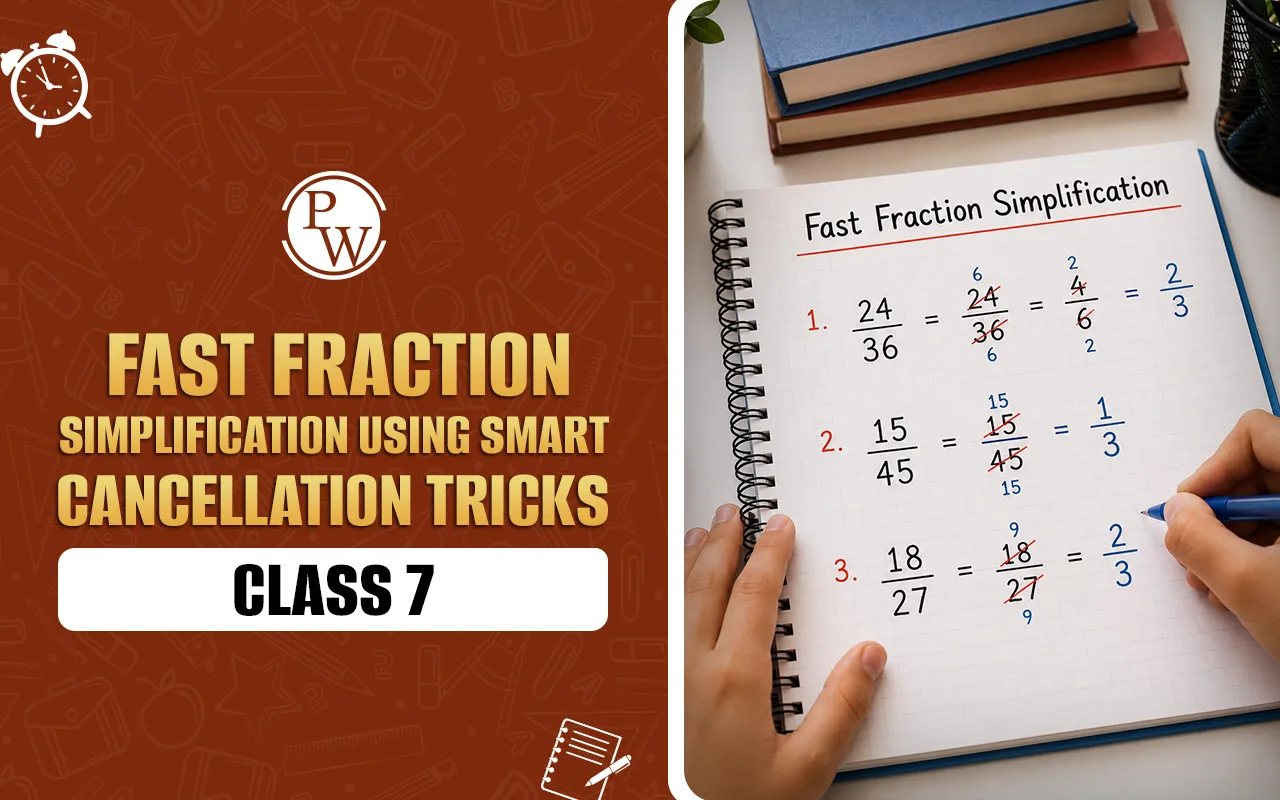
Fast Fraction Simplification Using Smart Cancellation Tricks (Class 7)
 Nikita Aggarwal29 May, 2026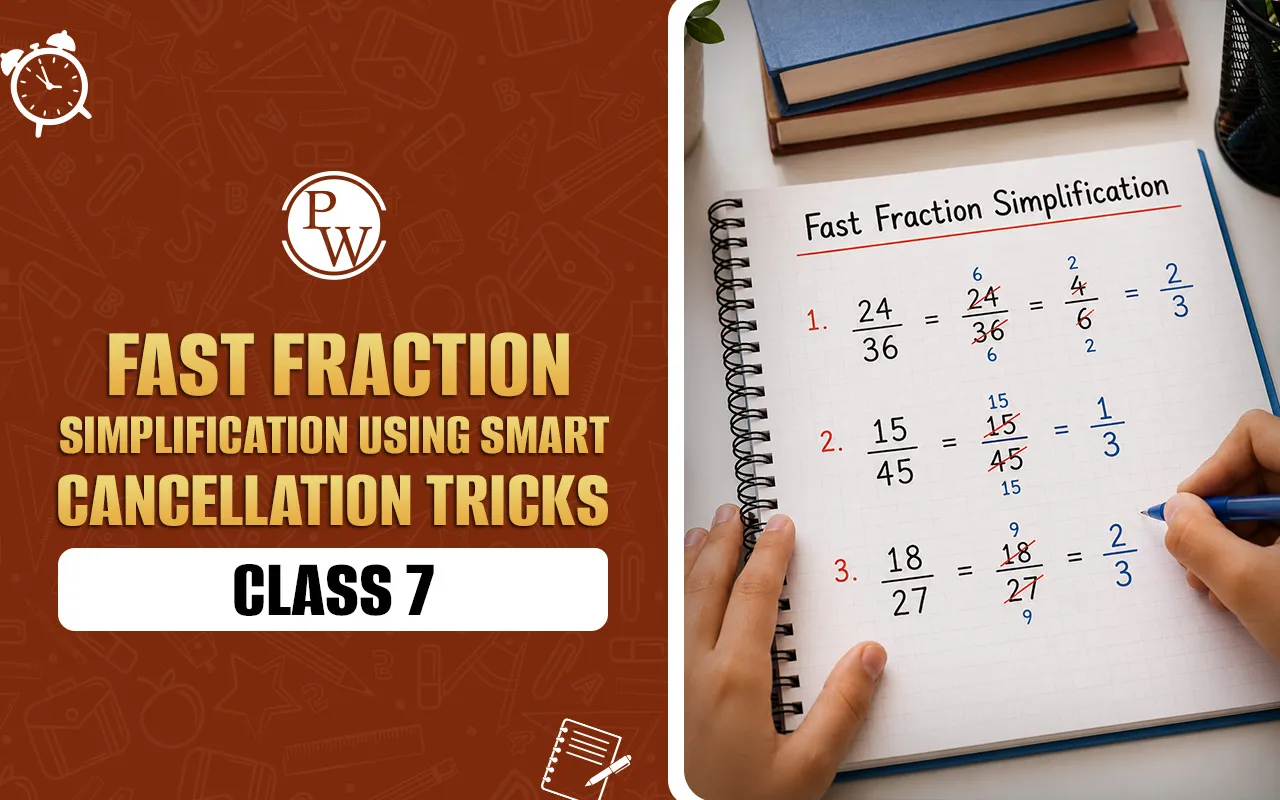
Fraction Simplification Tricks to Understand Numerators and Denominators
Before we get into the quick tricks, you need to understand what is really going on when you simplify a fraction. A fraction is a part of a whole . It has a numerator and a denominator . Simplifying means you change these numbers to the smallest whole numbers , but the overall value stays exactly the same .
The Top and Bottom Numbers
To quickly reduce fractions, you need to look at how the top and bottom values relate to each other.
Numerator: The number on the top that shows you how many parts you have.
The Denominator: The bottom number that shows how many equal parts there are.
When you do numerator denominator tricks your main goal is to find a number that will divide into both evenly. You divide both parts by the same number. The value of the fraction doesn’t change, but it’s much easier to read and work with in future sums.
Fraction Simplification Tricks Using the Cancellation Method
To simplify a fraction you find the Highest Common Factor of both numbers and divide them by it . This is good for small numbers . But for large numbers , it takes too long to find the HCF in an exam .
Cancellation method math pathway is a great alternative. Instead of trying to find the biggest factor first, you eliminate common factors in tiny, lightning-quick steps. Imagine it as knocking down a giant wall one brick at a time instead of trying to take it all in one go.
It breaks down big scary numbers into smaller bits you can deal with.
It stops you from making big division mistakes.
It lets you work across several fractions when you multiply or divide.
It is best for mental maths class 7 routine.
Read More - Syllogisms Mental Maths Tricks for Class 7
Fraction Simplification Tricks Using Divisibility Rules
To use cancellation tricks successfully you need to be able to see which numbers divide into each other without doing the long division. Learn a few simple rules for divisibility and you'll be very quick.
Rule for 2 (Even numbers)
If the last digit of a number is 0, 2, 4, 6, or 8, you can divide the whole number by 2. This is the trick easiest to spot at once.
The Rule for 3 (Sum of the Digits)
Sum all the single digits of the number. The sum of the digits of this number is divisible by 3, then the number itself is divisible by 3. For example, let us take the number 162 , then 1 + 6 + 2 = 9 . 162 is divisible by 3 since 9 is divisible by 3.
Rule for 5 (Ends in 0 or 5)
If a number ends with a 5 or a 0, you know it is a multiple of 5. This rule helps you cancel big values in seconds.
Rule for 10 (Ending in Zero)
If both the numerator and denominator end in 0s you can cancel those 0s out immediately. This is the same as dividing both numbers by 10.
Fraction Simplification Tricks with Examples
Now let us see how to solve actual problems using these rules for fast fraction solving. Clear down fractions without breaking a sweat with these steps.
The Trick of Consecutive Devision
When you have a large even number, don't look for the biggest factor. Just keep dividing by two or three until you can't anymore.
Example 1: Reduce 48 72
Step 1: Check the last digits. 48 and 72 are both even so divide both of those by 2.
2 into 48 is 24.
72 divided by 2 is 36 .
Your fraction is 24/36 now.
Step 2: The 24 and the 36 are still even. Again, divide by 2.
24 divided by 2 equals 12.
36/2=18
Now your fraction is 12 over 18.
Step 3: Divide by two again.
12/2=6
18 / 2 = 9
Your fraction is now 6/9 .
Step 4: Both 6 and 9 are multiples of 3, yet neither is an even number. Divide them by 3. 6 divided by 3 is 2. 9 divided by 3 is 3. Final Answer: 2/3.
The Zero-Scraping Shortcut
This is the final time-saver for large numbers ending in zeros.
Example 2: Reduce 300/5000
Step 1: Count how many zeros are at the end of the top number. It has two roots.
Step 2: Cross out the same amount of zeros from the bottom number.
Step 3: Retype the rest of the numbers. 300 loses two zeros to become 3. 5000 loses two zeros and is 50.
Answer: 3/50.
Read More - Binary Logic Mental Maths Tricks for Class 7
Fraction Simplification Tricks for Multiplying Fractions
The power of the cancellation method increases when you multiply two or more fractions together . You don't have to multiply the tops together and the bottoms together to make a giant fraction, you can cancel numbers diagonally.
How Diagonal Cancellation Is Done
When multiplying fractions, you can cancel any top number with any bottom number even if they’re not in the same fraction. Then your numbers are incredibly small and easy to handle.
Visualising diagonal cancellation
Let us look at a standard multi-fraction problem that usually frustrates students.
Example: Solve (15/4) multiplied by (16/45)
-
Traditional Method: Multiply 15 by 16 to get 240, then multiply 4 by 45 to get 180. Then try to simplify 240/180. This requires massive multiplication and long division.
-
Smart Cancellation Method: Look at the numbers diagonally. Look at 15 and 45, then look at 16 and 4.
|
Step Number |
Action Taken |
Resulting Numbers |
|
Step 1 |
Match 15 on top with 45 on the bottom. Both divide by 15. |
15 becomes 1, and 45 becomes 3. |
|
Step 2 |
Match 16 on top with 4 on the bottom. Both divide by 4. |
16 becomes 4, and 4 becomes 1. |
|
Step 3 |
Rewrite the new, smaller fractions. |
(1/1) multiplied by (4/3) |
|
Step 4 |
Multiply the remaining numbers straight across. |
1 multiplied by 4 is 4; 1 multiplied by 3 is 3. |
Fraction Simplification Tricks Practice Problems for Class 7
Practice these tricks for simplifying fractions with a couple of different situations so you can use them fluidly during your next school quiz.
Problem 1: Working with the 3s Rule
Question: Reduce 81/108 to lowest terms.
Analysis: Neither of these numbers are even so we cannot divide by 2. Let's check the rule for 3.
For the top : 8 + 1 = 9 ( Divisible by 3 )
Bottom: 1 + 0 + 8 = 9 (Divisible by 3)
Execution Divide the numbers by 3.
81 divided by 3 gives 27.
36 = 3 108 ÷
Now we have our fraction 27/36.
Next Step 27 and 36 are both in the 9 times table. To speed things up, let's divide by 9 right away.
27 divided by 9 is 3. 36 divided by 9 is 4.
Final Answer: 3/4
Problem 2: Big Numbers Ending With 5 and 0
Reduce 125/250 to the lowest terms
Analysis: The top number ends in 5. The bottom number ends in 0. So they are both divisible by 5.
Then divide by 5.
125 divided by 5 equals 25.
250 ÷ 5 = 50
Our ratio now is 25/50.
Next Step: It is easy to see that 25 goes into 50 exactly 2 times. Divide both sides by 25.
25/25=1.
50 / 25 = 2.
Answer: 1/2.
Fraction Simplification Tricks Checklist for Exams
To avoid silly mistakes when using these class 7 shortcuts, whenever you encounter a fraction problem, have this quick mental checklist ready:
Look for Zeros: Can I immediately cancel zeros from the top and bottom?
Check for Evenness: Are both numbers even? If yes, then start cutting them in half.
Check the Sum. Is the sum of the digits divisible by 3?
Look Diagonal: If it is a multiplication problem can I cancel numbers diagonal before I multiply?
Prime Number Break: If either the top or bottom number is a prime number (like 2, 3, 5, 7, 11 etc.) and this doesn't go into the other number, then your fraction is fully simplified.
Learn Fraction Simplification Tricks with CuriousJr
CuriousJr Mental Maths for Class 7 helps students improve calculation speed, logical thinking, and problem-solving skills through interactive mental maths practice. The program includes topics like fractions, decimals, percentages, algebra, and Vedic maths shortcuts specially designed for Class 7 learners.
Here’s how CuriousJr helps students learn fraction simplification techniques:
-
Smart Cancellation Methods: Students learn quick fraction-simplification tricks like diagonal cancellation, divisibility shortcuts, and numerator-denominator tricks for faster calculations.
-
Mental Maths Practice: Regular exercises improve speed and accuracy while reducing dependence on rough work and calculators.
-
Vedic Maths Techniques: Children practise quick calculation methods such as number splitting, left-to-right calculations, and fast multiplication shortcuts.
-
Interactive Live Classes: Small batch sessions, fun activities, and guided practice make learning maths more engaging and less stressful.
-
Step-by-Step Guidance: Teachers explain complex fraction concepts in simple ways so students can confidently solve problems during school exams.
-
Confidence Building: Continuous practice helps students improve speed, reduce silly mistakes, and solve maths problems more confidently.
With structured learning and fun mental maths activities, CuriousJr makes fraction simplification techniques easier, faster, and more enjoyable for Class 7 students.





Fast Fraction Simplification Using Smart Cancellation Tricks (Class 7) FAQs
What is the fastest method for fraction simplification techniques for big numbers?
How does the cancellation method math system work in multi-fraction multiplication?
Are these class 7 shortcuts for adding and subtracting fractions usable?
What tricks with numerator denominators can you use to see common factors right away?

Get Free Counselling Today
and Clear up all your Doubts
 Live & recorded classes available at easeDashboard for progress trackingLakhs of practice questions