Binary Logic Mental Maths Tricks for Class 7
 Nikita Aggarwal28 May, 2026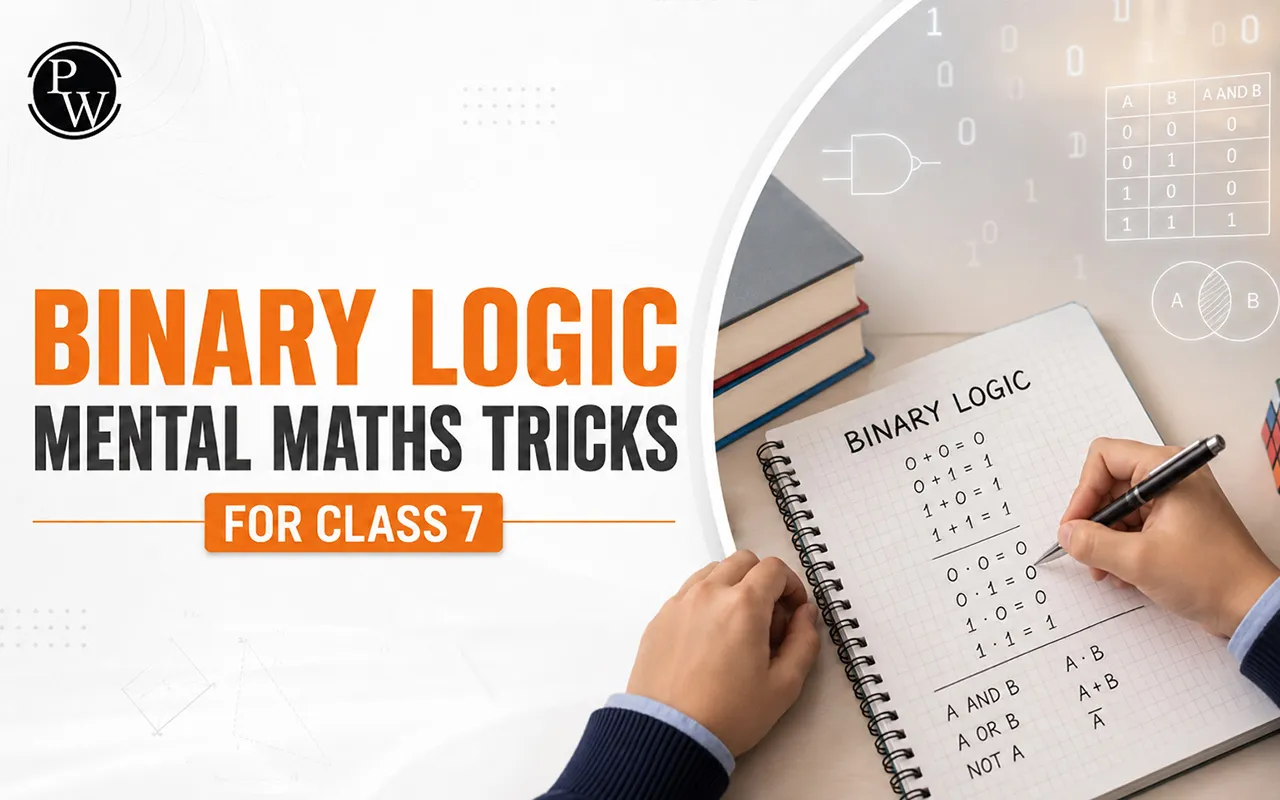
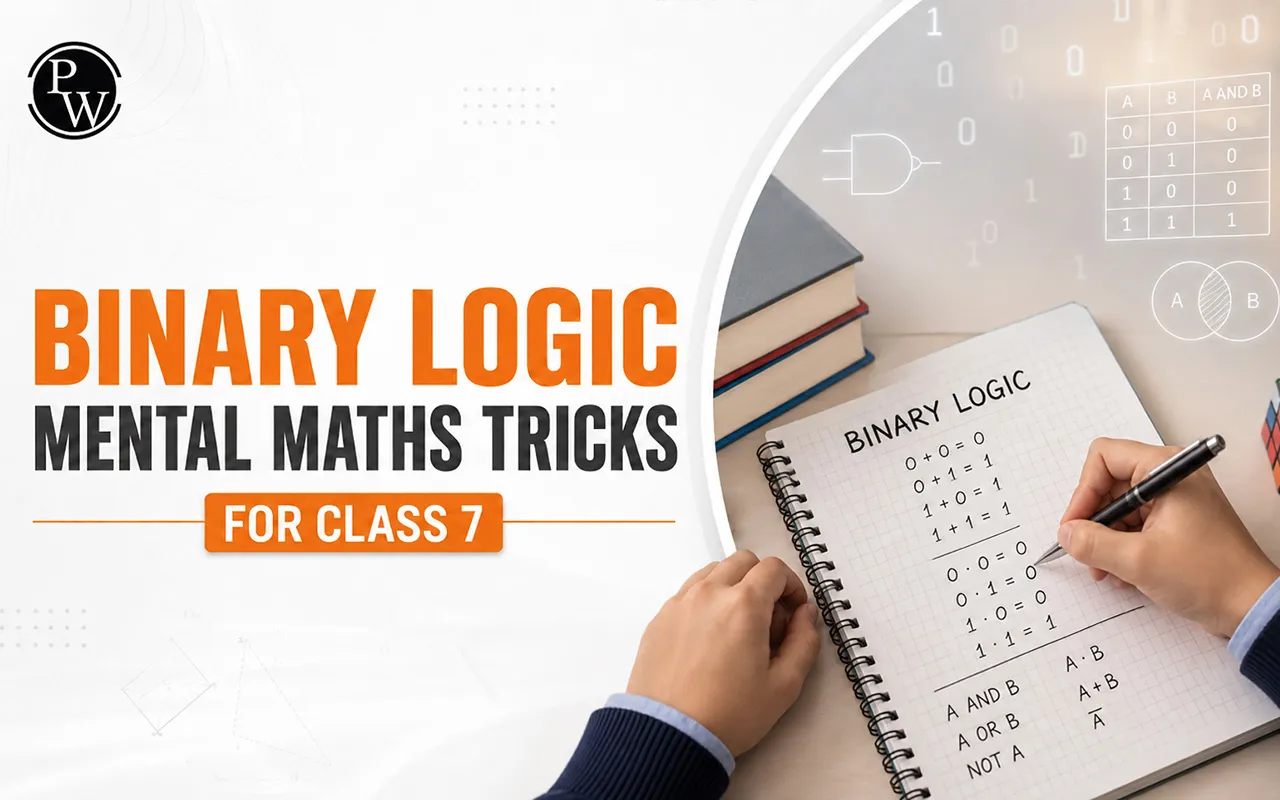
Importance of Binary Logic Mental Maths Tricks
Binary logic is a system of reasoning that deals with exactly two possibilities: true or false, yes or no, or 1 and 0. In school exams, learning these methods helps you save a massive amount of time during competitive tests and regular math olympiads.
When you master these shortcuts, you change the way your brain processes puzzle data. Here is how these skills help you improve your overall academic performance:
-
Speed up problem-solving: You can eliminate wrong options in a few seconds without writing down lengthy paragraphs.
-
Improve analytical thinking: It teaches your brain to spot contradictions and hidden patterns automatically.
-
Boost exam scores: Reasoning sections carry high marks, and getting these right gives you an edge over others.
Binary Logic Mental Maths Tricks for True and False Questions
The most common type of reasoning puzzle involves a group of people where some always tell the truth and others always lie. To solve true false binary logic problems without getting confused, you need to look for direct contradictions between the speakers.
When solving puzzles, look at what each person says about the others. If Person A says Person B is a liar, they cannot both be telling the truth.
The table below shows how different combinations of speakers change the outcome of a statement. It helps you see how a truth teller and a liar interact in a typical puzzle:
|
If Person A is a... |
And Person A says Person B is a... |
Then Person B must actually be a... |
|
Truth Teller |
Truth Teller |
Truth Teller |
|
Truth Teller |
Liar |
Liar |
|
Liar |
Truth Teller |
Liar |
|
Liar |
Liar |
Truth Teller |
To use this strategy, assume one person is telling the truth and see if it creates a clash. If a clash happens, your assumption is wrong, and you can instantly switch to the other option.
Read More - Struggling with Calculations? Try These Mental Maths Hacks
How to Learn Binary Logic Mental Maths Tricks Step by Step
If you are new to this topic, following a structured system prevents mistakes. Mastering binary logic for class 7 requires breaking down statements into true ($T$) and false ($F$) values systematically.
When you encounter a logic puzzle with three or more statements, use this exact sequence to find the correct answer without stress:
-
Read all statements carefully: Identify who is talking about whom.
-
Find the link: Look for the person who is mentioned the most number of times in the puzzle.
-
Make a test assumption: Start by assuming the first person is a truth teller ($T$).
-
Fill in the values: Write down what the other statements would become based on your first choice.
-
Check for errors: If any statement contradicts your assumption, scrap it and try the opposite value ($F$).
Using this checklist ensures you never get trapped in a loop of guessing answers randomly during an exam.
Binary Logic Mental Maths Tricks Practice Puzzles for Students
The best way to get comfortable with these techniques is by trying out real exam scenarios. Let us look at a classic puzzle that often appears in middle school mental math competitions.
Imagine three friends—Rahul, Rohit, and Amit. One of them ate the last slice of cake.
-
Rahul says: "Rohit ate the cake."
-
Rohit says: "Amit did not eat the cake."
-
Amit says: "Rahul is lying."
Knowing that only one person is telling the truth, let us find out who ate the cake. We will use our core rules to test the statements.
If we assume Rahul is telling the truth ($T$), then Rohit ate the cake. This means Rohit’s statement ("Amit did not eat the cake") is also true. Since we know only one person can tell the truth, our assumption fails because we have two true statements.
Now, let us assume Amit is telling the truth. That means Rahul is lying ($F$), so Rohit did not eat the cake. Since Rahul lied, Rohit must be telling the truth, or Amit must be telling the truth. By checking the remaining combinations, we find that Rohit is the actual culprit, and Amit was the only one speaking the absolute truth.
Binary Logic Mental Maths Tricks Exercises for Daily Practise
To build your confidence, you should regularly solve binary logic statements exercises that challenge your mind. Regular practice helps you spot the clues faster.
Try to solve the following riddles using a rough sheet of paper and the truth tables we discussed above:
-
Riddle 1: Maya says Sonu always lies. Sonu says Kavita always lies. Kavita says both Maya and Sonu are lying. Who is telling the truth?
-
Riddle 2: Raj says the treasure is in Box A. Yash says the treasure is not in Box A. If only one statement is correct, where is the treasure?
-
Riddle 3: Simran says, "I am a truth teller." Tina says, "Simran is a liar." Analyse who is who.
Spending just ten minutes daily on these types of questions will make your brain sharper at handling everyday mathematical challenges.
Read More - How to Learn Mental Maths from Zero Level
Binary Logic Mental Maths Tricks for Competitive Exams
When you face binary logic questions in talent search exams, the questions might have three categories of people: Truthtellers (who always speak the truth), Liars (who always lie), and Alternators (who alternate between truth and lies).
Alternators are tricky because their first sentence might be true, but their second sentence will definitely be false.
The list below outlines how to tackle advanced questions that feature these specific characters:
-
Count the total statements: Check how many sentences each character speaks in the question.
-
Isolate the absolute characters: Always look for the pure truth-tellers or pure liars first to establish a baseline fact.
-
Test the alternating pattern: If a character speaks two sentences, test the ($T-F$) combination first, followed by the ($F-T$) combination.
By separating the sentences, you prevent the alternator from confusing your calculations.
How CuriousJr Helps You Learn Advanced Mental Math Tricks
Understanding digital logic and reasoning forms the foundational base for modern computer science and advanced mathematics. Exploring educational tools like the CuriousJr Mental Maths online class allows students to apply these logical steps to real-world coding problems and interactive math quizzes.
Learning these skills early makes school subjects much easier to handle. If you want to explore more engaging challenges, check out the interactive mental Maths modules on the CuriousJr Class 7 Mental Maths Page.