

Factoring Methods: Types, Formulas and Examples
 Study Abroad22 Oct, 2026
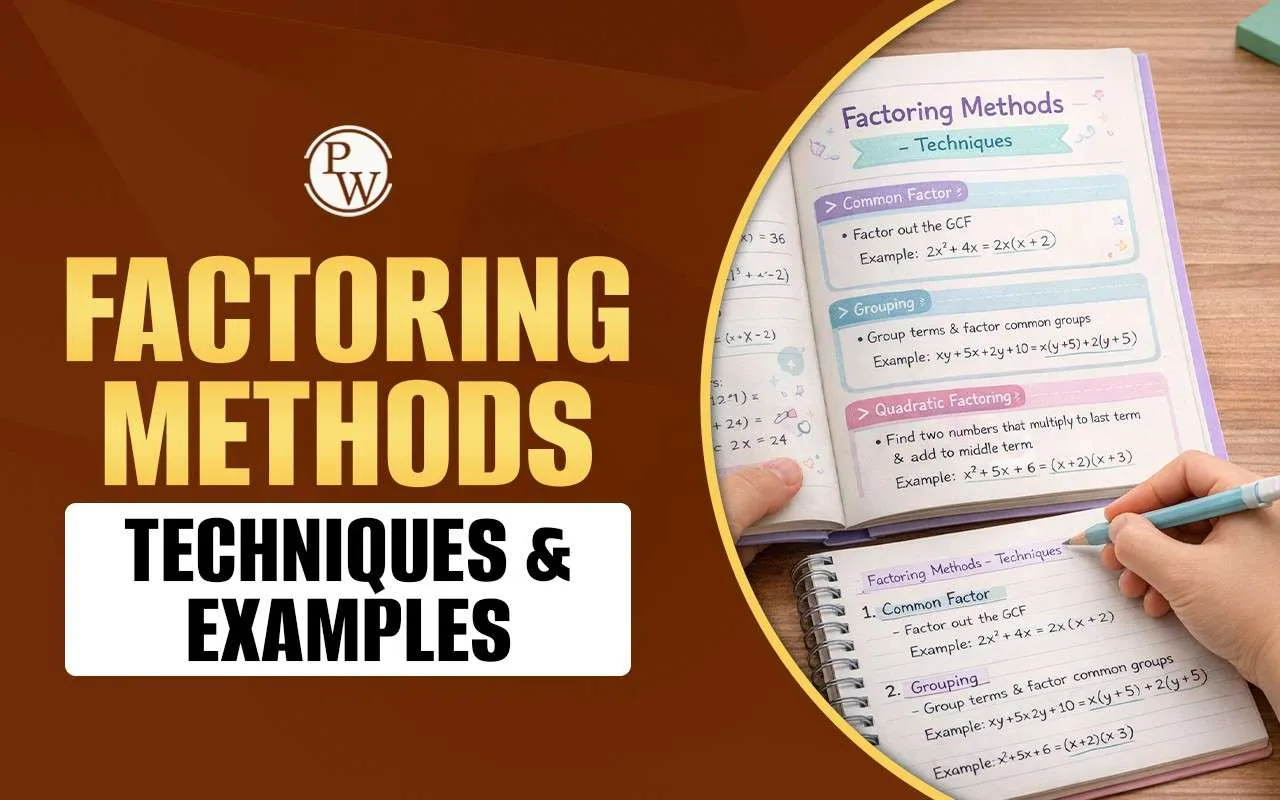
Factoring methods are techniques used to write an algebraic expression as a product of simpler expressions called factors. Common methods include taking out the greatest common factor (GCF), factoring by grouping, factoring trinomials, and applying algebraic identities. Each method works with a different expression pattern.
For example, (x^2+5x+6) can be factored as ((x+2)(x+3)). Multiplying these factors gives the original expression. Factoring is the reverse of expanding brackets and is useful for simplifying expressions, solving quadratic equations, and working with polynomials.
This guide explains the main types of factoring methods, when to use each method, important formulas, and step-by-step examples.
What Is Factorisation in Mathematics?
Factorisation is the process of expressing a number or algebraic expression as a product of two or more factors. For example, (12=3\times4), so 3 and 4 are factors of 12. In algebra, (x^2+4x) can be factorised as (x(x+4)) because both terms contain the common factor (x).
Factorisation is the reverse of expansion. When you expand an expression, you multiply the terms inside brackets. When you factorise it, you write the expression as a product of factors. This process helps simplify algebraic expressions and can make equations easier to solve.
At CuriousJr, students can learn different factoring methods through simple steps and solved examples to understand algebraic expressions and simplify mathematical problems.
Why Is Factorisation Used?
Factorisation helps students simplify algebraic expressions, identify patterns, and solve equations. It is especially useful when working with quadratic equations because a factorised equation can often be solved by setting each factor equal to zero. It also helps students understand algebraic identities and higher-degree polynomials.
Common uses of factorisation include:
-
Simplifying algebraic expressions.
-
Solving quadratic and polynomial equations.
-
Identifying common factors and algebraic patterns.
-
Finding the roots or solutions of polynomial equations.
-
Preparing for more advanced algebra.
Types of Factoring Methods
The method you choose depends on the number of terms, common factors, and patterns in the expression. Some textbooks classify special identities separately, while others include them under broader factoring techniques. The table below covers the main methods students commonly learn.
|
Factoring method |
When to use it |
Example |
|
Greatest Common Factor (GCF) |
When every term has a common factor. |
(6x+12=6(x+2)) |
|
Factoring by grouping |
Often when four terms can be arranged into pairs with a common factor. |
(xy+2y+3x+6=(x+2)(y+3)) |
|
Factoring trinomials |
When an expression has three terms, often a quadratic. |
(x^2+5x+6=(x+2)(x+3)) |
|
Difference of squares |
When two perfect squares are separated by subtraction. |
(x^2-25=(x-5)(x+5)) |
|
Perfect square trinomials |
When a trinomial matches a perfect-square identity. |
(x^2+6x+9=(x+3)^2) |
|
Sum of cubes |
When both terms are perfect cubes joined by addition. |
(x^3+8=(x+2)(x^2-2x+4)) |
|
Difference of cubes |
When both terms are perfect cubes joined by subtraction. |
(x^3-8=(x-2)(x^2+2x+4)) |
There is no single fixed number of factoring methods used in every curriculum. Some methods are broad techniques, while others are special cases of factoring. The important skill is to recognise the expression's pattern and choose a method that works.
CuriousJr Mental Maths classes help students strengthen their calculation skills and problem-solving abilities through engaging maths exercises and simple techniques for understanding mathematical concepts.
Step-by-Step Factoring Methods and Examples
The following methods explain how to factor common algebraic expressions. Start by checking for a common factor, then look for a recognisable pattern. Each worked example shows the steps and the final factorised form.
1. Factoring by Greatest Common Factor (GCF)
The greatest common factor is the largest factor shared by every term in an expression. Factoring by GCF is usually the first method to try because taking out a common factor can make the remaining expression easier to factor further.
Follow these steps:
-
Find the greatest common numerical factor of all terms.
-
Identify any variable factors shared by every term, using the smallest power.
-
Divide each term by the complete GCF.
-
Write the GCF outside the brackets and the quotients inside.
Example: Factor (12x^2+18x)
Step 1: Find the GCF of 12 and 18.
[
\operatorname{GCF}(12,18)=6
]
Step 2: Both terms contain (x), so the complete GCF is (6x).
Step 3: Divide each term by (6x).
[
\frac{12x^2}{6x}=2x,\qquad
\frac{18x}{6x}=3
]
Step 4: Write the factorised expression.
[
\boxed{12x^2+18x=6x(2x+3)}
]
Answer: (6x(2x+3))
Always check for a GCF before applying another factoring method. An expression may need more than one method to become fully factored.
2. Factoring by Grouping
Factoring by grouping is useful when an expression has four terms that can be arranged into two pairs. Factor each pair separately, then take out the common binomial if both groups contain the same factor. This method is especially helpful for certain four-term polynomials.
Example: Factor (xy+2y+3x+6)
Step 1: Group the terms into pairs.
[
(xy+2y)+(3x+6)
]
Step 2: Take out the GCF from each pair.
[
y(x+2)+3(x+2)
]
Step 3: Take out the common binomial ((x+2)).
[
\boxed{xy+2y+3x+6=(x+2)(y+3)}
]
Answer: ((x+2)(y+3))
The key to factoring by grouping is to arrange the terms so that both groups produce the same factor. If the common binomial does not match, check whether the terms need to be reordered or whether grouping is suitable for the expression.
3. Factoring Trinomials
A trinomial is an algebraic expression containing three terms. A quadratic trinomial commonly has the form (ax^2+bx+c), where (a), (b), and (c) are constants and (a\ne0). Factoring means writing the quadratic as a product of simpler expressions, when possible.
Method A: Factoring a Monic Trinomial
A monic quadratic has the form (x^2+bx+c), meaning the coefficient of (x^2) is 1. To factor it, find two numbers whose product is (c) and whose sum is (b).
Example: Factor (x^2+5x+6)
Step 1: Identify the coefficients.
[
b=5,\qquad c=6
]
Step 2: Find two numbers that multiply to 6 and add to 5.
[
2\times3=6,\qquad 2+3=5
]
Step 3: Use these numbers to write the factors.
[
\boxed{x^2+5x+6=(x+2)(x+3)}
]
Answer: ((x+2)(x+3))
Method B: AC Method for Quadratic Trinomials
The AC method is useful for a quadratic (ax^2+bx+c) when the coefficient of (x^2) is not 1. Multiply (a) by (c), find two numbers whose product is (ac) and whose sum is (b), split the middle term, and factor by grouping.
Example: Factor (6x^2+11x+3)
Step 1: Identify the coefficients and calculate (ac).
[
a=6,\quad b=11,\quad c=3
]
[
ac=6\times3=18
]
Step 2: Find two numbers whose product is 18 and whose sum is 11.
The numbers are 9 and 2.
Step 3: Split the middle term.
[
6x^2+9x+2x+3
]
Step 4: Group the terms.
[
(6x^2+9x)+(2x+3)
]
Step 5: Factor each group.
[
3x(2x+3)+1(2x+3)
]
Step 6: Take out the common binomial.
[
\boxed{6x^2+11x+3=(3x+1)(2x+3)}
]
Answer: ((3x+1)(2x+3))
Always multiply the final factors to verify that they reproduce the original quadratic expression.
Also Read, Rounding numbers with definitions, rules, steps, and examples. Learn how to round numbers to the nearest ten, hundred, or thousand, and round decimals correctly to simplify calculations and improve maths skills.
4. Factoring Using the Difference of Two Squares
The difference of two squares applies when two perfect squares are separated by a minus sign. It allows the expression to be written as the product of a difference and a sum.
Formula:
[
\boxed{a^2-b^2=(a-b)(a+b)}
]
Example: Factor (16x^2-25)
Step 1: Write both terms as perfect squares.
[
16x^2=(4x)^2,\qquad25=5^2
]
Step 2: Apply the formula.
[
\boxed{16x^2-25=(4x-5)(4x+5)}
]
Answer: ((4x-5)(4x+5))
Remember that this identity applies to the difference of two squares, not their sum. For example, (x^2+25) cannot be factored into real linear factors using this identity.
5. Factoring Perfect Square Trinomials
A perfect square trinomial is a three-term expression that can be written as the square of a binomial. To recognise one, check whether the first and last terms are perfect squares and whether the middle term is twice the product of their square roots.
Formulas:
[
\boxed{a^2+2ab+b^2=(a+b)^2}
]
[
\boxed{a^2-2ab+b^2=(a-b)^2}
]
Example: Factor (x^2+6x+9)
Step 1: Identify the square terms.
[
x^2=x^2,\qquad9=3^2
]
Step 2: Check the middle term.
[
2(x)(3)=6x
]
The middle term matches the positive perfect square identity.
Step 3: Write the factorised expression.
[
\boxed{x^2+6x+9=(x+3)^2}
]
Answer: ((x+3)^2)
A perfect square trinomial has two identical binomial factors. Check the sign of the middle term to decide whether the factors use addition or subtraction.
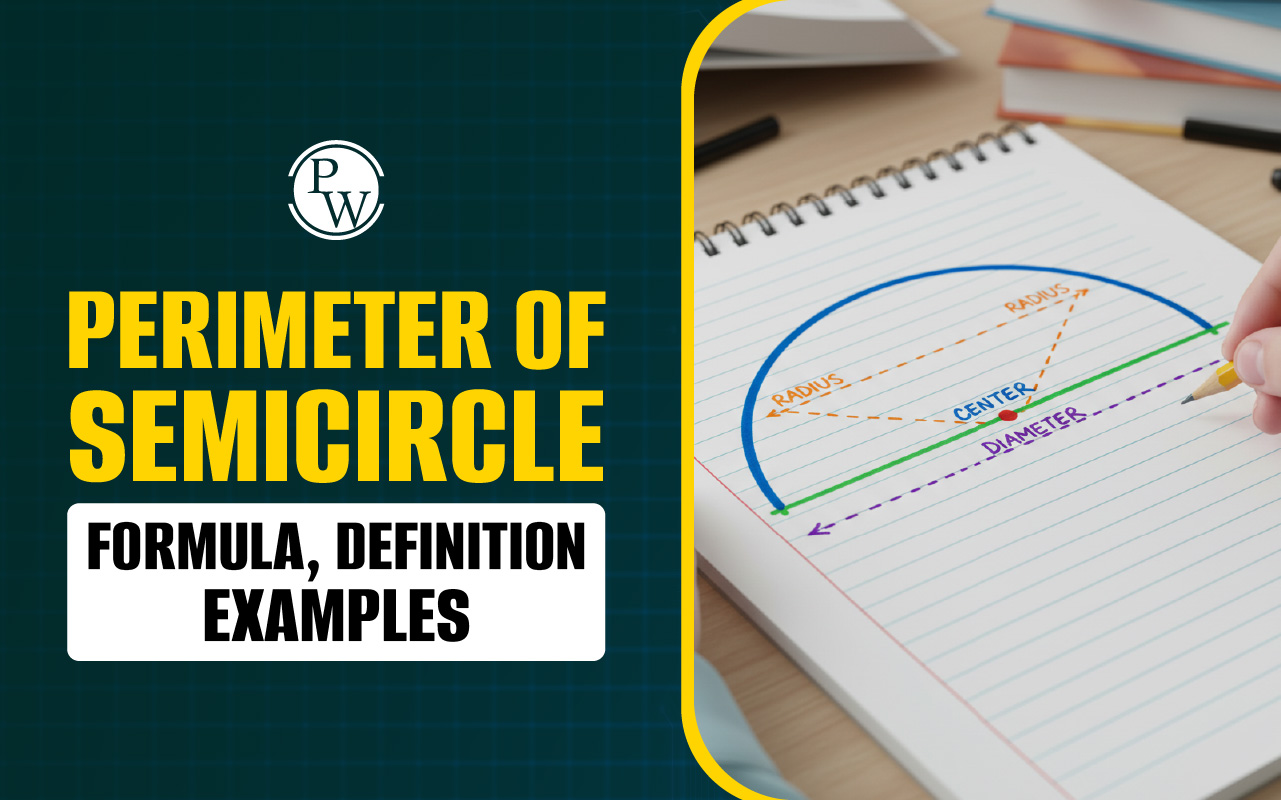
Also Read, What pi (π) is with its symbol, value, formula, and examples. Understand how pi relates to a circle’s circumference and diameter, and explore its importance in geometry and everyday mathematical calculations.
6. Factoring the Sum and Difference of Cubes
The sum and difference of cubes formulas are useful when both terms are perfect cubes. A cube is a number or expression raised to the power of 3, such as (x^3) or (8=2^3).
Sum of cubes:
[
\boxed{a^3+b^3=(a+b)(a^2-ab+b^2)}
]
Difference of cubes:
[
\boxed{a^3-b^3=(a-b)(a^2+ab+b^2)}
]
Example: Factor (x^3-8)
Step 1: Express both terms as cubes.
[
x^3-8=x^3-2^3
]
Step 2: Apply the difference of cubes formula.
[
\boxed{x^3-8=(x-2)(x^2+2x+4)}
]
Answer: ((x-2)(x^2+2x+4))
These formulas help factor certain cubic polynomials without expanding or solving them by trial and error. Remember the sign pattern: the first factor follows the original sum or difference, while the second factor uses the opposite sign in its middle term.
Factoring Methods for Quadratic Equations and Algebra 2
Factoring is commonly used in Algebra 2 to solve quadratic equations and simplify higher-degree polynomials. A quadratic equation has the standard form (ax^2+bx+c=0), where (a\ne0). If the expression can be factored, the zero-product property can be used to find its solutions.
How to Solve a Quadratic Equation by Factoring
To solve a quadratic equation by factoring, first write the equation in standard form with zero on one side. Factor the quadratic, set each factor equal to zero, and solve the resulting equations separately.
Example: Solve (x^2-5x+6=0)
Step 1: Factor the quadratic expression.
Find two numbers whose product is 6 and whose sum is (-5). These numbers are (-2) and (-3).
[
(x-2)(x-3)=0
]
Step 2: Apply the zero-product property.
[
x-2=0\qquad\text{or}\qquad x-3=0
]
Step 3: Solve each equation.
[
x=2\qquad\text{or}\qquad x=3
]
Final answer:
[
\boxed{x=2,\ 3}
]
The solutions are the values of (x) that make the original equation equal to zero. You can verify each solution by substituting it into the original equation.
How to Factor Higher-Degree Polynomials
Higher-degree polynomials may require more than one factoring method. Start by checking for a GCF, then look for familiar identities or expressions that can be factored further. Continue until none of the remaining factors can be broken down using the method and coefficient set required by the problem.
Example: Factor (2x^3-8x)
Step 1: Take out the GCF.
[
2x^3-8x=2x(x^2-4)
]
Step 2: Recognise the difference of squares.
[
x^2-4=(x-2)(x+2)
]
Step 3: Write the complete factorisation.
[
\boxed{2x^3-8x=2x(x-2)(x+2)}
]
Answer: (2x(x-2)(x+2))
The expression is fully factored over the integers because none of the remaining factors can be broken down further into nonconstant integer-coefficient factors.
Also Read, Motivational math quotes for students to build confidence, develop problem-solving skills, and overcome challenges. Discover inspiring words that encourage a positive attitude towards mathematics and make learning maths more enjoyable.
Factoring Methods Cheat Sheet: Formulas and Summary
Use this factoring methods cheat sheet to identify a suitable method from the expression's pattern. First check for a common factor, then look for a matching identity or a quadratic structure. These formulas provide a quick revision reference for solving algebra problems.
|
Expression pattern |
Factoring method |
Formula |
|
Common factor in every term |
GCF |
(ab+ac=a(b+c)) |
|
Four terms that form matching pairs |
Grouping |
(ax+ay+bx+by=(a+b)(x+y)) |
|
Monic quadratic trinomial |
Trinomial factoring |
(x^2+(p+q)x+pq=(x+p)(x+q)) |
|
Difference of two squares |
Difference of squares |
(a^2-b^2=(a-b)(a+b)) |
|
Perfect square trinomial |
Perfect square identity |
(a^2\pm2ab+b^2=(a\pm b)^2) |
|
Sum of two cubes |
Sum of cubes |
(a^3+b^3=(a+b)(a^2-ab+b^2)) |
|
Difference of two cubes |
Difference of cubes |
(a^3-b^3=(a-b)(a^2+ab+b^2)) |
In the perfect square formula, the signs must match: (a^2+2ab+b^2=(a+b)^2) and (a^2-2ab+b^2=(a-b)^2). For trinomial factoring, choose (p) and (q) so their sum matches the coefficient of (x) and their product matches the constant term.
How to Choose the Right Factoring Method
Use the following order when factoring an algebraic expression. Checking the simplest patterns first can save time and reduce mistakes.
-
Check whether all terms have a GCF.
-
Count the terms and identify whether the expression is a binomial, trinomial, or polynomial with four or more terms.
-
Look for special patterns, such as a difference of squares or a perfect square trinomial.
-
For quadratic trinomials, try ordinary trinomial factoring or the AC method.
-
For four terms, try grouping if the pairs produce a common binomial.
-
Multiply the factors to check that they reproduce the original expression.
Not every polynomial can be factored using integer coefficients. If none of these methods applies, the expression may be irreducible over the integers or may require another technique.
Common Factoring Mistakes to Avoid
When learning factoring methods, students should check their work carefully. Most errors come from overlooking a common factor, choosing numbers with the wrong signs, or stopping before the expression is fully factored. Use the following checks to verify each solution.
-
Missing the GCF: Check whether every term shares a common factor before trying another method.
-
Incorrect signs: When factoring trinomials, check both the product and the sum of the chosen numbers.
-
Stopping too early: After factoring once, check whether any factor can be factored further.
-
Misusing identities: The difference of squares formula applies to subtraction, not addition.
-
Not checking the answer: Multiply the factors to confirm that they reproduce the original expression.
Practising these checks helps reduce calculation errors and makes factoring solutions easier to verify.





Factoring Methods FAQs
What are the main factoring methods in algebra?
How many types of factoring methods are there?
How do you factor an expression step by step?
What is the easiest method for factoring quadratic equations?






Get Free Counselling Today
and Clear up all your Doubts
 Live & recorded classes available at easeDashboard for progress trackingLakhs of practice questions

