Syllogisms Mental Maths Tricks for Class 7
 Nikita Aggarwal28 May, 2026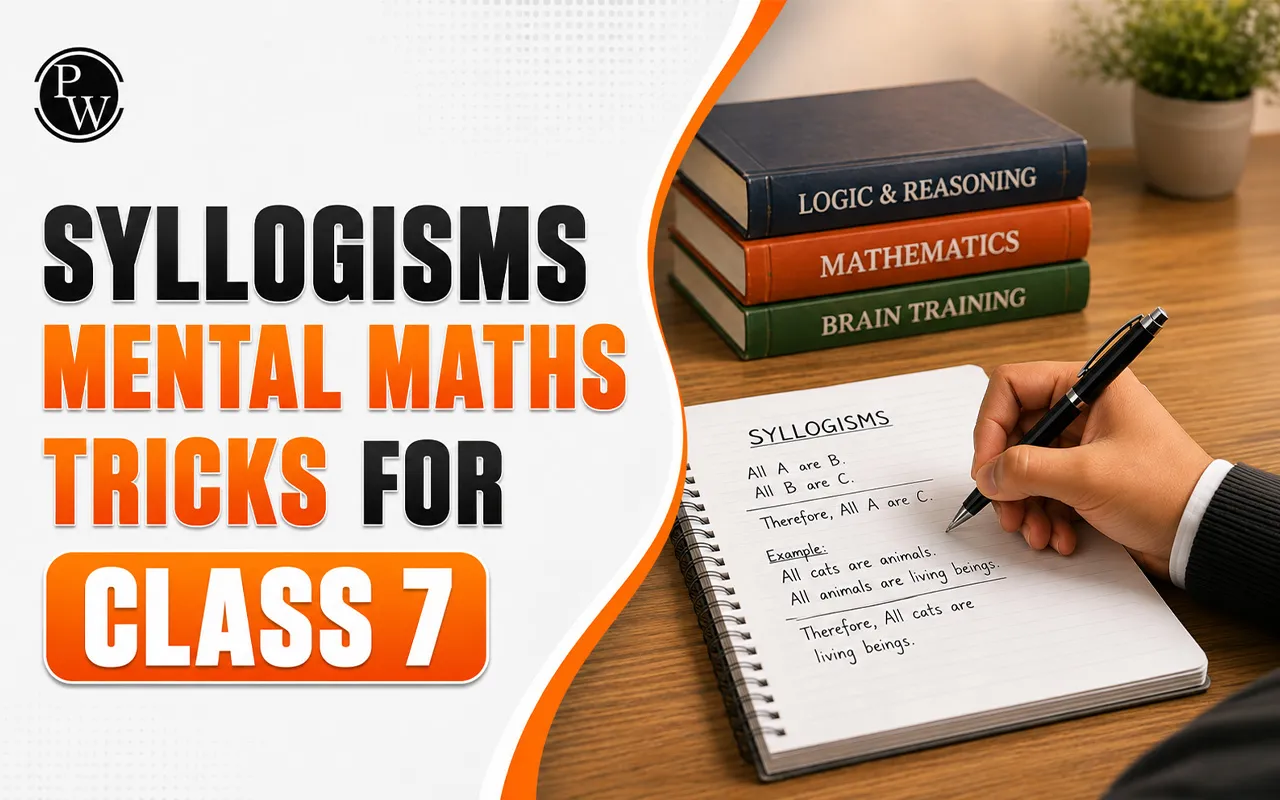
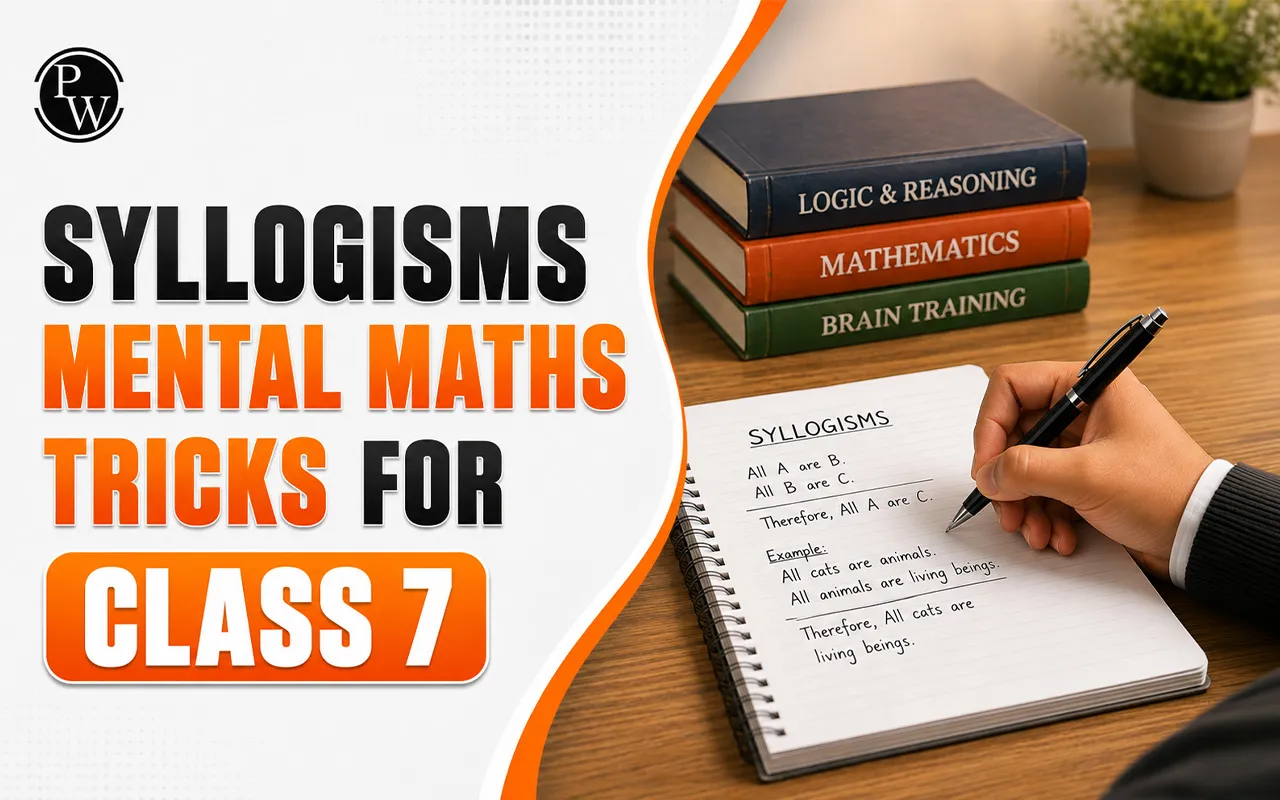
What are Syllogisms for Class 7?
Before diving into the shortcuts, you need to understand what a syllogism actually is. It is a
form of logical puzzle where you are given two or more statements, followed by conclusions. Your job is to decide which conclusions definitely follow the rules of the statements.
The statements are divided into two main parts that you must analyze:
-
The Premises: The initial facts or statements given to you, which you must always accept as one hundred per cent true.
-
The Conclusions: The statements you need to test are based purely on the given premises.
In school exams, these are often called "statement-and-conclusion" syllogisms. The most important rule to remember is to forget about the real world. If a statement says "all pens are rivers," you must accept it as an absolute fact for that specific problem.
Importance of Syllogisms Mental Maths Tricks
Logical thinking is just as important as multiplying numbers quickly. When you practice these logic puzzles, you train your brain to spot patterns and connections faster than regular calculation methods allow.
Syllogisms are a core part of mental ability exams. They teach you how to take general statements and find a guaranteed true result. Mastering these quick shortcuts ensures you do not waste precious minutes drawing out massive charts during a test. It builds a foundation for advanced maths and computer programming by sharpening your deductive reasoning skills.
How to Solve Syllogism Problems with Mental Maths Tricks?
The secret to solving syllogism reasoning questions quickly lies in categorisation. Every statement in a puzzle falls into one of four distinct categories. Identifying the category immediately tells your brain how to process the information.
The table below breaks down the four standard types of statements you will encounter in logical deduction problems, grade 7 worksheets, along with what they actually imply.
|
Statement Type |
Example |
What it Means Logically |
|
Universal Positive |
All A are B |
Every single member of group A sits inside group B. |
|
Universal Negative |
No A are B |
Group A and Group B are completely separate. |
|
Particular Positive |
Some A are B |
At least one member of A overlaps with group B. |
|
Particular Negative |
Some A are not B |
Part of group A stays completely away from B. |
Read More - Mental Division Tricks for Class 7
Syllogisms Mental Maths Tricks for Logical Deduction Problems
The most reliable mental trick to solve these puzzles is to draw tiny, imaginary circles in your head. This technique relies on Venn diagrams, which visually represent how different groups relate to one another.
When you read a question, mentally sketch how the circles overlap based on these simple rules:
-
For "All" statements: Draw a small circle entirely inside a larger circle. The first item goes inside; the second item is the outside shell.
-
For "No" statements: Draw two separate circles with a clear gap between them to show they can never touch.
-
For "Some" statements: Draw two circles that overlap slightly in the middle, creating a shared zone.
By keeping these visual rules in your mind, you can quickly test any conclusion against your mental map to see if it holds true in every possible scenario.
Syllogisms Mental Maths Tricks for Statement and Conclusion Rules
To ensure you never make a mistake, you can follow a strict order of elimination. This mental checklist helps you filter out wrong conclusions instantly.
The following sequence details how to process a standard two-statement logic puzzle systematically:
-
Read the premises carefully: Identify if the statements are universal (All/No) or particular (Some).
-
Look for negative statements: If both premises are negative (e.g., "No cats are dogs" and "No dogs are birds"), no definite conclusion can be drawn between the first and last items.
-
Check the common term: Find the word that appears in both statements. This is your bridge connecting the remaining items.
-
Test the conclusion: Ask yourself if the conclusion is always true, or just sometimes true. If it is only sometimes true, it must be rejected.
Read More - Speed Maths Test for Class 7 (Try Now)
Mistakes to Avoid in Syllogisms Mental Maths Tricks
Many students lose marks because they confuse a possibility with an absolute certainty. Just because something could be true does not mean it must be true based on the text.
During your syllogisms mental maths tricks practice sessions, watch out for these regular pitfalls:
-
Assuming reverse logic: If "All apples are fruits," it does not mean "All fruits are apples." The reverse is rarely true on its own.
-
Ignoring the overlapping middle: When two things share a part of a third thing, they do not automatically share a part of each other.
-
Using real-world facts: Never use your own outside knowledge. Stick strictly to the rules provided in the question lines.
How to Learn Syllogisms Mental Maths Tricks with CuriousJr?
Learning to solve logical puzzles efficiently is a fantastic way to prepare for future academic challenges. These mental maths classes train your brain to think structurally, which makes learning subjects like mathematics and science much easier as you grow.
If you enjoy mastering shortcuts like these syllogisms mental maths tricks, taking regular structured practice can help you improve even faster. Exploring guided games and interactive logic challenges helps keep your mind sharp and makes learning feel like play.