Straight Angle (180°) – Definition, Degree, Properties, Examples
 Amit Lingwal19 Jan, 2026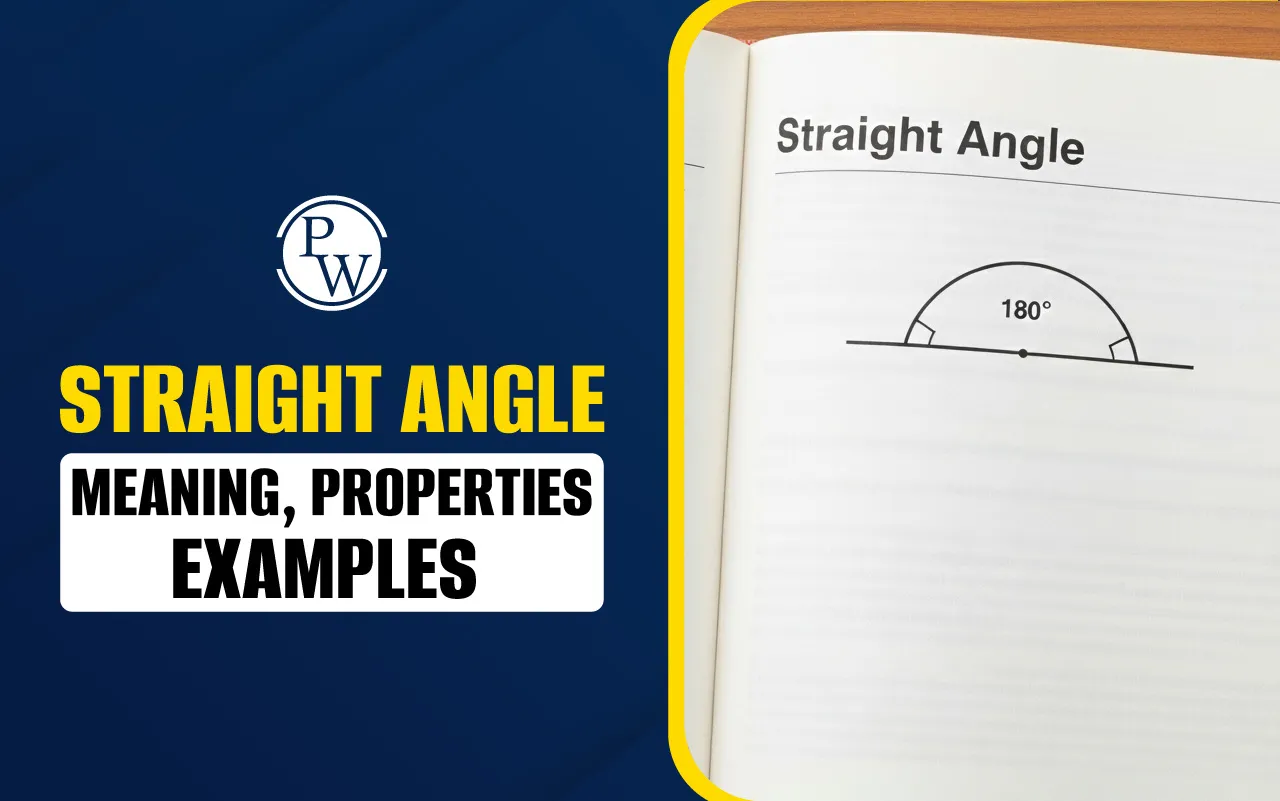
Straight Angle
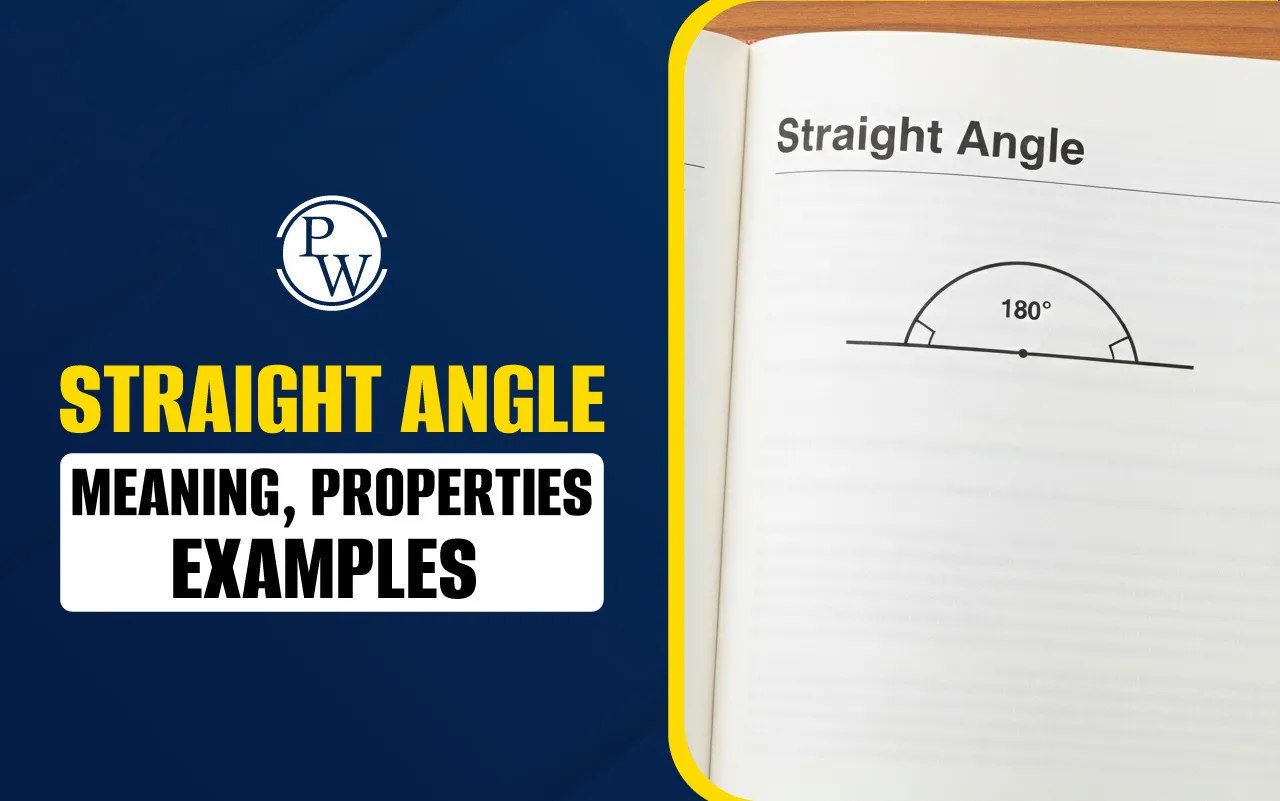
Straight angle measures exactly 180° or π radians, formed when two rays extend in opposite directions from a vertex. It represents a flat, half-turn angle, used in geometry, triangles, supplementary angles, and real-life objects like clocks, roads, and tables.
Straight angle looks like a straight line and measures 180 degrees, but it’s more than just a flat shape. This angle is used in geometry to show half a turn, explain how lines meet, and solve problems involving other angles. Here, you will learn what is straight angle, how a straight angle works, straight angle degree, how to draw it, how to measure it, and where it shows up in real-life situations and math problems.
What is an Angle?
To understand the straight angle, it helps to first know what an angle is. An angle is made when two lines or rays meet at a single point.
This point is called the vertex, and the lines or rays are known as the arms of the angle. The space between the arms tells us how wide or narrow the angle is. Angles can come in different types based on how wide they open. These include:
-
Acute angle: Measures less than 90 degrees
-
Right angle: Measures exactly 90 degrees
-
Obtuse angle: Measures more than 90 degrees but less than 180 degrees
-
Straight angle: Measures exactly 180 degrees
-
Reflex angle: Measures more than 180 degrees but less than 360 degrees
-
Complete angle: Measures exactly 360 degrees
Also read: Arc Formula - How to Find Length of an Arc?
Straight Angle Definition
The straight angle definition states that it is an angle formed when the arms of an angle lie in exactly opposite directions, creating a straight line. The measure of straight angle is always 180 degrees, which makes it unique compared to other angles. When learning about straight angle, students often understand that it represents half of a revolution. To understand better, one can practice how to draw straight angle using a protractor by marking 180° on a line. Since the straight angle is equal to 180 degrees, it is easy to identify and measure in geometry.
What is Straight Angle?
In geometry, a straight angle is an angle that measures exactly 180 degrees. It is formed when two rays start from the same point, called the vertex, and extend in opposite directions. This creates an angle that looks like a straight line.
A straight angle does not have any turn or curve. Both sides of the angle lie in a continuous line, but face away from each other. Because of its flat shape, it is sometimes also called a flat angle.
This type of angle is one of the basic types used in geometry and is important for understanding lines, shapes, and turns.
Straight Angle Degree
The straight angle degree is always 180 degrees. This is the exact measure that defines a straight angle. If an angle measures less than 180 degrees, it is not a straight angle. If it measures more than 180 degrees, it is called a reflex angle.
In geometry, angles can also be measured in a unit called radians. When written in radians, the straight angle measure is shown as π (pi). This means that 180 degrees and π radians both describe the same type of angle.
The straight angle is often used as a reference point for comparing and measuring other angles in geometry.
Also read: Types of line in Math with Examples
Properties of Straight Angle
The measure of straight angle remains fixed at 180 degrees regardless of the size of the line. If we read more about straight angle, we see that it plays an important role in classifying other angles such as acute, obtuse, and reflex. Students can easily learn how to draw straight angle by extending a ray in the opposite direction to form a line. A straight angle is equal to 180 degrees, it is widely used in geometry, trigonometry, and real-life applications. Here are some interesting and important properties of the straight line angle:
-
A straight angle is exactly half of a full circle or revolution.
-
It always measures 180° or π radians.
-
A straight angle is formed when two rays extend in exactly opposite directions, creating a perfect straight line.
-
You can create a straight angle by combining two right angles, since 90° + 90° equals 180°.
-
This type of angle is also commonly referred to as a flat angle.
-
It is often used as a reference point for comparing and measuring other angles in geometry.
Steps to Construct Straight Angle
To construct a straight angle, you will need a ruler and a protractor. Follow these steps:
Step 1: Using a ruler, draw a straight line and label it XY. Ensure the line is perfectly straight, and place an arrowhead at point Y to indicate direction.
Step 2: Position a protractor so that its center point sits exactly on point X. Align the baseline of the protractor with line XY, making sure the 0° mark is pointing toward Y.
Step 3: On the inner scale of the protractor, find the 180° mark. Starting from 0°, follow the scale and mark the point at 180 degrees. Label this point as Z.
Step 4: Draw a straight line from point X to Z. This forms the second ray of the angle. Add an arrowhead at Z to show its direction.
Now, the angle formed between ray XY and ray XZ is a straight angle. It measures 180 degrees, and both rays lie in opposite directions on the same line.
Also read: Rectangular Prism
Difference Between Straight Angle and Straight Line
A straight angle and a straight line may look similar, but they are not the same thing.
A straight angle is a type of angle. It shows the amount of rotation between two rays that start from the same point and extend in exactly opposite directions. When this happens, the angle formed is 180 degrees. This flat shape is called a straight angle.
A straight line is a geometric figure. It is a continuous path that connects two or more points and extends in both directions without curving or bending.
The reason they look alike is because a straight angle forms a flat shape, just like a straight line. However, one represents a measure of rotation, while the other is a basic shape in geometry.
Straight Angle in Pairs
When two angles are placed side by side on a straight line and share the same vertex, they form a straight angle pair. This is also called a linear pair. Together, the two angles always add up to 180 degrees.
This concept is very useful in geometry. If you know the value of one angle in the pair, you can always find the other by subtracting from 180 degrees.
For example, If one angle is 120 degrees, the other angle in the pair must be:
180 − 120 = 60 degrees
Straight angle pairs are often found in shapes, diagrams, and construction drawings where two angles meet along a straight path.
Also read: 30-60-90 Triangle
Real Life Straight Angle Examples
Straight angles are not just in books and drawings. They can be found all around you. Here are some straight angle examples from everyday life:
-
Clock at 6:00: The minute hand points at 12, and the hour hand points at 6. Together, they form a straight angle.
-
Ruler or pencil: When a pencil lies flat on a desk, its shape follows a straight line angle.
-
Road divider: A road that goes straight with no curves forms a 180-degree angle.
-
Tabletop edges: Many tables have long edges that form straight angles at the sides.
-
Stair railings: On flat staircases, the handrails often follow a straight angle path.
Straight Angle in Geometry and Math
The straight angle is not only a basic concept, but it also helps in understanding more advanced ideas in mathematics. Here are a few important ways the straight angle is used:
Triangles: In every triangle, the three interior angles always add up to 180 degrees. This total is equal to the measure of straight angle, which helps in checking and solving problems in triangle geometry.
Supplementary Angles: When two angles add up to 180 degrees, they are called supplementary angles. Together, they form a straight angle when placed side by side.
Linear Equations: In graphing, a straight line on a coordinate plane forms a straight angle. This idea is used in algebra when studying linear equations, where the graph makes a flat line showing a constant rate of change.
Understanding the concept of a straight angle helps students connect geometry with other areas of math, such as algebra and measurement.
Also read: a²+b²+c² formula with Examples
Make Your Child a Mental Math Champion with CuriousJr!
Does your child still rely on fingers to solve simple problems? Do not let basic calculations bother them in class or exams. With CuriousJr’s Mental Maths Classes, students can strengthen their calculation skills, improve speed, and gain confidence in maths.
Our classes are interactive, fun, and designed to help children solve problems mentally without using calculators or writing every step. With regular practice, personalised guidance, and small group learning, we make maths simple and enjoyable for every child.
We keep parents informed with progress updates and provide support to help your child grow through every class.At CuriousJr, we turn learning into an experience your child will look forward to.
Book a demo class today and see how CuriousJr makes maths fun, fast, and stress-free!