
Blood Relations Mental Maths Tricks for Class 4
 Nikita Aggarwal29 May, 2026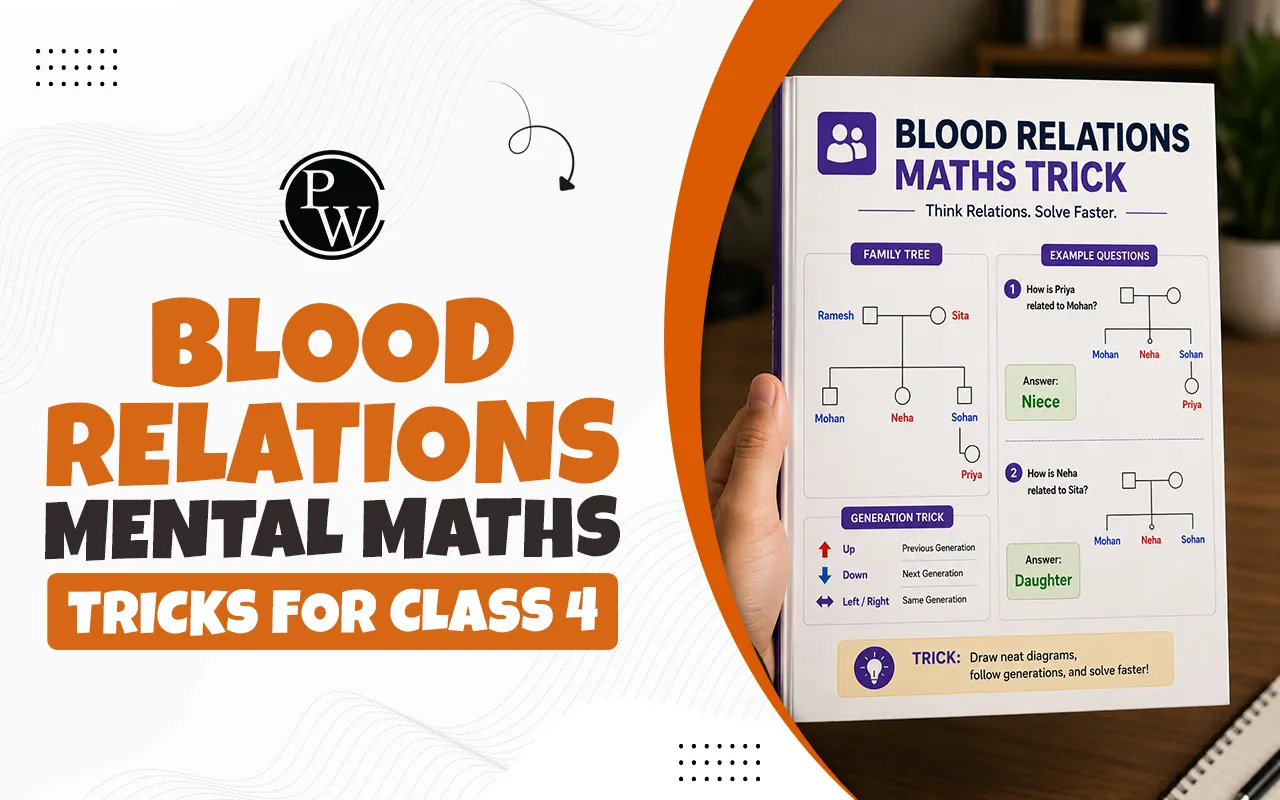
Importance of Blood Relations Mental Maths Tricks
Learning blood relations mental maths tricks improves logical thinking and helps children solve family-relation questions more efficiently.
-
Children learn how to connect family members step by step.
-
Family tree methods help children reach answers quickly without confusion.
-
Many school tests and Olympiad exams include blood relation questions, making these skills useful for exams.
-
Children improve their memory by organising family relationships clearly.
-
Regular practice increases confidence and reduces hesitation while solving reasoning questions.
Blood Relations Mental Maths Tricks for Understanding Family Relationships
In Class 4, children learn how family members are connected to one another. Blood relations mental maths tricks become easier when children first understand common family terms.
Some questions use simple family names:
-
Father
-
Mother
-
Brother
-
Sister
Other questions introduce more advanced family terms:
-
Maternal Uncle
-
Paternal Grandfather
-
Nephew
-
Niece
Learning these terms gradually makes relationship questions much easier to understand and solve.
Blood Relations Mental Maths Tricks for Maternal and Paternal Relations
One of the most useful blood relations mental maths tricks is learning the difference between maternal and paternal family members.
Paternal Relations (Father’s Side)
-
Father’s father = Paternal Grandfather
-
Father’s mother = Paternal Grandmother
-
Father’s brother = Paternal Uncle
-
Father’s sister = Paternal Aunt
Maternal Relations (Mother’s Side)
-
Mother’s father = Maternal Grandfather
-
Mother’s mother = Maternal Grandmother
-
Mother’s brother = Maternal Uncle
-
Mother’s sister = Maternal Aunt
Understanding which side of the family is being discussed helps children avoid common mistakes.
|
Family Description |
Family Member |
|
Father’s or Mother’s Father |
Grandfather |
|
Father’s or Mother’s Mother |
Grandmother |
|
Father’s or Mother’s Brother |
Uncle |
|
Father’s or Mother’s Sister |
Aunt |
|
Brother’s Son |
Nephew |
|
Brother’s Daughter |
Niece |
|
Uncle’s or Aunt’s Child |
Cousin |
Read More - Mental Division Tricks for Class 4
Blood Relations Mental Maths Tricks Using Symbols and Diagrams
Many blood relations mental maths tricks become easier when children use symbols and visual diagrams instead of reading long sentences repeatedly.
Simple symbol system:
|
Symbol |
Meaning |
|
□ |
Male |
|
○ |
Female |
|
= |
Married Couple |
|
— |
Brothers and Sisters |
|
│ |
Parent–Child Connection |
Using these symbols allows children to draw family trees quickly and organise information visually.
Blood Relations Mental Maths Tricks with Generation Levels
One of the easiest blood relations mental maths tricks is arranging family members according to generations.
Top Generation
-
Grandfather
-
Grandmother
Middle Generation
-
Father
-
Mother
-
Uncle
-
Aunt
Bottom Generation
-
Brother
-
Sister
-
Cousin
Separating family members into generations helps children avoid confusion while solving complex relationship questions.
Read More - Math Puzzles for Class 4 Students
Blood Relations Mental Maths Tricks for Family Tree Problems
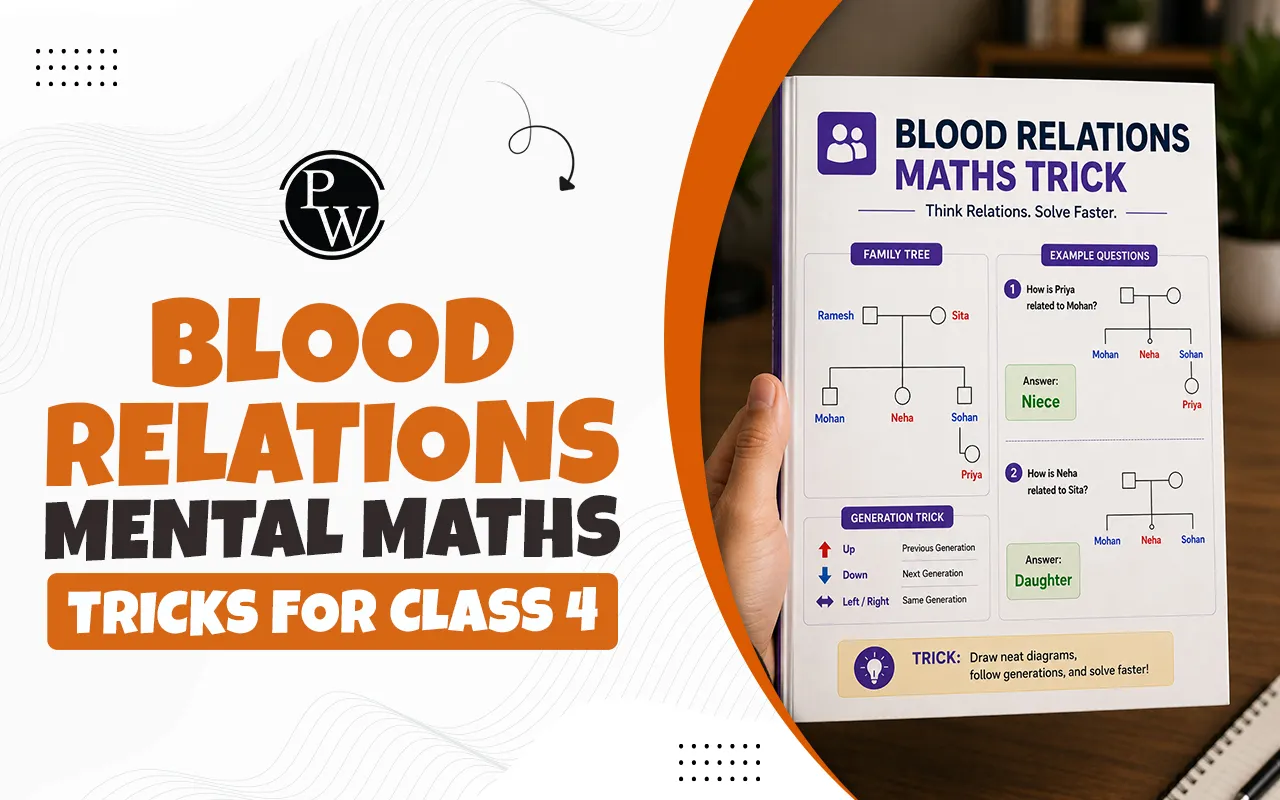
Drawing diagrams is one of the most effective blood relations mental maths tricks for solving reasoning questions.
Example Question
“Anil says, Rohan’s father is the only son of my grandfather.”
How is Anil related to Rohan?
Solution
-
Identify the oldest person: Grandfather
-
Find the “only son”: Anil’s father
-
The same person is also Rohan’s father
Answer: Anil and Rohan are brothers.
Simple family tree:
[ Grandfather ]
|
[ Father ]
/ \
[ Anil ] [ Rohan ]
This visual approach makes relationships much easier to understand.
Blood Relations Mental Maths Tricks Using Self-Substitution
A useful blood relations mental maths trick is self-substitution.
Instead of reading unfamiliar names, children replace the names with people from their own family.
Example:
“Mother’s brother’s daughter”
Children can think:
-
Mother’s brother = Maternal Uncle
-
Maternal Uncle’s daughter = Cousin
This method helps children understand relationships more naturally.
Blood Relations Mental Maths Tricks Through Backward Reading
Some relationship questions become easier when read from the end.
Example
“The daughter of the only brother of my father.”
Step-by-step:
-
Start with “my father”
-
Father’s only brother = Uncle
-
Uncle’s daughter = Cousin
Reading backward helps children solve long questions systematically rather than guessing.
Blood Relations Mental Maths Tricks for Solving ‘Only’ Clues
The word “only” often provides an important shortcut in blood relations mental maths tricks.
Examples:
-
“My grandfather’s only son” = Father
-
“Only child” = No brother and no sister
Children should always pay close attention whenever the word “only” appears because it usually removes multiple possibilities.
Blood Relations Mental Maths Tricks Practice Questions
Question 1
Meera says:
“He is the father of my brother’s only sister.”
Answer
-
Meera’s brother’s only sister is Meera.
-
Therefore, the man is Meera’s father.
Question 2
Rahul’s mother is the only daughter of Priya’s mother.
Answer
-
Priya is Rahul’s mother.
Question 3
Amit is Sonia’s brother. Jyoti is Amit’s sister.
Answer
-
Jyoti is Sonia’s sister.
Regular practice helps children apply blood relations mental maths tricks more confidently.
How to Learn Blood Relations Mental Maths Tricks with Daily Practice?
Children improve much faster when they practise a little every day.
Parents can:
-
Draw simple family trees together.
-
Ask relationship-based questions.
-
Use picture cards to represent family members.
-
Play family guessing games.
-
Create small family-relation puzzles.
Short daily activities gradually strengthen logical reasoning and memory skills.
Common Mistakes to Avoid While Using Blood Relations Mental Maths Tricks
Children often lose marks because of small, avoidable mistakes.
Common mistakes include:
-
Guessing whether a person is male or female based only on a name.
-
Confusing maternal relatives with paternal relatives.
-
Reading relationship chains too quickly.
-
Finding the correct relationship but answering from the wrong person's perspective.
-
Ignoring important words such as “only,” “elder,” or “younger.”
Reading carefully and drawing a family tree usually prevents these errors.
How to Learn Blood Relations Mental Maths Tricks with CuriousJr?
CuriousJr online mental maths class helps children learn blood relations mental maths tricks through interactive reasoning activities and guided learning sessions.
Benefits include:
-
Interactive Logic Games: Children solve family relation puzzles through fun activities and quizzes.
-
Step-by-Step Learning: Lessons slowly move from simple family relations to harder reasoning questions.
-
Friendly Teacher Guidance: Teachers explain mistakes clearly and help children improve.
-
Better Exam Confidence: Children become faster and more confident during school tests and Olympiad exams.
The table below shows the key learning areas and what children will learn:
|
CuriousJr Learning Areas |
Skills Children Learn |
|
Family Tree Activities |
Better relation understanding |
|
Logic Puzzle Games |
Faster reasoning skills |
|
Visual Learning Tools |
Easy family tree creation |
|
Guided Practice Sessions |
Better accuracy and confidence |