
Narration in English Grammar: Meaning, Rules, Examples & Tips for Students
 Shivam Singh29 May, 2026
Narration in English Grammar
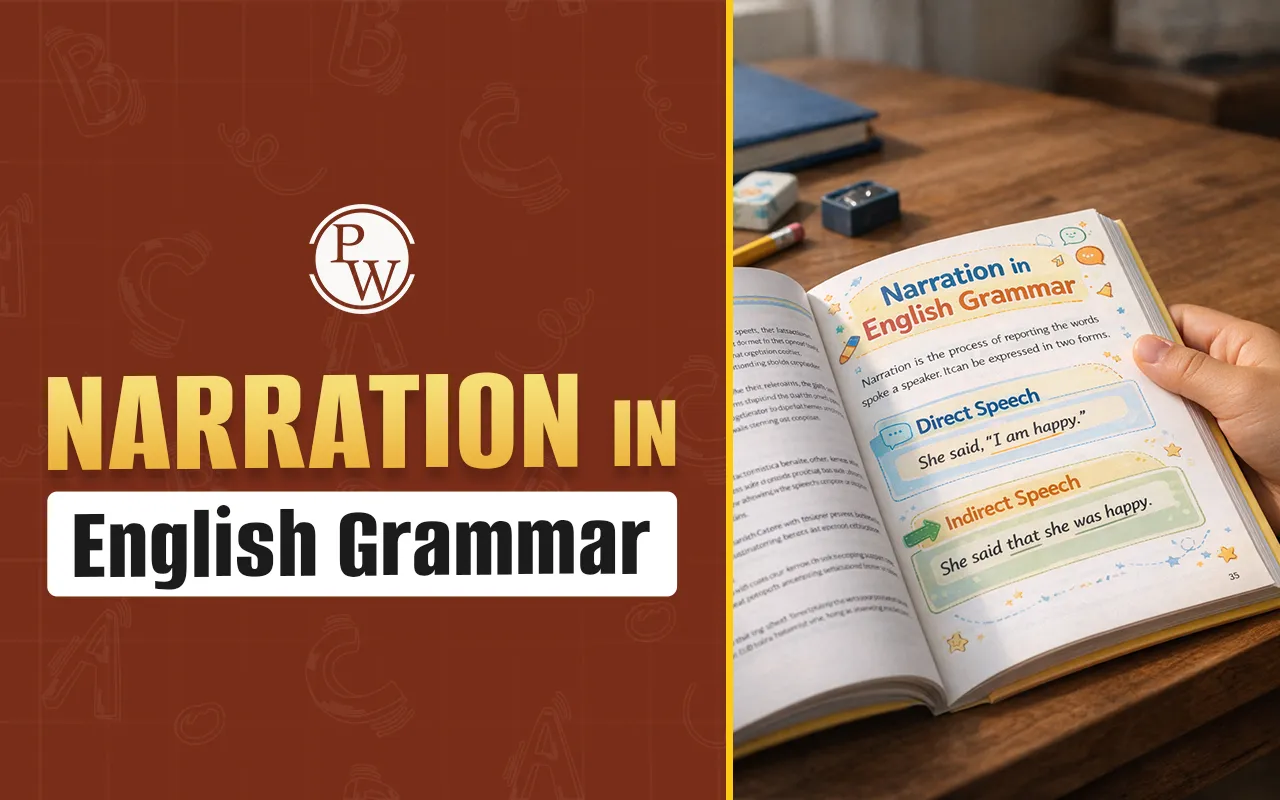
Narration in English grammar refers to the way we report what someone has said or thought. It includes direct speech, where exact words are used, and indirect speech, where the meaning is reported without quotation marks. Narration helps students understand sentence structure, tense changes, and pronoun usage. It is an important topic for school exams and competitive exams, and regular practice makes it easy and scoring.
Narration in English grammar mainly deals with:
-
Direct Speech
-
Indirect Speech
When we change a sentence from direct speech to indirect speech, it is called a change of narration.
What is Narration in Grammar?
Narration means reporting what someone has said.
In grammar, narration is the way of expressing a speaker’s words either exactly as spoken or in an indirect form.
Narration Definition
Narration is the method of reporting speech or thoughts of a speaker.
Types of Narration
There are two main types of narration:
1. Direct Narration (Direct Speech)
In direct narration, the exact words of the speaker are written inside quotation marks (“ ”).
Example:
-
He said, “I am tired.”
2. Indirect Narration (Indirect Speech)
In indirect narration, the exact words are not used, and quotation marks are removed.
Example:
-
He said that he was tired.
Read More: Prepositions of Time
Rules of Narration with Examples
Rule 1: Change of Pronouns
Pronouns change according to the subject and object of the reporting verb.
Example:
-
She said, “I am happy.”
-
She said that she was happy.
Rule 2: Change of Tense
If the reporting verb is in the past tense, the tense of the reported speech usually changes.
|
Direct Speech |
Indirect Speech |
|
Present Simple |
Past Simple |
|
Present Continuous |
Past Continuous |
|
Present Perfect |
Past Perfect |
|
Past Simple |
Past Perfect |
Example:
-
He said, “I write a letter.”
-
He said that he wrote a letter.
Rule 3: No Change of Tense (Universal Truth)
If the sentence expresses a universal truth, the tense does not change.
Example:
-
The teacher said, “The sun rises in the east.”
-
The teacher said that the sun rises in the east.
Rule 4: Change of Time and Place Words
Some words related to time and place change.
|
Direct |
Indirect |
|
now |
then |
|
today |
that day |
|
yesterday |
the previous day |
|
tomorrow |
the next day |
|
here |
there |
Example:
-
She said, “I will come tomorrow.”
-
She said that she would come the next day.
Rule 5: Remove Quotation Marks
In indirect speech, quotation marks (“ ”) are removed and ‘that’ is often used.
Example:
-
He said, “I am ready.”
-
He said that he was ready.
Read More: Abstract Nouns
Narration Change Rules
1. Assertive Sentences
Use said / told and that.
Example:
-
She said, “I like tea.”
-
She said that she liked tea.
2. Interrogative Sentences (Questions)
-
Use asked / inquired
-
Change question form into statement
-
Use if / whether for yes–no questions
Example:
-
He said, “Are you ready?”
-
He asked if I was ready.
3. Imperative Sentences (Orders, Requests)
-
Use ordered, requested, advised
-
Use to + verb
Example:
-
She said, “Open the door.”
-
She ordered me to open the door.
4. Exclamatory Sentences
-
Use exclaimed, exclaimed with joy/sorrow
-
Remove exclamation mark
Example:
-
He said, “What a beautiful day!”
-
He exclaimed that it was a very beautiful day.
Read More: Silent Letters in English
Narration Examples with Answers
Example 1
Direct:
She said, “I am learning English.”
Indirect:
She said that she was learning English.
Example 2
Direct:
Ram said, “I have finished my work.”
Indirect:
Ram said that he had finished his work.
Example 3
Direct:
The teacher said, “Do your homework.”
Indirect:
The teacher told us to do our homework.
Example 4
Direct:
He said, “Alas! I am hurt.”
Indirect:
He exclaimed with sorrow that he was hurt.
Narration Exercise for Students
Change the following sentences into indirect speech:
-
She said, “I am busy now.”
-
He said, “I will call you tomorrow.”
-
The boy said, “I have lost my book.”
-
The teacher said, “Be quiet.”
Answers:
-
She said that she was busy then.
-
He said that he would call me the next day.
-
The boy said that he had lost his book.
-
The teacher ordered us to be quiet.
Also Read: 7 Daily Habits to Improve English Fluency
Help Your Child Speak English Clearly and Confidently with CuriousJr
Does your child struggle to speak fluent English or use incomplete sentences? This can reduce confidence in the classroom and affect exam performance and communication skills. CuriousJr’s online English learning classes are designed to help children improve their grammar, vocabulary, pronunciation, and writing skills in a fun and easy way.
What CuriousJr English Online Classes Offer
Easy Grammar Lessons: Concepts are taught simply so children can speak and write correctly.
Live Interactive Classes: Experienced mentors guide students through examples and practice exercises.
Vocabulary and Pronunciation Practice: Children learn new words and improve clarity while speaking.
Fun Learning Activities: Games, writing tasks, and speaking exercises keep learning enjoyable.
Progress Updates: Parents receive regular reports to track their child’s improvement.
Multiple Learning Levels: Courses are designed to match each child’s learning pace.
Book a demo class today and see how CuriousJr can help your child build confidence in English and develop a strong foundation for the future.




Narration in English Grammar FAQs
What is narration in English grammar?
What are the types of narration?
What is direct narration?
What is indirect narration?
What are the basic rules of narration?










Get Free Counselling Today
and Clear up all your Doubts
 Live & recorded classes available at easeDashboard for progress trackingLakhs of practice questions

