Math Puzzles for Class 4: Fun Questions with Answers
 Nikita Aggarwal30 Sept, 2026
Math Puzzles for Class 4
Math puzzles for Class 4 are short problems that make students think, calculate, identify patterns and use logic to find an answer. They can include number patterns, missing numbers, maths riddles, multiplication puzzles, magic squares and simple logic questions.
Here are some examples to get started:
| Puzzle | Question | Answer |
| Number pattern | 2, 4, 8, 16, ? | 32 |
| Missing number | 7 + ? = 15 | 8 |
| Multiplication | 6 × ? = 42 | 7 |
| Number riddle | I am an odd number. Remove one letter and I become even. What am I? | Seven |
| Addition | 18 + 12 + ? = 40 | 10 |
Try solving each puzzle before checking the answer.
Math Puzzles for Class 4 with Answers
Puzzle 1: Find the Missing Number
5, 10, 20, 40, ?
Each number is multiplied by 2.
5 × 2 = 10
10 × 2 = 20
20 × 2 = 40
40 × 2 = 80
Answer: 80
Puzzle 2: Complete the Addition
8 + 6 + ? = 20
First add:
8 + 6 = 14
Now subtract 14 from 20:
20 - 14 = 6
Answer: 6
Puzzle 3: Find the Next Number
3, 6, 9, 12, ?
The difference between consecutive numbers is 3.
12 + 3 = 15
Answer: 15
Puzzle 4: Find the Missing Number
4, 8, 12, 16, ?
Each number increases by 4.
16 + 4 = 20
Answer: 20
Puzzle 5: Multiplication Puzzle
7 × ? = 56
56 ÷ 7 = 8
Answer: 8
Puzzle 6: A Number Riddle
I am a two-digit number. The sum of my digits is 9. When my digits are reversed, the new number is 27 greater than me. What number am I?
Try 36:
3 + 6 = 9
Reverse 36 to get 63.
63 - 36 = 27
Answer: 36
Puzzle 7: Which Number Does Not Belong?
12, 18, 24, 31, 36
All the numbers except 31 are divisible by 6.
Answer: 31
Puzzle 8: Think and Calculate
A number is multiplied by 4 and the answer is 28. What is the number?
28 ÷ 4 = 7
Answer: 7
Puzzle 9: Consecutive Numbers
Find two consecutive numbers whose sum is 25.
Let the first number be n.
The next number is n + 1.
n + (n + 1) = 25
2n + 1 = 25
2n = 24
n = 12
So the numbers are 12 and 13.
Answer: 12 and 13
Puzzle 10: Simple Logic Puzzle
Riya has 24 candies. She gives 8 candies to her friend. How many candies does she have left?
24 - 8 = 16
Answer: 16 candies
Also, check: Number Patterns Worksheet for Maths Practice
Maths Riddles for Class 4
Maths riddles for Class 4 combine numbers with simple clues. Read each riddle carefully before solving it.
Riddle 1
I am an odd number. Take away one letter and I become even. What number am I?
Answer: Seven
SEVEN → remove S → EVEN
Riddle 2
I am a number between 20 and 30. I am even and divisible by 3. What am I?
Answer: 24
Riddle 3
I have two digits. My tens digit is 4 and my ones digit is 5. What number am I?
Answer: 45
Riddle 4
I am greater than 50 but less than 60. My digits add up to 10. What number am I?
Answer: 55
Riddle 5
I have 4 equal sides and 4 right angles. What shape am I?
Answer: Square
Number Puzzles for Class 4
Number puzzles help students practise addition, subtraction, multiplication, division and number patterns.
Number Puzzle 1
10, 20, 30, 40, ?
Answer: 50
Number Puzzle 2
100, 90, 80, 70, ?
Answer: 60
Number Puzzle 3
2, 6, 10, 14, ?
Answer: 18
The pattern adds 4 each time.
Number Puzzle 4
81, 72, 63, 54, ?
Answer: 45
The pattern subtracts 9 each time.
Number Puzzle 5
1, 4, 9, 16, ?
These are square numbers:
1², 2², 3², 4², 5²
Answer: 25
Multiplication Puzzles for Class 4
Multiplication puzzles help students practise multiplication facts while also using reasoning.
Puzzle 1
6 × ? = 48
48 ÷ 6 = 8
Answer: 8
Puzzle 2
9 × ? = 63
63 ÷ 9 = 7
Answer: 7
Puzzle 3
A box contains 8 pencils. How many pencils are there in 6 boxes?
8 × 6 = 48
Answer: 48 pencils
Puzzle 4
There are 7 rows with 5 students in each row. How many students are there altogether?
7 × 5 = 35
Answer: 35 students
Check: Consecutive Numbers: Meaning, Types, Formulas and Examples
Pattern Puzzles for Class 4
Pattern puzzles ask students to identify the rule used to move from one number to the next.
| Pattern | Rule | Missing Number |
| 2, 4, 6, 8, ? | Add 2 | 10 |
| 5, 10, 15, 20, ? | Add 5 | 25 |
| 3, 6, 12, 24, ? | Multiply by 2 | 48 |
| 50, 45, 40, 35, ? | Subtract 5 | 30 |
| 4, 8, 12, 16, ? | Add 4 | 20 |
Tip: Before guessing an answer, compare each pair of numbers and look for a repeated operation.
Magic Square Puzzle for Class 4
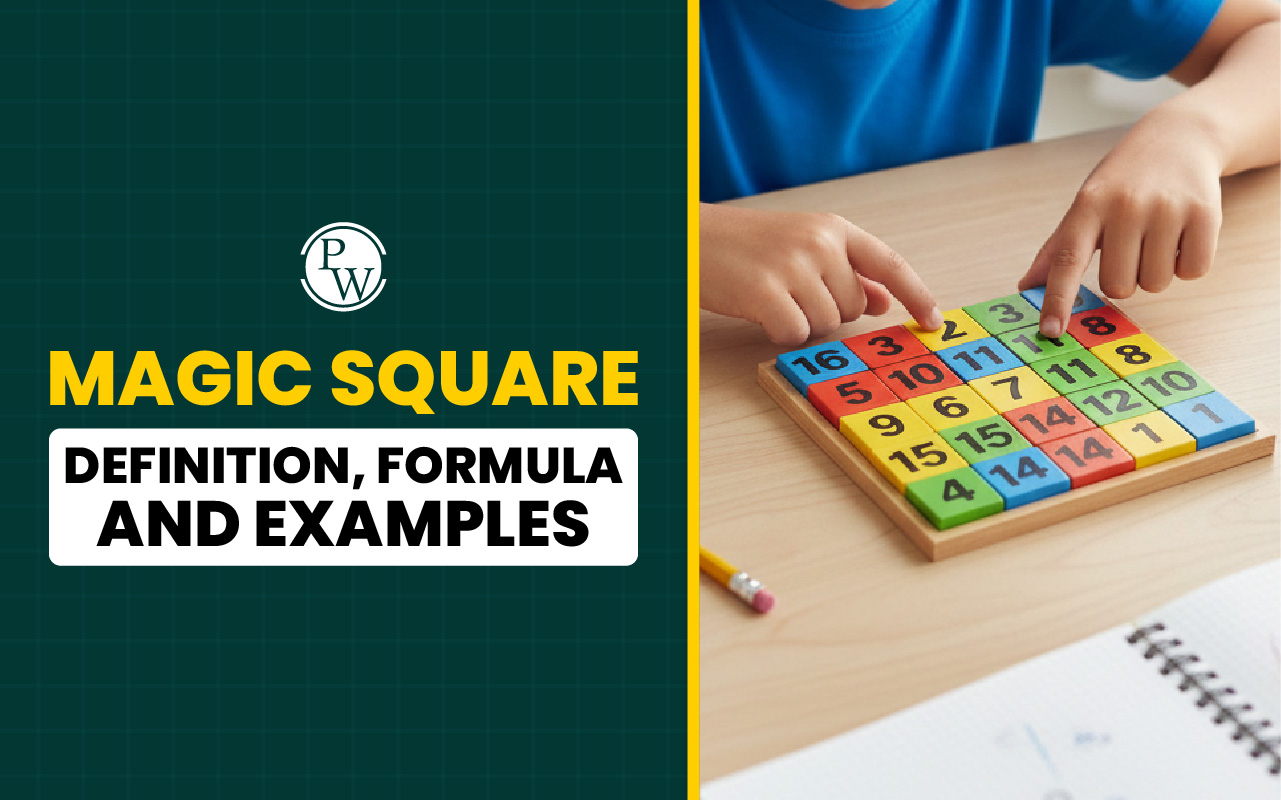
A magic square is a number grid in which the numbers are arranged so that every row, column and diagonal has the same sum.
Try this 3 × 3 magic square using the numbers 1 to 9:
| 8 | 1 | 6 |
| 3 | 5 | 7 |
| 4 | 9 | 2 |
Check the rows:
8 + 1 + 6 = 15
3 + 5 + 7 = 15
4 + 9 + 2 = 15
The columns and diagonals also add up to 15.
Magic sum: 15
Logic Puzzles for Class 4
Logic puzzles require students to use clues rather than only perform calculations.
Puzzle 1
A number is greater than 30 and less than 40. It is odd and divisible by 5. What is the number?
Answer: 35
Puzzle 2
There are 3 children. Each child has 4 pencils. How many pencils are there altogether?
3 × 4 = 12
Answer: 12 pencils
Puzzle 3
A clock shows 3:00. What angle is formed by the hour and minute hands?
At 3:00, the hands form a right angle.
Answer: 90°
Puzzle 4
I am a number between 40 and 50. I am divisible by 2 and 3. What number am I?
Answer: 42
42 is divisible by both 2 and 3.
Brain Teasers for Class 4
Here are some short maths brain teasers for Class 4.
-
What comes next: 7, 14, 21, 28, __?
Answer: 35 -
What is half of 100?
Answer: 50 -
What number comes immediately before 1,000?
Answer: 999 -
What number comes immediately after 499?
Answer: 500 -
Which is greater: 3/4 or 1/2?
Answer: 3/4 -
If one notebook costs ₹20, how much do 4 notebooks cost?
Answer: ₹80 -
A rectangle has 4 sides. How many sides do 3 rectangles have altogether?
Answer: 12 sides -
What is 25% of 100?
Answer: 25
Puzzles for Class 4 with Answers: Practice Set
Try these questions without looking at the answers first.
Questions
-
6, 12, 18, 24, __
-
100, 80, 60, 40, __
-
9 × __ = 72
-
64 ÷ 8 = __
-
25 + 17 = __
-
Find two consecutive numbers whose sum is 41.
-
Which number does not belong: 10, 20, 30, 41, 50?
-
A number is 15 more than 25. What is the number?
-
What is the next number: 1, 3, 5, 7, __?
-
A square has a side of 5 cm. What is its perimeter?
Answers
-
30
-
20
-
8
-
8
-
42
-
20 and 21
-
41
-
40
-
9
-
20 cm
How Math Puzzles Help Class 4 Students
Math puzzles can give students additional practice with skills they already learn in mathematics.
1. Number Sense
Number patterns and missing-number puzzles help students recognise relationships between numbers.
2. Logical Thinking
Students need to examine clues, identify patterns and decide which operation can solve a problem.
3. Calculation Practice
Addition, subtraction, multiplication and division puzzles provide practice without using only routine exercises.
4. Problem-Solving
Many puzzles require more than one step, helping students practise choosing and checking a solution.
5. Mathematical Communication
Explaining why an answer is correct helps students put their mathematical reasoning into words.
Students can practise number patterns, riddles, multiplication and logic-based questions through interactive maths learning on CuriousJr.
How to Solve Math Puzzles for Class 4
Use these simple steps when a puzzle seems difficult:
-
Read the question carefully.
-
Underline important numbers or clues.
-
Look for a pattern.
-
Decide which operation or method is needed.
-
Try a simple calculation.
-
Check the answer using the original question.
-
If your answer does not work, try another approach.
For visual puzzles, drawing a quick diagram can make the problem easier to understand.
Math Puzzle Worksheets for Class 4
A useful Class 4 maths puzzle worksheet can include different types of questions rather than repeating the same calculation.
A balanced worksheet may contain:
-
Number patterns
-
Missing-number puzzles
-
Addition and subtraction puzzles
-
Multiplication puzzles
-
Division puzzles
-
Maths riddles
-
Logic puzzles
-
Shape and geometry puzzles
-
Word problems
-
Brain teasers
An answer key is useful because students can check their work after attempting the questions themselves.
Easy Math Puzzles for Class 4
Students who are new to puzzles can start with simple questions.
Example 1: 10 + 5 = ?
Answer: 15
Example 2: 20 - 7 = ?
Answer: 13
Example 3: 4 × 5 = ?
Answer: 20
Example 4: 30 ÷ 5 = ?
Answer: 6
Example 5: 2, 4, 6, 8, __
Answer: 10
Once these become easy, students can move to multi-step puzzles and logic questions.
Quick Revision: Class 4 Math Puzzles
-
Math puzzles use numbers, patterns, operations and clues.
-
Number patterns can involve addition, subtraction, multiplication or division.
-
Maths riddles combine clues with mathematical reasoning.
-
Multiplication puzzles reinforce multiplication facts.
-
Logic puzzles require students to use information carefully.
-
Always check whether the final answer satisfies the original question.
-
Start with easy puzzles and gradually try more challenging ones.




Math Puzzles for Class 4 Students FAQs
1. What are math puzzles for Class 4?
2. Where can I find maths puzzles for Class 4 with answers?
3. What are some maths riddles for Class 4?
4. Are math puzzles useful for Class 4 students?
5. How can a Class 4 student solve a math puzzle?

Get Free Counselling Today
and Clear up all your Doubts
 Live & recorded classes available at easeDashboard for progress trackingLakhs of practice questions