
Tables Memorization Tricks Using Patterns for Class 2
 Nivedita Dar28 May, 2026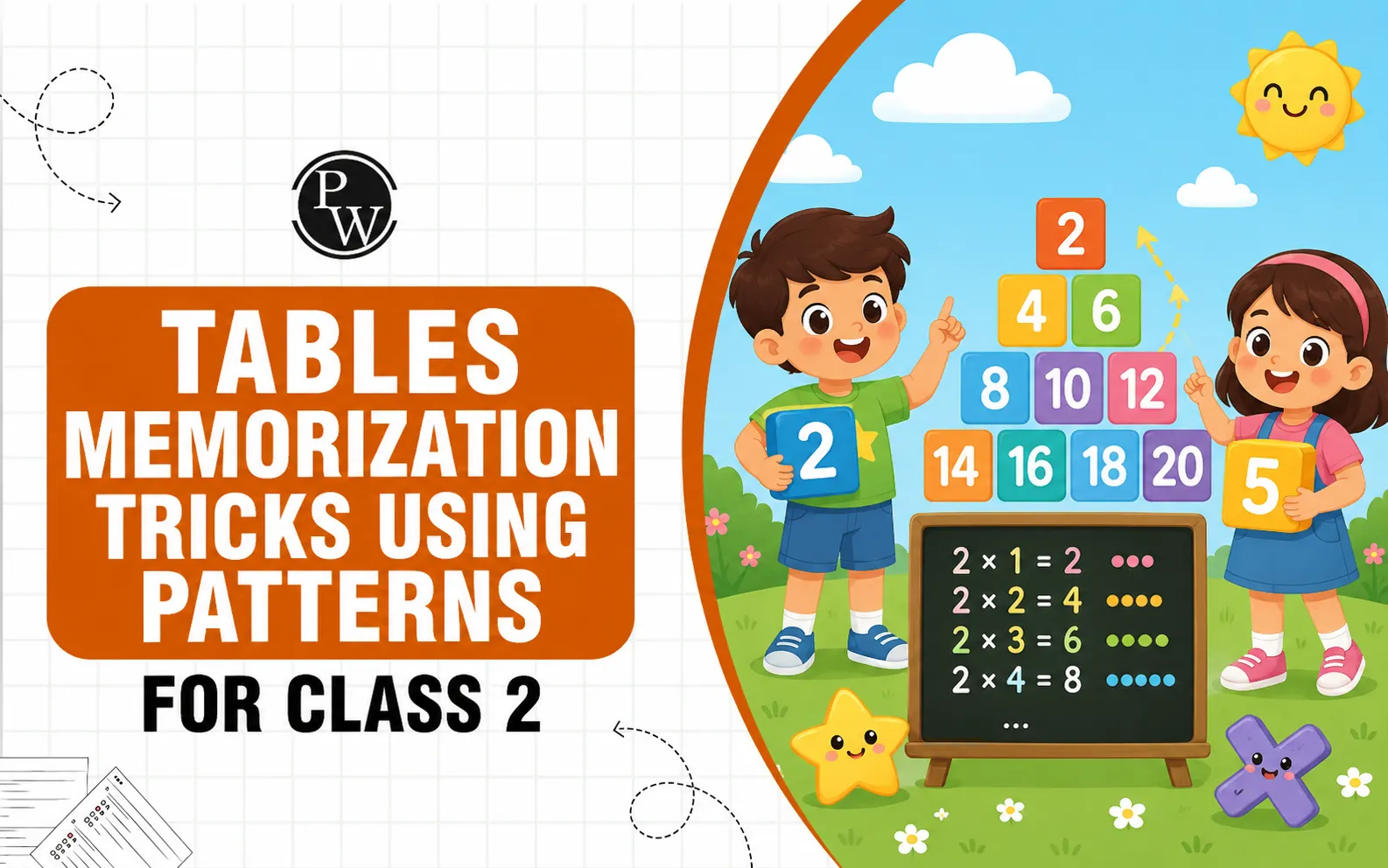
Starting with multiplication can feel like a massive mountain to climb for a seven-year-old. Many students struggle to move past rote learning, which leads to confusion and a lack of confidence during exams. This article focuses on tables memorization tricks specifically designed for Class 2 learners. Instead of just repeating numbers..
Importance of Tables Memorization Tricks
Using tricks for table memorization helps transition a child from simple addition to fast multiplication. In Class 2, the brain is highly receptive to visual patterns. When we teach kids to spot these patterns, they don't just "remember" a number; they "calculate" it instantly in their heads.
Benefits of using pattern-based learning:
-
Reduces Anxiety: Knowing a trick gives students a safety net if they forget a specific result.
-
Speed: Multiplication table tricks allow for faster answering during mental maths quizzes.
-
Foundation Building: It sets the stage for division and fractions in higher classes.
Simple Tables Memorization Tricks for 2, 5, and 10
The easiest way to start with tricks for table memorization is by focusing on the most rhythmic numbers: 2, 5, and 10. These form the backbone of mental maths.
The Doubling Rule for Table of 2
The table of 2 is essentially just doubling a number. To learn this class 2 maths tables hack, tell the student to add the number to itself.
-
2 x 3 is just 3 + 3 = 6.
-
2 x 8 is just 8 + 8 = 16.
Every answer in the table of 2 ends in 0, 2, 4, 6, or 8. This visual cue is a great tables learning hack.
The Clock Pattern for Table of 5
The table of 5 is a favourite because of its predictable pattern. All results end in either 5 or 0.
-
Odd numbers multiplied by 5 end in 5 (5, 15, 25).
-
Even numbers multiplied by 5 end in 0 (10, 20, 30).
Using a clock face is one of the best tricks for table memorization here, as each hour mark represents a multiple of 5.
The Zero Addition for Table of 10
This is the simplest of all multiplication tricks. Simply take the number you are multiplying and put a 0 at the end.
-
10 x 4 = 4 with a 0 = 40.
-
10 x 9 = 9 with a 0 = 90.
Read More - Mental Division Tricks for Class 2
How to Use Pattern Based Tables Memorization Tricks
As the numbers get slightly higher, students need more structured table memorization tricks. For the tables of 3 and 4, we look for hidden sequences.
The Square for Table of 3
To use this tables learning hack, draw a 3x3 grid (like Tic-Tac-Toe).
-
Write numbers 1 to 9 starting from the bottom-left box moving upwards.
-
In the top row, put a 0 in front of each number (03, 06, 09).
-
In the middle row, put a 1 in front (12, 15, 18).
-
In the bottom row, put a 2 in front (21, 24, 27).
This grid creates the first nine multiples of the table of 3 instantly!
The Double-Double Trick for Table of 4
If a student knows their table of 2, they already know the table of 4. This is a classic multiplication table trick.
-
To find 4 x 3, first double 3 (which is 6), then double it again (6 + 6 = 12).
-
To find 4 x 6, first double 6 (12), then double 12 (24).
This approach strengthens mental maths skills by reinforcing addition.
Tables Memorization Tricks for Higher Numbers
Even though Class 2 usually focuses on 1 through 10, introducing tricks for table memorization for numbers like 9 can give students a huge head start.
The Finger Trick for Table of 9
-
Hold up all ten fingers.
-
To find 9 x 3, fold down your third finger (from the left).
-
Count the fingers to the left of the folded one (2) and the fingers to the right (7).
-
Put them together: 27.
This tactile method is one of the most effective pattern based table techniques for young learners.
The Commutative Property Hack
One of the most important tricks for table memorization is teaching kids that 3 x 4 is the same as 4 x 3. This effectively halves the amount of information they need to learn. If they know the table of 2 and 5, they already know several parts of the tables for 6, 7, and 8.
Tables Memorization Trick Games
To make tables memorization tricks stick, you must move away from the desk. Mental maths should be active and engaging.
Try these activities:
-
Skip Counting Catch: Throw a ball and say "3". The child catches it and says "6". Throw it back for "9".
-
Target Practice: Write multiples of a table on paper cups. Call out a problem like "5 x 3" and have the child knock down the cup with "15" on it.
-
Number Staircase: Assign a number to each step of the stairs. As the child climbs, they recite the class 2 maths tables.
Read More - Speed Maths Test for Class 2 (Try Now)
Tables Memorization Trick Patterns
Applying these tricks for table memorisation consistently will transform how a child perceives mathematics. Instead of a subject based on memory, it becomes a subject based on logic and discovery. Encourage them to find their own patterns in pattern based table to boost their confidence even further.
|
Table |
The Pattern to Remember |
Ending Digits |
|
Table of 2 |
Double the number |
0, 2, 4, 6, 8 |
|
Table of 4 |
Double-Double the number |
0, 4, 8, 2, 6 |
|
Table of 5 |
Half of 10 |
0 or 5 |
|
Table of 9 |
Digits always add up to 9 |
Decreasing sequence |
|
Table of 10 |
Add a zero at the end |
Always 0 |
How CuriousJr Helps Kids Learn Tables Through Patterns
CuriousJr Mental Maths for Class 2 makes multiplication practice more engaging by combining visual learning, interactive activities, and mental maths techniques specially designed for young learners. Instead of relying only on rote memorisation, the platform encourages children to recognise number patterns, improve calculation speed, and build confidence step by step.
Here’s how CuriousJr supports Class 2 students with table memorization tricks:
-
Pattern-Based Learning: Kids learn to identify number sequences, skip counting methods, and visual multiplication patterns that make tables easier to remember.
-
Interactive Mental Maths Practice: Activities focus on strengthening Class 2 mental maths skills through quick calculations and logical thinking instead of repetitive mugging.
-
Step-by-Step Difficulty Levels: Students begin with simpler tables like 2, 5, and 10 before moving to advanced multiplication concepts gradually.
-
Fun and Engaging Exercises: Visual games, quizzes, and practical exercises help maintain interest while improving retention.
-
Confidence Building: Regular practice sessions help children answer multiplication questions faster during school tests and mental maths rounds.
By making multiplication more activity-driven and less stressful, CuriousJr helps children see maths as a subject of discovery and patterns rather than just memorization.