
Dialogue Writing in English: Format, Rules & Examples
 Shivam Singh22 Oct, 2026
What Is Dialogue Writing?
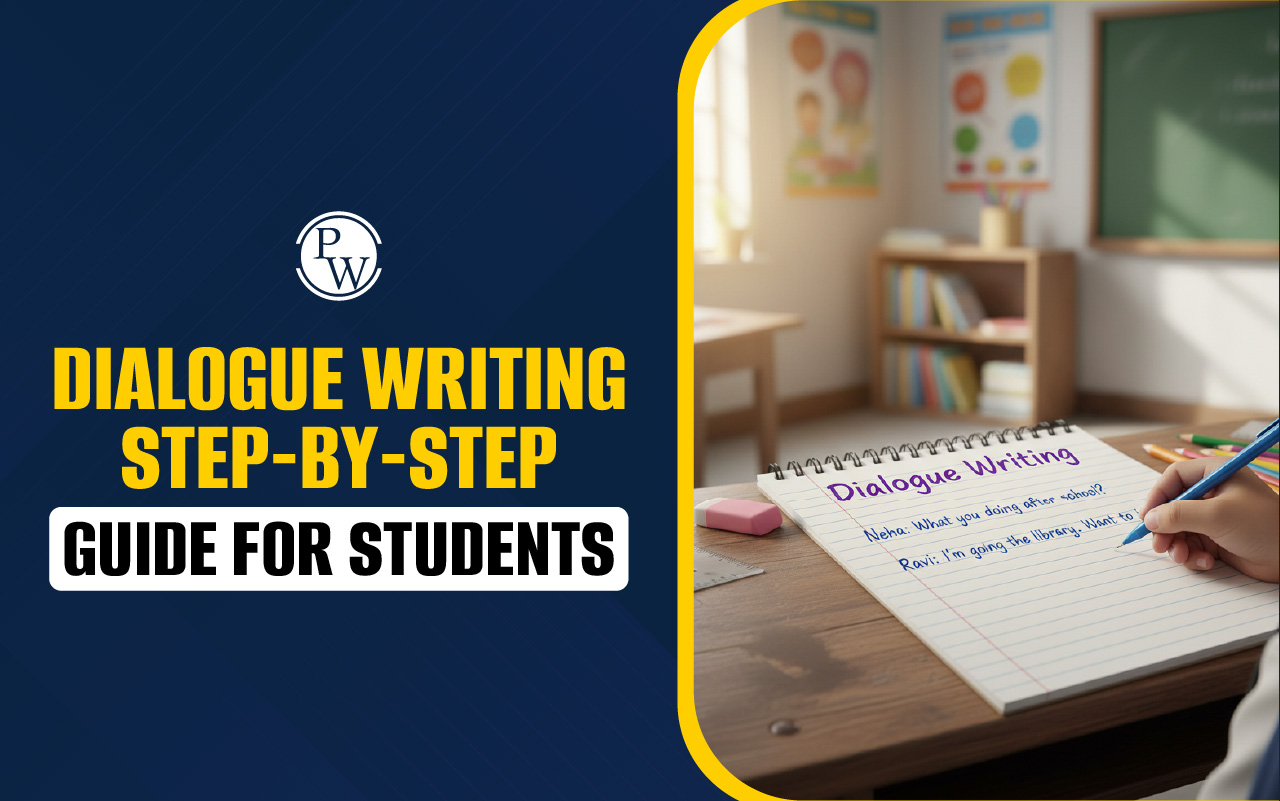
Dialogue writing is the written form of a conversation between two or more speakers. Each speaker shares information, asks questions, responds to another person, or expresses an opinion.
For example:
Riya: Are you going to the library?
Aman: Yes, I need to return a book.
Riya: Can I come with you?
Aman: Of course. Let’s go together.
This is an example of dialogue writing because two speakers exchange connected statements about a common topic.
Dialogue writing is different from narration. Narration describes an event, whereas dialogue presents the exact words spoken by the characters. Dialogue can be used in stories, plays, interviews, classroom activities, and everyday conversations.
At CuriousJr, students can learn dialogue writing in English through simple formats, essential rules, and practical examples to improve their communication and creative writing skills.
Dialogue Writing in English: Format
The dialogue writing format depends on the type of assignment. In school exercises, students often write the speaker’s name followed by a colon. In stories, spoken words are usually enclosed in quotation marks.
1. Speaker Format
This format is commonly used for school assignments and conversation-writing exercises.
Example:
Teacher: Good morning, students.
Student: Good morning, ma’am.
Teacher: Have you completed your homework?
Student: Yes, ma’am. I completed it yesterday.
In this format, write each speaker’s name or role before their words. Start every new speaker’s turn on a separate line.
2. Narrative Dialogue Format
In narrative writing, dialogue appears within a story. Quotation marks show the words spoken by each character.
Example:
“Are you coming to the library?” asked Rohan.
“Yes,” replied Arjun. “I need to return my book.”
Use a new paragraph when the speaker changes. Place punctuation correctly and use dialogue tags such as said, asked, replied, or explained when needed.
Basic Dialogue Writing Format
For a school assignment, follow this simple structure:
-
Write the topic or situation if the question requires it.
-
Introduce the speakers using their names or roles.
-
Write each speaker’s words on a separate line.
-
Keep the conversation connected to the given situation.
-
End the dialogue naturally after the purpose has been achieved.
CuriousJr English learning classes help students understand dialogue writing formats, follow the correct rules, and practise writing natural conversations to improve their English speaking, vocabulary, and writing skills.
How to Write a Dialogue in English
Follow these steps to write a clear and meaningful dialogue.
1. Choose the Situation
Decide what the speakers will discuss. It could be a conversation between friends, a student asking a teacher for help, buying something from a shop, or planning a school activity.
2. Identify the Speakers
Choose two or more speakers and decide their roles. Their relationship helps you select suitable words and expressions.
3. Decide the Purpose
Think about what the speakers want to communicate or achieve. For example, a student may want to understand a difficult question, or a customer may want to buy a notebook.
4. Write Connected Questions and Responses
Each line should relate to the previous one. Avoid unrelated statements or repeated information. The conversation should move towards a clear conclusion.
5. Use Suitable Language
Use simple, friendly language for conversations between friends. In formal situations, use polite expressions such as “Could you please explain?” and “Thank you for your time.”
6. Check the Dialogue
Read the conversation again. Check the speaker names, sentence structure, punctuation, spelling, and sequence of ideas. Make sure the dialogue sounds natural when read aloud.
Rules of Dialogue Writing
Following these dialogue writing rules makes conversations easier to read and understand.
Use Correct Punctuation
Use question marks for questions, full stops for statements, and commas where required. In narrative dialogue, punctuation must also follow the conventions of direct speech.
Example:
“Where are you going?” asked Neha.
“I am going to the market,” replied Riya.
Start a New Line When the Speaker Changes
Give each new speaker a separate line in a school dialogue. In narrative writing, begin a new paragraph when another character speaks.
Identify Speakers Clearly
Use names or roles such as Riya, Teacher, Customer, or Interviewer. In narrative dialogue, use dialogue tags when they help readers identify the speaker.
Use Quotation Marks for Direct Speech
When writing the exact words spoken by a character within a story, enclose those words in quotation marks.
Example: “I will help you,” said Meera.
In a speaker-label format, quotation marks are not usually necessary unless the assignment specifically asks for them.
Keep the Conversation Relevant
Every line should support the topic. Avoid adding unnecessary details that do not help the conversation progress.
Match the Tone to the Situation
Use informal language with friends and polite language when speaking to teachers, principals, customers, or interviewers.
Keep the Conversation Natural
People respond to what others say. Use realistic questions, answers, and reactions rather than making every line sound like an unrelated statement.
Dialogue Writing Examples
The following dialogue writing examples cover common situations students may encounter in English assignments.
Example 1: Dialogue Between Two Friends
Ravi: Have you completed your homework?
Aman: Yes, I finished it yesterday.
Ravi: Did you understand the last question?
Aman: It was difficult at first, but I understood it after checking the example.
Ravi: Could you explain it to me?
Aman: Sure. Let’s solve it together.
Ravi: Thank you. That would be helpful.
Example 2: Dialogue Between a Student and a Teacher
Student: Good morning, ma’am. May I ask you a question?
Teacher: Good morning. Of course. What would you like to know?
Student: Could you please explain the last question again?
Teacher: Certainly. Let’s solve it step by step.
Student: I understand it now. Thank you, ma’am.
Teacher: You’re welcome. Keep practising.
Example 3: Dialogue at a Shop
Customer: Excuse me, how much does this notebook cost?
Shopkeeper: It costs fifty rupees.
Customer: Do you have a larger notebook?
Shopkeeper: Yes, this one costs seventy rupees.
Customer: I will take the larger one, please.
Shopkeeper: Certainly. Here you are.
Customer: Thank you.
Example 4: Dialogue Between a Parent and Child
Mother: Have you packed your school bag?
Child: Yes, I have packed my books and notebooks.
Mother: Did you put your lunch box in the bag?
Child: Not yet. I will put it in now.
Mother: Please check your timetable before leaving.
Child: Okay, Mom. I will check it.
Example 5: Formal Dialogue Writing
Interviewer: Good morning. Please introduce yourself.
Candidate: Good morning. My name is Priya Sharma. I recently completed my graduation.
Interviewer: What interests you about this position?
Candidate: I am interested in learning new skills and contributing to the team.
Interviewer: What are your strengths?
Candidate: I am organised, willing to learn, and comfortable working with others.
Interviewer: Thank you for your answers.
Candidate: Thank you for the opportunity.
Also Read: Speech on kindness for students, along with helpful tips and simple examples. Learn how to express the importance of empathy, helping others, and spreading kindness in everyday life.
Short Dialogue Writing in English
Short dialogue writing in English uses a few lines to present a complete conversation. It is useful for classroom exercises, examinations, and assignments that specify a limited number of exchanges.
Example 1: Borrowing a Book
Neha: Can I borrow your science book?
Meera: Sure. Do you need it today?
Neha: Yes, I have to complete my homework.
Meera: Here you go. Please return it tomorrow.
Neha: Thank you. I will.
Example 2: Making a Plan
Aarav: Are you free this evening?
Kabir: Yes. Why do you ask?
Aarav: Would you like to play football?
Kabir: Sure. Let’s meet at five.
Aarav: Great! See you then.
Example 3: Asking for Directions
Riya: Excuse me, could you tell me the way to the library?
Man: Go straight and turn left at the crossing.
Riya: Is it far from here?
Man: No, it is about five minutes away.
Riya: Thank you for your help.
Man: You’re welcome.
Dialogue Writing Examples for Students by Class
Students should choose words and sentence structures that match their class level. Younger students can practise short, familiar conversations, while older students can write longer dialogues with more detailed responses.
Dialogue Writing for Class 3
Topic: Getting Ready for School
Mother: Have you finished your breakfast?
Riya: Yes, Mom.
Mother: Have you packed your school bag?
Riya: Yes, I have packed my books.
Mother: Good. Let’s get ready to leave.
Riya: Okay, Mom.
Dialogue Writing for Class 4
Topic: Talking About Homework
Aman: Did you finish your English homework?
Rohan: Yes, I completed it last evening.
Aman: Was the story difficult to understand?
Rohan: No, it was interesting. Did you read it?
Aman: Not yet. I will read it today.
Rohan: I think you will enjoy it.
Dialogue Writing for Class 5
Topic: Planning a School Project
Teacher: Have you selected a topic for your project?
Student: Yes, ma’am. We want to work on saving water.
Teacher: What will you include in the project?
Student: We will explain why water conservation is important and suggest ways to save water.
Teacher: That sounds useful. Remember to include examples.
Student: We will, ma’am. Thank you.
Dialogue Writing for Class 6
Topic: Preparing for an Examination
Riya: Have you started preparing for the science examination?
Meera: Yes, I have revised two chapters.
Riya: Which chapter do you find difficult?
Meera: I need more practice with electricity.
Riya: We can revise it together after school.
Meera: That would be great. Let’s solve some questions.
Dialogue Writing for Class 7
Topic: Discussing a School Activity
Student: Good morning, ma’am. Our class would like to organise a cleanliness drive.
Teacher: That is a good idea. Have you discussed the plan?
Student: Yes, ma’am. We want to clean the school garden and put up awareness posters.
Teacher: How will you divide the responsibilities?
Student: We will form small groups and assign a task to each group.
Teacher: Please prepare the schedule and share it with me.
Student: Certainly, ma’am.
Dialogue Writing for Class 8
Topic: Discussing Environmental Protection
Aarav: Do you think students can help reduce plastic waste?
Kabir: Yes. We can use reusable bottles and avoid single-use plastic.
Aarav: Our school could also organise an awareness campaign.
Kabir: That would help students understand the effects of plastic pollution.
Aarav: We could prepare posters and explain better alternatives.
Kabir: Let’s discuss the idea with our teacher.
Also Read, Inspiring thoughts of the day for students to boost motivation, build confidence, and develop a positive mindset. Find meaningful quotes about success, hard work, discipline, and learning.
Formal Dialogue Writing
Formal dialogue writing is used in academic, professional, or official situations. It requires respectful language, complete sentences, and a clear purpose.
Common situations include:
-
A student speaking to the principal
-
An interview between a candidate and an interviewer
-
A customer speaking to a service representative
-
A student asking a teacher for clarification
-
A meeting between team members
Example: Conversation Between a Student and a Principal
Principal: Good morning. How can I help you?
Student: Good morning, sir. I would like permission to organise a reading activity.
Principal: What is the purpose of the activity?
Student: We want to encourage students to read more books and share their favourite stories.
Principal: Have you prepared a schedule?
Student: Yes, sir. We have prepared a plan and a list of activities.
Principal: Please submit the plan for review.
Student: Certainly, sir. Thank you for your time.
Conversation Writing in English
Conversation writing in English is closely related to dialogue writing. Both involve an exchange of ideas between two or more speakers. The terms are often used interchangeably in school assignments.
A good conversation includes a clear topic, connected questions and answers, suitable language, and a natural ending.
Example: Conversation About a Science Exhibition
A: Did you attend the science exhibition yesterday?
B: Yes, I did. There were many interesting models.
A: Which model did you like the most?
B: I liked the water filtration model because it showed how water can be cleaned.
A: Did the students explain how it worked?
B: Yes. They demonstrated each step and answered our questions.
A: I wish I had attended it.
B: You should visit the next exhibition. It was very informative.
Also Read, Informal letter format in English with examples, topics, and easy writing tips. Understand the structure, greetings, body, and closing to write friendly letters to friends and family.
Tips for Effective Dialogue Writing
Use these tips to make your dialogue writing clearer and more natural:
-
Understand the topic: Identify the situation and the purpose of the conversation before writing.
-
Choose suitable speakers: Decide who is speaking and how they know each other.
-
Keep the language simple: Use words that suit the speakers and the class level.
-
Write connected responses: Make every line relate to what was said before.
-
Follow the correct format: Use speaker labels or narrative dialogue according to the assignment.
-
Check punctuation: Review question marks, full stops, commas, and quotation marks.
-
Avoid repetition: Do not repeat the same idea in several lines.
-
End naturally: Finish when the purpose of the conversation has been achieved.
-
Read it aloud: Check whether the speakers sound natural and the conversation is easy to follow.




Dialogue Writing FAQs
What is dialogue writing in English?
What is the format of dialogue writing?
What are the main rules of dialogue writing?
How do you write a short dialogue in English?

Get Free Counselling Today
and Clear up all your Doubts
 Live & recorded classes available at easeDashboard for progress trackingLakhs of practice questions