Spatial Reasoning Mental Maths Tricks for Class 4
 Nikita Aggarwal29 May, 2026
What is Spatial Reasoning?
The ability to think in terms of shapes, patterns and spaces is known as spatial reasoning. It includes tracking the part-relationships between how things fit together, wherein four objects maintain a pair-open-tracking-turning relation to other spatialising points on either side. Rather than relying solely on written equations or brute force calculation, a student gifted in spatial ability has mental images that make it possible to easily solve problems.
A learner in Class 4 can develop spatial reasoning by focusing on a few key things.
-
Visualising shapes and objects accurately without needing to draw them on paper.
-
Understanding positions and directions such as left, right, up, down, front, and back.
-
Mentally rotating or flipping objects along a specific axis.
-
Recognising patterns, symmetry, and visual layouts in everyday math worksheets.
Although parents may often focus their attention solely on traditional mental Maths skills, they should also consider other vital primary Maths skills. However, the primary foundation of early math is visual meaning with spatial layouts and pattern recognition. Such children may have difficulty completing jigsaw puzzles, writing that is messy and with uneven spacing or being perplexed about the understanding of 2D/3D shapes.
Best Spatial Reasoning Mental Maths Tricks
Some studies on spatial skills training are not as awful as you might think. Train a child's brain to process visual information at speed, by introducing structured spatial reasoning mental Maths tricks Here are six visual shortcuts which take primary school Maths from boring to exciting.
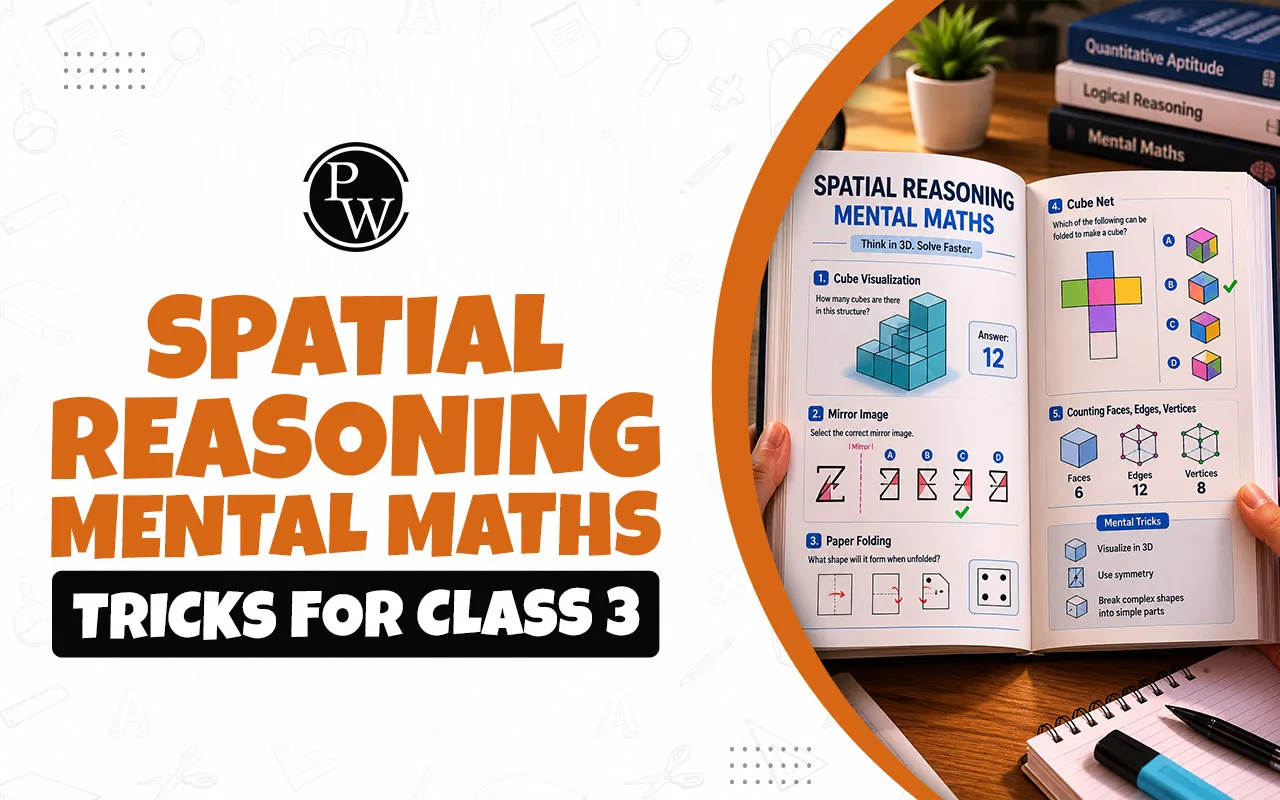
1. The Shape Rotation Trick
This method provides kids the skill to mentally rotate objects rather than either physically turning over paper or haphazard guessing. Students should be working something like the following into their heads: we see that a shape turns in one of three ways—left, right or upside down.
To perfect this skill, make your child focus on a specific portion of the shape — an arrow tip or long edge or dark corner. Have them focus on that particular feature and picture it rotating like a clock hand.
-
Example: "What will a square look like after one turn?" If a square has a small dark circle in its top-left corner, one clockwise turn shifts that circle to the top-right corner. The overall square shape stays the same, but the inner detail moves predictably.
2. The Mirror Image Trick
In mirror imaging, children have to reverse a pattern along an axis while keeping the proportions of it intact. Students wonder how a shape or pattern would appear in its mirror image.
Rule of proximity: features closest to the mirror line must remain nearest in the mirrored image. If any feature is pointing away from the line, then its reflection must point in the opposite direction of the arrow that points outward.
-
Example: If the letter "L" faces left, how will it look in a mirror placed on its right? The horizontal bottom bar points away from the mirror line to the left. In the reflection, that bottom bar will flip and point away to the right, reversing the character.
3. The Pattern Spotting Trick
Patterns are the foundation of geometry and structural Maths. This section is where you help your kids find that missing shape or number in the sequence.
Do not treat a sequence as just gibberish; feed it information until it realises the pattern. Teach how to pronounce shapes in order so that they find their cadence. Easily identify the next element and avoid repeating using blocks. This tactic is ideal for the visual reasoning questions that are often part of grade four papers.
-
Example: Look at the following sequence: Triangle, Circle, Triangle, Circle, Blank. By reading the sequence aloud, the pattern becomes obvious. The missing answer at the end of the line is a triangle.
4. The Visual Counting Trick
When children count many items one by one, they often get lost. This is a trick which teaches them to count objects quickly by grouping instead of counting individually.
This strategy naturally connects to multiplication and division. Look for symmetry or pairs in a small bunch of chaos, and let your child scale the numbers up in their head.
-
Example: If a page contains a messy scattering of dots, see 12 dots as 3 groups of 4. By multiplying 3 by 4 mentally, the child finds the total of 12 instantly, eliminating the risk of double-counting or skipping a dot.
Read More - Mental Division Tricks for Class 4
5. The Block Building Trick
It helps students move from flat drawings to 3D buildings. We picture blocks stacked to figure out total volume or a structure.
When they see a drawing of a block tower, children tend to overlook the lower layers that support them and perceive only what is above ground. So, you start from the ground up. Teach them to look row-wise or column-wise. This method greatly cultivates the 2D and 3D forms of geometries.
-
Example: "How many cubes are in this tower?" If a tower peaked at one cube resting on top of a lower layer, the student must remember that there is a hidden foundation cube directly underneath that peak supporting it. They count the visible exterior faces and add the hidden base blocks to find the true total.
6. The Direction Sense Trick
This technique is a hybrid of spatial mapping and active navigation. Students rely on mental directions such as left, right, north and south when following the paths of movements across an imaginary grid.
Ask your child to close their eyes and visualise themselves on a giant game board. The exercise links abstraction compass directions to the physical orientation of body parts.
-
Example: Take 2 steps forward, 1 step right — where are you now? By mapping this pathway mentally, the student tracks their final position relative to their starting point without needing to physically walk across the room.
Read More - Class 4 Word Problem Solving Tricks
Benefits of Spatial Reasoning Mental Maths Tricks
Regular work with such mental Maths tricks for kids introduces a new perspective to the students regarding this subject. This approach takes away the worry of dealing with abstract numbers and geometric shapes, offering structural brain benefits that aid in overall school success:
-
Boosts Calculation Speed: Spatial array-aware learners can group blocks or clusters of numbers with ease. This is why left-to-right addition or splitting numbers (after multiplication) is much faster.
-
Reduces Careless Mistakes: Using visual tracking, students can check their answers right away. If they are able to represent a geometry problem in their heads, they can tell as soon as the written numerical answer is impossible.
-
Improves Page Layout and Writing: Learning how to track the space between letters can assist children with spacing on whispering sheets where words will be complete without overlapping or more bizarre with uneven numbers.
-
Prepares for Advanced Exams: Visual reasoning puzzles are a staple in primary school placement tests and early Maths Olympiads that also aim to identify children with a higher level of mathematical ability.
How Does CuriousJr Help with Class 4 Mental Maths Tricks?
CuriousJr is a straightforward way to succeed when the Class 4 learner finds multi-step word problems, fractions, or geometry challenging. The platform emphasises active logic and visual learning instead of memorisation.
Here is how CuriousJr online kids mental maths class transforms the ways of your kid's primary Maths journey:
-
Interactive Gamified Learning: CuriousJr gamifies spatial thinking puzzles and calculation tasks into different levels of games. Students learn mental shortcuts as they progress through story-driven modules.
-
Syllabus Alignment: It perfectly aligns with the Class 4 school syllabus by combining fundamental mathematics with some key visual concepts, including shape, symmetry and measurement sequences.
-
Vedic Mathematics Strategies: Students acquire effective mental calculation strategies; they will choose from available tools like complements, doubling and halving, and splitting numbers for computing rapidly without requiring rough paper.
-
Clear Visual Aids: For students intimidated by straight numbers, CuriousJr implements a simple yet effective strategy of spatial grouping and representational blocks that make every student see the math happening in front of their eyes.
-
Live Guided Coaching: Stepwise, engaging student-teacher interaction in live sessions; clear and patient instruction from expert educators helps foster a sense of enduring school confidence.