
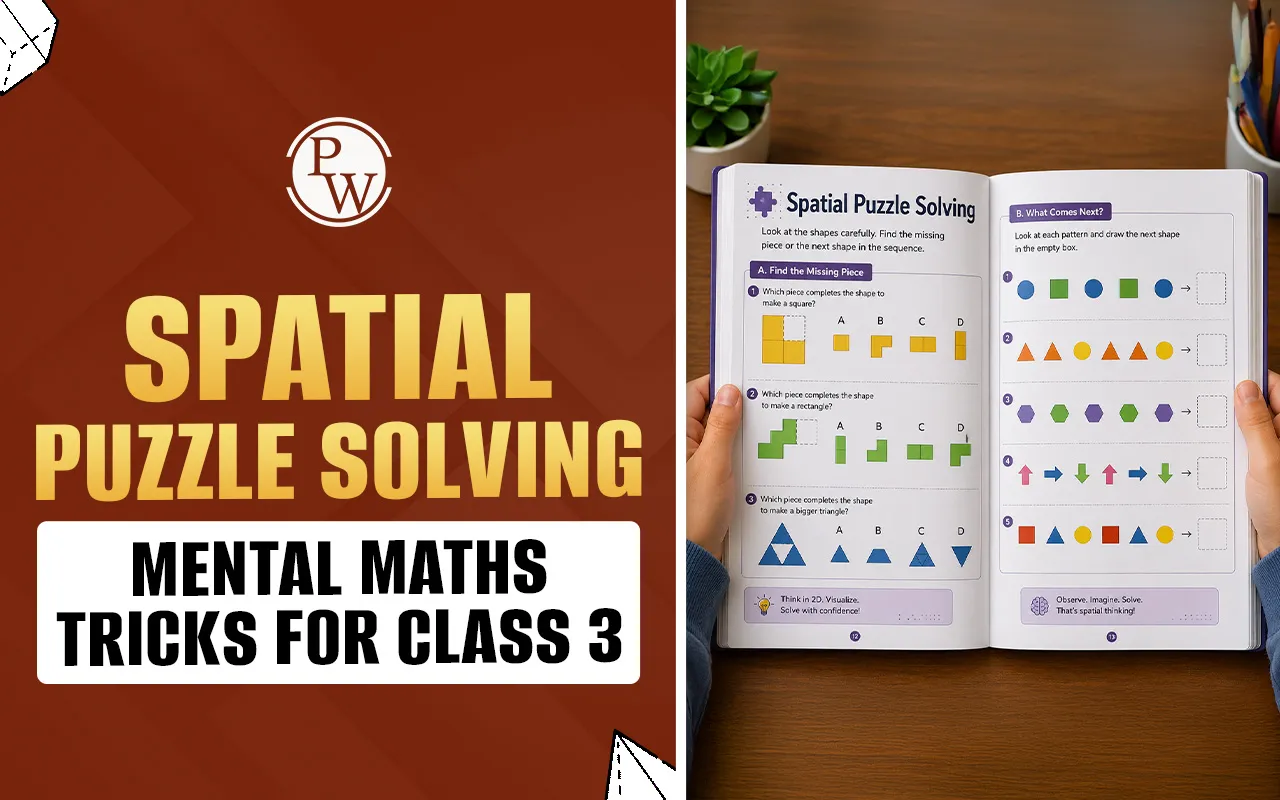
Spatial Puzzle Solving Mental Maths Tricks for Class 3
 Nikita Aggarwal29 May, 2026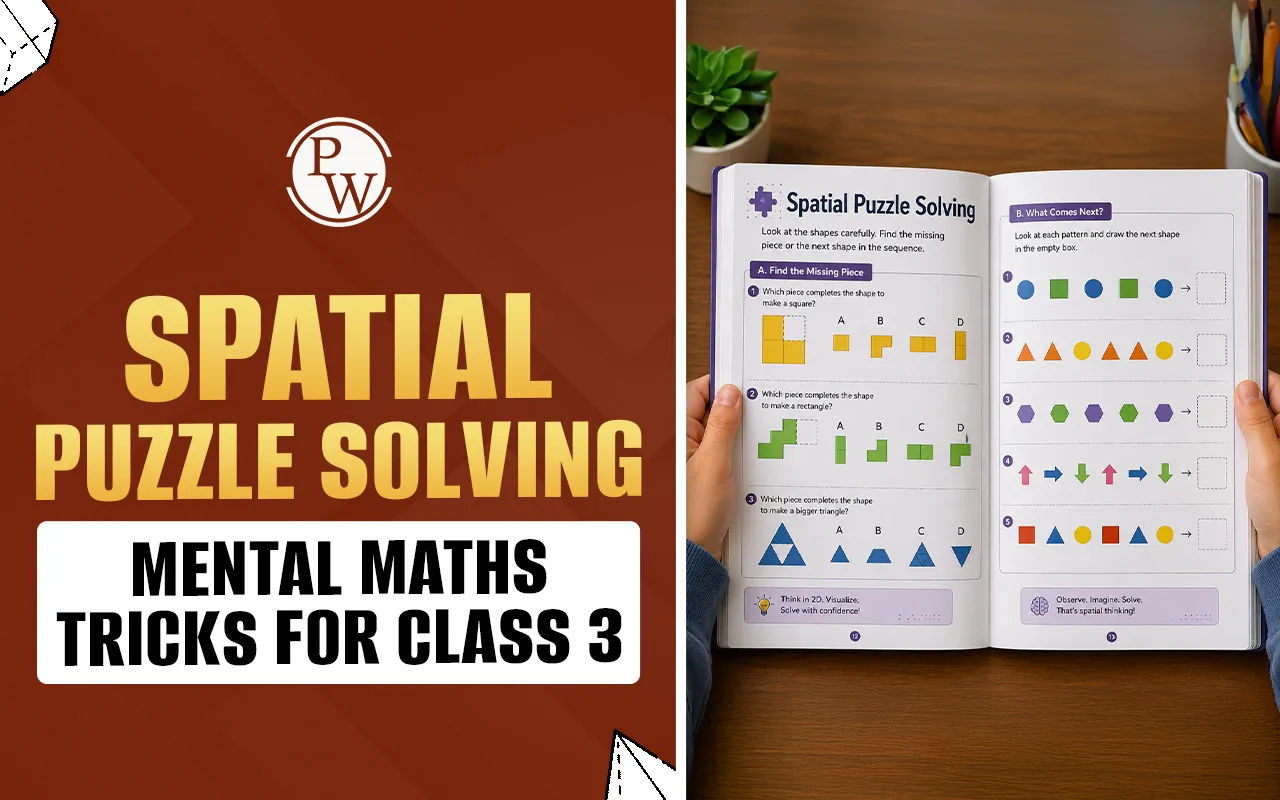
Importance of Spatial Puzzle Solving Mental Maths Tricks
Learning spatial puzzle solving mental maths tricks helps children connect visual thinking with number solving.
Faster Mental Calculations
Children stop depending only on finger counting and start using mental pictures and number patterns.
-
Better Shape Understanding: Children quickly notice corners, edges, straight lines, and curved shapes.
-
Less Test Fear: Fast puzzle solving helps children stay calm during class tests and maths activities.
-
Stronger Logical Thinking: Children learn how to predict patterns, solve grids, and understand number layouts.
-
Better Focus: Puzzle activities train children to carefully observe details before answering.
How to Learn Spatial Puzzle Solving Mental Maths Tricks at Home?
Parents do not need expensive toys or kits for class 3 spatial puzzles practice. Simple home items work very well.
Parents can use:
-
Paper
-
Cardboard
-
Colour sheets
-
Blocks
-
Toys
-
Magazines
These activities help children improve thinking skills while having fun.
Spatial Puzzle Solving Mental Maths Tricks with Paper Puzzles
One simple activity is making paper shape puzzles.
How to Play
-
Draw shapes on paper
-
Cut the paper into puzzle pieces
-
Ask the child to join the pieces correctly
Parents can guide children using simple instructions like:
-
“Find the corner piece.”
-
“Turn this shape sideways.”
-
“Look for the flat edge.”
This activity improves shape-matching and visual thinking skills.
Read More - 10-Second Addition Tricks for Class 3
Spatial Puzzle Solving Mental Maths Tricks for Visual Shape Sequences
Pattern activities are excellent for visual puzzle-solving grade 3 practice.
Example
Circle → Square → Triangle → Circle → Square →?
The answer is:
Triangle
Children learn to split the sequence into repeating groups.
This skill later helps with multiplication tables and number patterns.
Spatial Puzzle Solving Mental Maths Tricks Using Repeating Patterns
Many kids mental maths tricks use repeating patterns because they improve quick thinking.
Example
Star → Heart → Star → Heart → Star →?
The missing shape is:
Heart
Children slowly learn how to notice patterns without writing or counting every item.
This improves mental speed and confidence.
Spatial Puzzle Solving Mental Maths Tricks with Magic Squares
A magic square uses a grid where every row and column gives the same total.
Example Grid
|
2 |
7 |
6 |
|
9 |
5 |
1 |
|
4 |
3 |
8 |
Every row, column, and diagonal equals:
15
Easy Solving Method
Step 1
Find rows with missing numbers.
Step 2
Add the numbers already given.
Step 3
Subtract from 15 to find the missing number.
Children slowly learn how to solve grid maths mentally instead of writing long calculations.
Read More - Learn Subtraction Without Borrowing (Class 3)
Spatial Puzzle Solving Mental Maths Tricks with Clock Activities
Time questions often confuse young learners. Using clocks makes maths easier and more visual.
Example
If the clock shows 9 o’clock now, what time will it be after 5 hours?
Children can move step by step:
-
10
-
11
-
12
-
1
-
2
The answer is:
2 o’clock
This activity helps children understand how numbers move around a clock.
Spatial Puzzle Solving Mental Maths Tricks with Sock Puzzles
Simple home puzzles also improve logical thinking.
Example
A drawer has:
-
White socks
-
Blue socks
How many socks must you pick to guarantee one matching pair?
Easy Thinking Method
-
First sock may be white
-
The second sock may be blue
-
The third sock must match one colour
So the answer is:
3 socks
This activity teaches children how to think step by step instead of guessing.
Spatial Puzzle Solving Mental Maths Tricks with Shape Rotation
Children also improve by learning how shapes turn or move.
Parents can ask:
-
“What happens if we turn this triangle?”
-
“Which side moves to the top?”
-
“Which shape still looks the same after turning?”
These small games improve visual memory and shape understanding.
Spatial Puzzle Solving Mental Maths Tricks with Building Blocks
Blocks are excellent tools for puzzle learning.
Children can:
-
Build towers
-
Copy designs
-
Match shapes
-
Create patterns
These activities improve:
-
Hand-eye coordination
-
Shape recognition
-
Logical thinking
-
Visual planning
Children also enjoy learning more when using real objects.
Spatial Puzzle Solving Mental Maths Tricks for Daily Practice
Children improve faster with small daily practice sessions.
Parents can spend 10 to 15 minutes daily doing:
-
Shape puzzles
-
Grid games
-
Pattern matching
-
Clock questions
-
Block activities
Short daily learning works better than long study sessions.
Children slowly become more confident in maths class.
Spatial Puzzle Solving Mental Maths Tricks Using Number Splitting
Number splitting is another useful trick.
Example
29 + 6
Instead of counting slowly:
-
Add 1 to make 30
-
Add the remaining 5
30 + 5 = 35
This method makes mental addition much easier.
Children slowly learn faster calculation methods without stress.
Spatial Puzzle Solving Mental Maths Tricks with Real Objects
Parents can use daily household objects for learning.
Kitchen Activity
Ask children to arrange:
-
Plates
-
Cups
-
Spoons
into matching patterns.
Toy Sorting
Children can group toys by:
-
Size
-
Shape
-
Colour
These simple games build strong observation and sorting skills.
How to Learn Spatial Puzzle Solving Mental Maths Tricks with CuriousJr?
CuriousJr online mental maths class chelps children learn spatial puzzle solving mental maths tricks through fun online classes, games, and visual activities. The platform makes maths simple and interesting for Class 3 students by turning difficult topics into easy puzzle-based learning.
-
Interactive Puzzle Games: Children solve fun visual maths puzzles that improve thinking speed and problem-solving skills.
-
Easy Step-by-Step Learning: Lessons start with simple activities and slowly move towards harder maths puzzles and spatial challenges.
-
Friendly Teacher Guidance: Teachers help children during practice sessions and explain mistakes in a simple and easy way.
-
Better Maths Confidence: Children improve speed, accuracy, focus, and confidence for school maths and class tests.