Reflex Angle - Definition, Degree, Examples
 Nikita Aggarwal20 Jan, 2026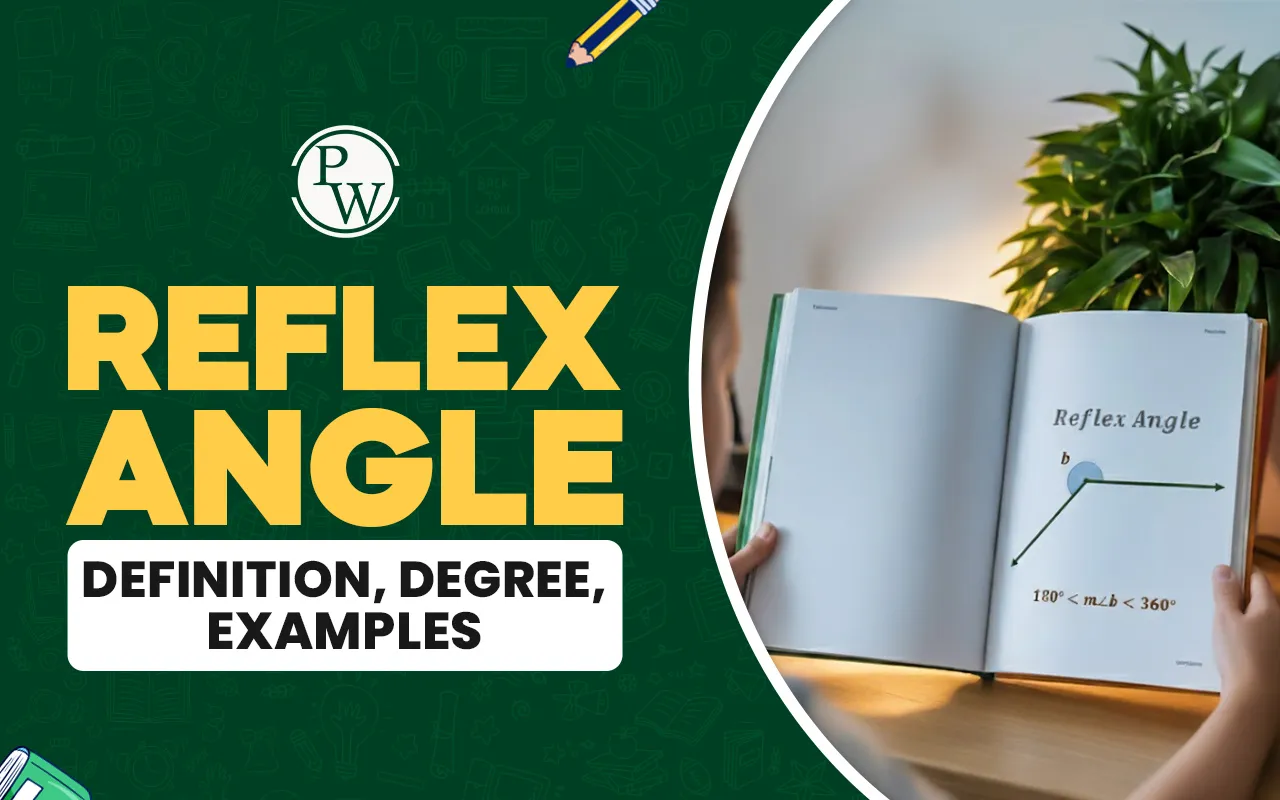
Reflex Angle
A reflex angle is an important concept in geometry that helps students understand angles that are larger than a straight line but smaller than a full circle. The angles are calculated using the first angle and the terminal angle of a rotation steeper than a straight angle. In more simple words, reflex angle is the greater part of the rotation between two lines or rays.
Reflex angles are widely used in mathematics, engineering, art, and everyday contexts where circular or rotational patterns appear. It is a basic step to get to know what the reflex angle is in order to establish a strong background in geometry. It also introduces the students on more advanced matters like polygons, circular motion and trigonometry.
Students can learn about the reflex angle definition, the range of reflex angle degrees, how to measure a reflex angle, reflex angle examples in real life and more below.
Reflex Angle Definition
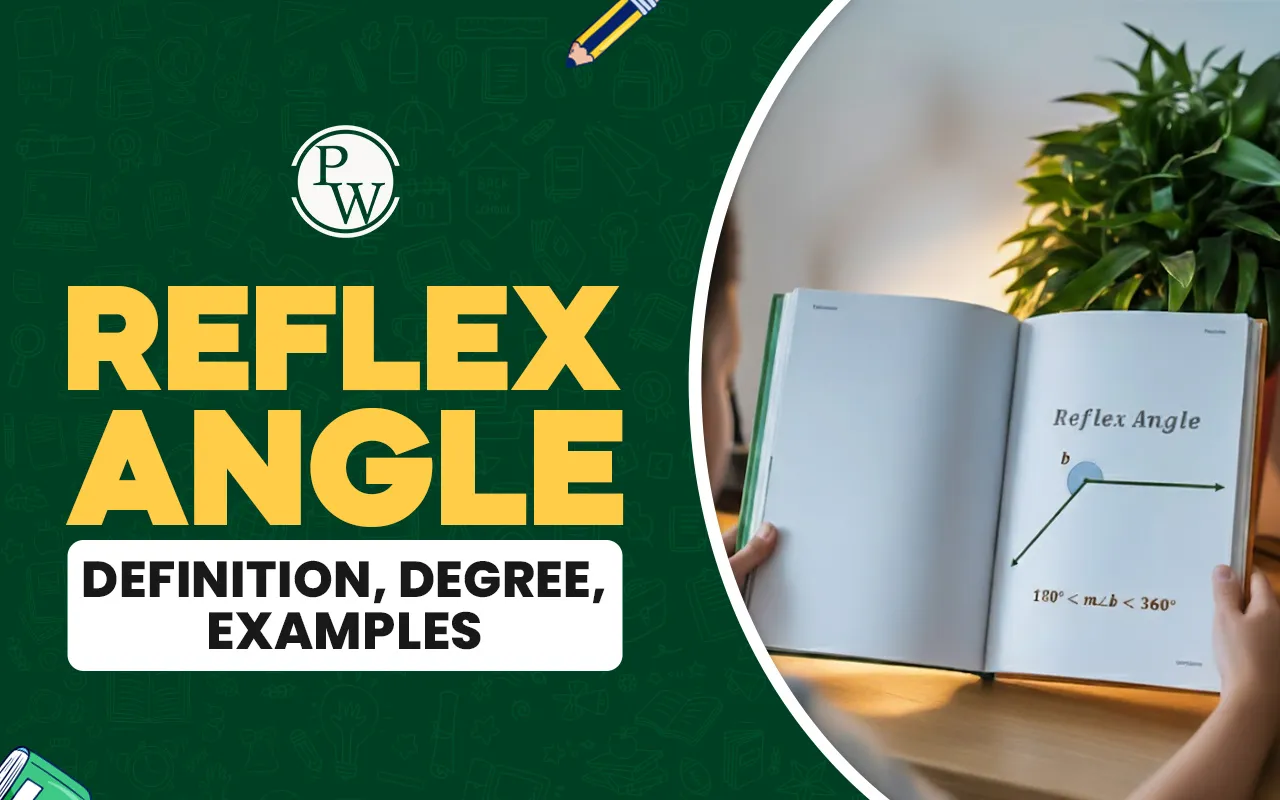
Reflex angle definition states that it is an angle that measures more than 180° but less than 360°. Geometrically, it is the larger angle formed when two rays or lines meet at a point and the rotation extends beyond a straight line but does not complete a full circle.
Key characteristics of a reflex angle include:
-
Measures greater than a straight angle (180°)
-
Measures less than a complete circle (360°)
-
Represents the larger rotation between two lines or rays
Understanding this definition helps distinguish reflex angles from other types of angles: acute, right, obtuse, and straight angles.
Read More - Segment of a Circle, Types, Formula, Properties, Examples
Reflex Angle Degree
Reflex angle degrees describe the numerical measurement of a reflex angle. A reflex angle is always greater than 180° and less than 360°.
Range of Reflex Angle Degrees:
-
Minimum: Just above 180°
-
Maximum: Just below 360°
Properties of Reflex Angle Degrees:
-
Reflex angles appear as wide, sweeping angles in diagrams.
-
Every reflex angle has a smaller corresponding angle that, together, sum to 360°.
For instance, if the smaller angle between two rays is 120°, then the reflex angle can be calculated as: 360° − 120° = 240°
Read More - Perimeter of a Sector- Definition, Types, Examples
How to Measure Reflex Angle?
Knowing how to measure a reflex angle is crucial for geometry students, especially since most protractors measure up to only 180°. Reflex angles require a combination of measurement and calculation techniques. The following are the methods to measure a Reflex Angle:
1. Using a Protractor:
-
Measuring the smaller angle (smaller than 180 degrees) is the first to measure.
-
Calculate the difference between this angle and 360 degrees to obtain the reflex angle.
2. Mathematical Calculation:
-
When the angle between any two lines is known, the angle of reflexion is determined by using the formula:
Reflex Angle = 360° − Known Angle
3. Using Geometry Tools:
-
In circular diagrams, the reflex angle can be calculated by use of the arc length or rotation.
-
Reflex angle degrees can be calculated by the help of center points and radius measurements.
Tips:
-
Identify whether the angle in question is the smaller or larger rotation.
-
Reflex angles are often marked with a curved arrow showing the larger rotation.
Read More - Construction in Maths: Methods and Examples
Reflex Angle Examples in Real Life
Reflex angles occur in many real life situations. Looking at them will make students relate geometry concepts to real-life applications.
Examples of the common Reflex Angle in real life are listed below:
-
Clock Hands: At times when a clock has a big angle between the hour and minute hands, e.g., at 10:10, the angle between the two hands is a reflex angle.
-
Windshield Wipers: The sweeping movement of wipers is usually a reflex angle.
-
Rotating Fans: During rotation of fan blades, reflex angles are involved.
-
Tripods: The tripod legs are the angles of the legs which are reflexed with the central axis to provide stability.
-
Art and Architecture: Reflex angles are applied to abstract art, sculpture, and modern construction to construct dynamic and appealing edifices.
Improve Math Speed and Confidence with PW CuriousJr’s Mental Maths Course
PW CuriousJr is a well-constructed Mental Maths Course that the student can use to increase their speed, accuracy, and confidence when calculating problems. The course is divided into steps with emphasis on key topics in math in order to equip the students with skills in a gradual and successful manner.
The course focuses on the ability to resolve problems in the mind, making the students more familiar and confident with numbers. Lessons are easy, straightforward, and involving, and students have the opportunity to practice routinely without being stressed or overwhelmed.
Students strengthen core concepts such as addition, subtraction, multiplication, and division while learning tricks and shortcuts to solve problems faster. Regular practice and interactive activities help develop strong mental math abilities, which improve overall school performance.
PW CuriousJr’s approach is student-friendly and stress-free, making it perfect for learners who want to sharpen their everyday math skills in an easy-to-follow and enjoyable way.
Reflex Angle FAQs
What is the reflex angle?
What are the degrees of range of the reflex angle?
Measurement of a reflex angle?
Can a reflex angle be 180 or 360?
How do you know some of the reflex angle examples in the real world?
What is the significance of reflex angles in geometry?