Segment of a Circle, Types, Formula, Properties, Examples
 Nikita Aggarwal19 Jan, 2026
Segment of a Circle
In geometry, circles are one of the most basic and well-studied objects. They are used in everyday life from wheels to clocks, in architecture and engineering. Segment of a circle is a very important concept used to define the area between a chord and an arc of a circle. While it might be a small line in the circle, it is a big line when it comes to understanding curved shapes and calculating areas.
This topic finds particularly helpful application in geometry in solving problems concerning the parts of a circle. It is also applied in design, construction, and engineering. Students can learn more about the segment of a circle, its types, formulas, properties, and examples below.
What is a Segment of a Circle?
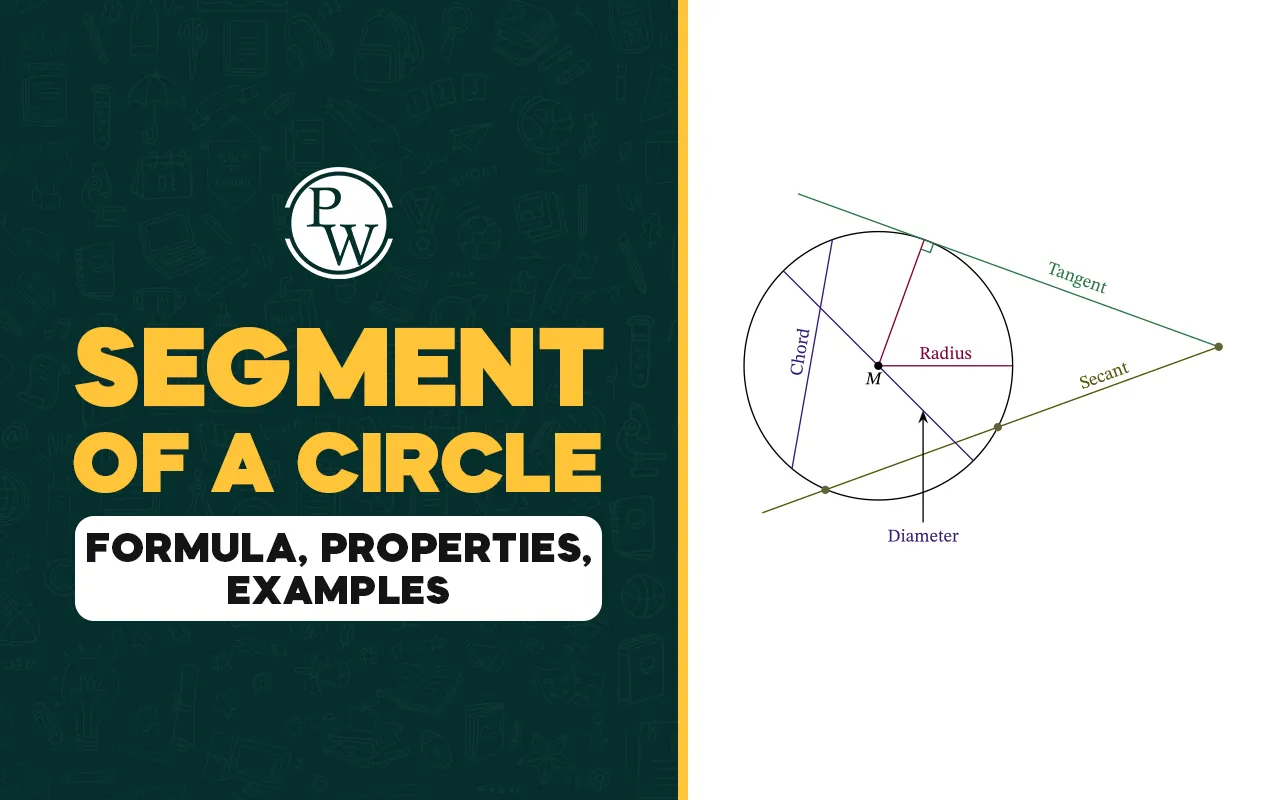
A segment of a circle is the region enclosed between a chord and the arc that connects the endpoints of that chord. In simpler terms, imagine cutting a slice of a circle using a straight line. The curved part of that slice is the arc, and the straight part is the chord. The space between them is the segment.
-
Chord: A straight line that connects two points on the circle.
-
Arc: A curved line that is part of the circle’s boundary.
-
Segment: The area between the chord and the arc.
It's important to note that a segment of a circle does not usually include the center of the circle, unless the chord used is a diameter. This makes it different from a sector, which includes the center and looks like a "pizza slice." Segments have many applications in practice, for example the calculation of the surface area of circular tanks, the design of curved windows and the building of domes.
Read More - Perimeter of a Circle - Definition, Formula with Examples
Types of Segment of a Circle
A segment of a circle can be divided into two main types, depending on the size of the arc and how much of the circle is covered:
1. Minor Segment of a Circle
-
A minor segment is formed when the arc is less than a semicircle (i.e., less than 180°).
-
It covers a smaller area of the circle.
-
These are more commonly used in basic geometry problems and diagrams.
2. Major Segment of a Circle
-
A major segment is formed when the arc is greater than a semicircle (i.e., more than 180°).
-
It covers a larger area of the circle.
-
Less common in beginner-level geometry but important in advanced applications.
Read More - Area of Semicircle: Formula, Examples
Segment of a Circle Formula
To calculate the area of a segment of a circle, use the following formula:
Area of Segment = Area of Sector – Area of Triangle
This formula finds the area between the arc and the chord by subtracting the area of the triangle (formed by the two radii and the chord) from the area of the sector.
1. Area of a Sector
Area of Sector = (𝜃 / 360) × π × r²
Where:
-
𝜃 = Central angle (in degrees)
-
r = Radius of the circle
-
π ≈ 3.1416
2. Area of the Triangle (when angle is in degrees)
Area of Triangle = (1 / 2) × r² × sin(𝜃)
So, putting it all together:
Variables Used
-
r: Radius of the circle
-
𝜃: Central angle in degrees
-
π: A constant value, approximately 3.1416
Segment of a Circle Properties
Segments of a circle follow certain geometric properties. Understanding these can help you solve problems more easily and understand how circle segments behave. The following are the key properties of Segments of a circle:
-
Bounded by a chord and arc: A segment is always enclosed between a straight line (chord) and a curved line (arc).
-
Does not always include the center: A segment includes the center only if the chord is the diameter.
-
Area depends on radius and angle: Larger radii or central angles result in larger segments.
-
Symmetry: Segments formed by diameters create symmetrical halves.
-
Part of a sector: A segment is part of a sector, minus the triangular portion.
These segment of a circle properties are essential when analyzing diagrams or solving geometry problems that involve parts of a circle.
Read More - Construction in Maths: Methods and Examples
Segment of a Circle Examples
Let’s work through a couple of segment of a circle examples to understand how to apply the segment of a circle formula and calculate the area of a segment.
Example 1: Minor Segment
Given:
-
Radius (r) = 10 cm
-
Central angle (θ) = 60°
Step 1: Area of Sector
Area of Sector = (θ / 360) × π × r²
= (60 / 360) × π × 10²
= (1 / 6) × π × 100
≈ 52.36 cm²
Step 2: Area of Triangle
Area of Triangle = (1 / 2) × r² × sin(θ)
= (1 / 2) × 10² × sin(60°)
= (1 / 2) × 100 × 0.866
≈ 43.30 cm²
Step 3: Area of Segment
Area of Segment = Area of Sector − Area of Triangle
= 52.36 − 43.30
= 9.06 cm²
Example 2: Major Segment
Given:
-
Radius (r) = 8 cm
-
Central angle (θ) = 270°
Step 1: Area of Sector
Area of Sector = (θ / 360) × π × r²
= (270 / 360) × π × 8²
= (3 / 4) × π × 64
≈ 150.80 cm²
Step 2: Area of Triangle
Area of Triangle = (1 / 2) × r² × sin(θ)
= (1 / 2) × 8² × sin(270°)
= (1 / 2) × 64 × (−1)
= −32 cm²
Since area cannot be negative, take the absolute value:
Area of Triangle = 32 cm²
Step 3: Area of Segment
Area of Segment = Area of Sector − Area of Triangle
= 150.80 − 32
= 118.80 cm²
Boost Math Speed and Confidence with PW CuriousJr’s Mental Maths Course
PW CuriousJr offers a well-structured Mental Maths Course designed to help students improve their calculation speed, accuracy, and confidence in math. The course is organized step-by-step, covering essential math topics so students can gradually build their skills.
It encourages mental problem-solving, helping students become more comfortable and confident with numbers. Lessons are clear, simple, and engaging, allowing regular practice without feeling overwhelmed.
The course focuses on core concepts like addition, subtraction, multiplication, and division while also helping students solve problems faster through consistent practice and practical activities. These exercises help develop strong mental math abilities that support better performance in school.
PW CuriousJr’s approach is stress-free and student-friendly, ideal for school learners who want to sharpen their everyday math skills in an easy-to-follow way.
Segment of a Circle FAQs
What is a segment of a circle?
How is a segment different from a sector?
What are the types of circle segments?
What is the formula for the area of a segment?
Can a segment include the center of the circle?
Where are circle segments used?