
How to Choose the Best Mental Maths Course for Class 5

Class 5 is an important stage in a child’s maths learning journey. Students begin working with larger numbers, fractions, decimals, percentages, geometry, graphs, patterns and more challenging calculations. At this stage, strong calculation skills and logical thinking can make maths easier to understand and solve.
But how do parents choose the best mental maths course for their child? A good programme should not focus only on calculation speed. It should strengthen school maths, build problem-solving skills, provide regular practice and help children become more confident with numbers.
What to Look for in a Class 5 Mental Maths Course
Before choosing a mental maths program, parents should look at the learning approach, teacher support, practice structure and how well it complements school studies.
1. School-Aligned Maths Learning
Mental maths should support what children learn at school. For Class 5, useful coverage includes large numbers, simplification, factors and multiples, fractions, decimals, average and percentage, time and money, geometry, graphs, patterns, series and speed mathematics.
A strong programme can also introduce reasoning activities such as classification, analogies, visual and spatial reasoning, number puzzles, coding-decoding, direction sense and ranking.
2. Live and Interactive Classes
Children can benefit from being able to interact with teachers, ask questions and participate in activities. When comparing online mental maths classes, parents should check whether the programme provides active learning rather than relying only on recorded lessons.
Interactive quizzes, puzzles and problem-solving activities can make maths practice more engaging while encouraging children to think through problems.
Read More - Mental Division Tricks for Class 5
3. Regular Practice and Assignments
Mental calculation skills improve with consistent practice. Look for quizzes, assignments, worksheets or other structured activities that allow children to apply newly learned concepts regularly.
Practice should cover both calculations and reasoning so children develop speed without losing conceptual understanding.
4. Doubt-Solving and Teacher Guidance
A child may understand a concept during class but struggle while solving a question independently. Accessible teacher support can help identify mistakes and clarify difficult topics.
This is especially useful for areas such as fractions, decimals, percentages, multiplication, division and word problems.
5. Progress Tracking
Parents should have a clear idea of how their child is progressing. Performance reviews, progress reports and regular feedback can help identify strengths and areas that need more practice.
This also makes it easier to adjust learning and provide support before small gaps become bigger challenges.
Read More - Percentage Tricks Using Mental Maths for Class 5
What Should Class 5 Mental Maths Improve?
The right Class 5 mental maths programme should develop more than fast calculations. Parents should look for improvement in:
-
Calculation speed and accuracy
-
Number understanding
-
Logical and quantitative reasoning
-
Problem-solving ability
-
Focus and concentration
-
Confidence in maths
Mental maths can help children approach calculations more efficiently while regular practice supports accuracy and familiarity with numbers. CuriousJr also highlights calculation speed, logical reasoning, problem-solving and maths confidence as key areas of its mental maths programme.
What Does CuriousJr Offer for Class 5?
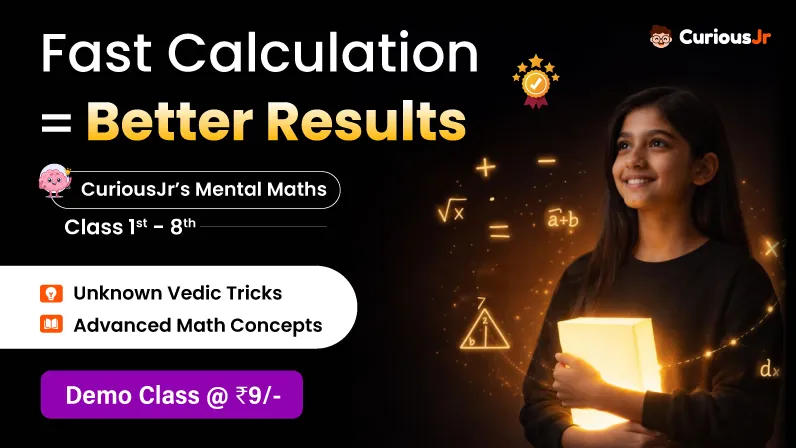
For parents exploring a structured maths course for kids, CuriousJr offers a Class 5 Mental Maths programme covering school maths, reasoning and fast-calculation techniques. Its Class 5 programme includes topics such as Roman numerals, large numbers, fractions, decimals, percentages, geometry, graphs, patterns, series, puzzles and speed mathematics.
The programme also covers reasoning areas such as patterns, classification, analogies, visual and spatial reasoning, logical and quantitative reasoning, number puzzles, direction sense, Venn diagrams and ranking.
Fast Calculation and Vedic Maths Techniques
The Class 5 programme includes techniques such as:
-
Complements to 10, 100 and 1,000
-
Addition and subtraction using base methods
-
Doubling and halving
-
Finger multiplication up to 9 × 9
-
Multiplication shortcuts
-
Number splitting
-
Left-to-right addition and subtraction
-
Division shortcuts
-
Squaring numbers ending in 5
-
Multiplication near base numbers
These techniques are most useful when combined with an understanding of the underlying maths concepts rather than treated as replacements for them.
Interactive Learning and Teacher Support
CuriousJr describes its mental maths classes as interactive and practice-led, with live learning, activities, teacher support and regular practice. Its current programme information also highlights daily live sessions, quizzes, gamified activities, Olympiad preparation and performance tracking.
The programme follows a dual-teacher model in which a Master Teacher handles lessons while a Class Teacher supports students with homework, doubts, progress and other academic needs.
How to Choose the Right Mental Maths Course for Your Child
Before enrolling in any online mental maths classes, parents can ask:
-
Does the programme complement school maths?
-
Are classes live and interactive?
-
Is regular practice included?
-
Can children get their doubts resolved?
-
Do teachers explain concepts instead of encouraging memorisation?
-
Can parents track progress?
-
Does the programme include reasoning and problem-solving?
-
Is the learning experience engaging for children?
The answers can help parents compare different programmes based on their child’s actual learning needs rather than choosing one only because it promises faster calculations.
The best mental maths course for Class 5 should go beyond quick calculation tricks by combining school maths, mental calculation, reasoning, regular practice and teacher support.
Parents should choose a programme that helps children become faster and more accurate while also building the mathematical understanding and confidence they need for future learning.
How to Choose the Best Mental Maths Course for Class 5 FAQs
Is mental maths useful for Class 5 students?
What should parents look for in a mental maths course?
Does CuriousJr offer mental maths for Class 5?
Can mental maths replace regular school maths?








Get Free Counselling Today
and Clear up all your Doubts
 Live & recorded classes available at easeDashboard for progress trackingLakhs of practice questions

