Perimeter of Pentagon - Definition, Formula, Properties, Examples
 Nikita Aggarwal13 Apr, 2026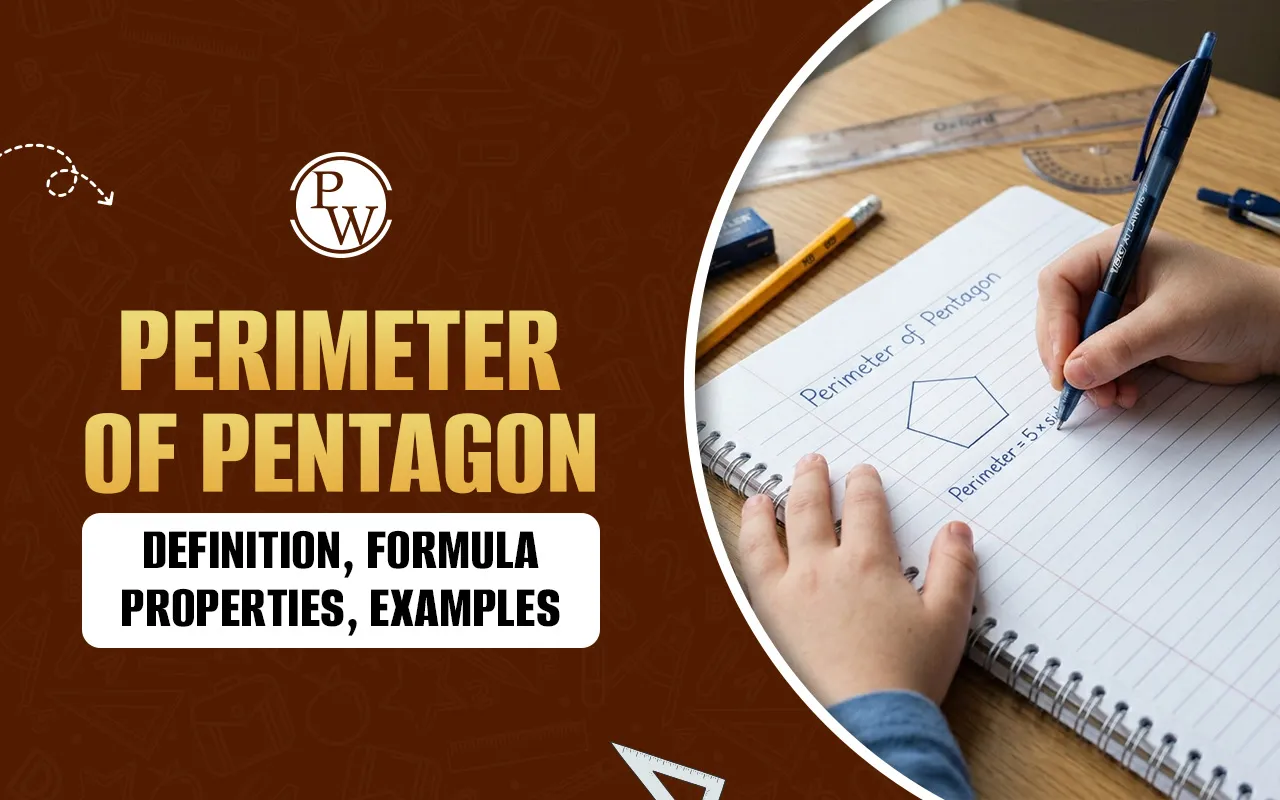
What is Perimeter of Pentagon?
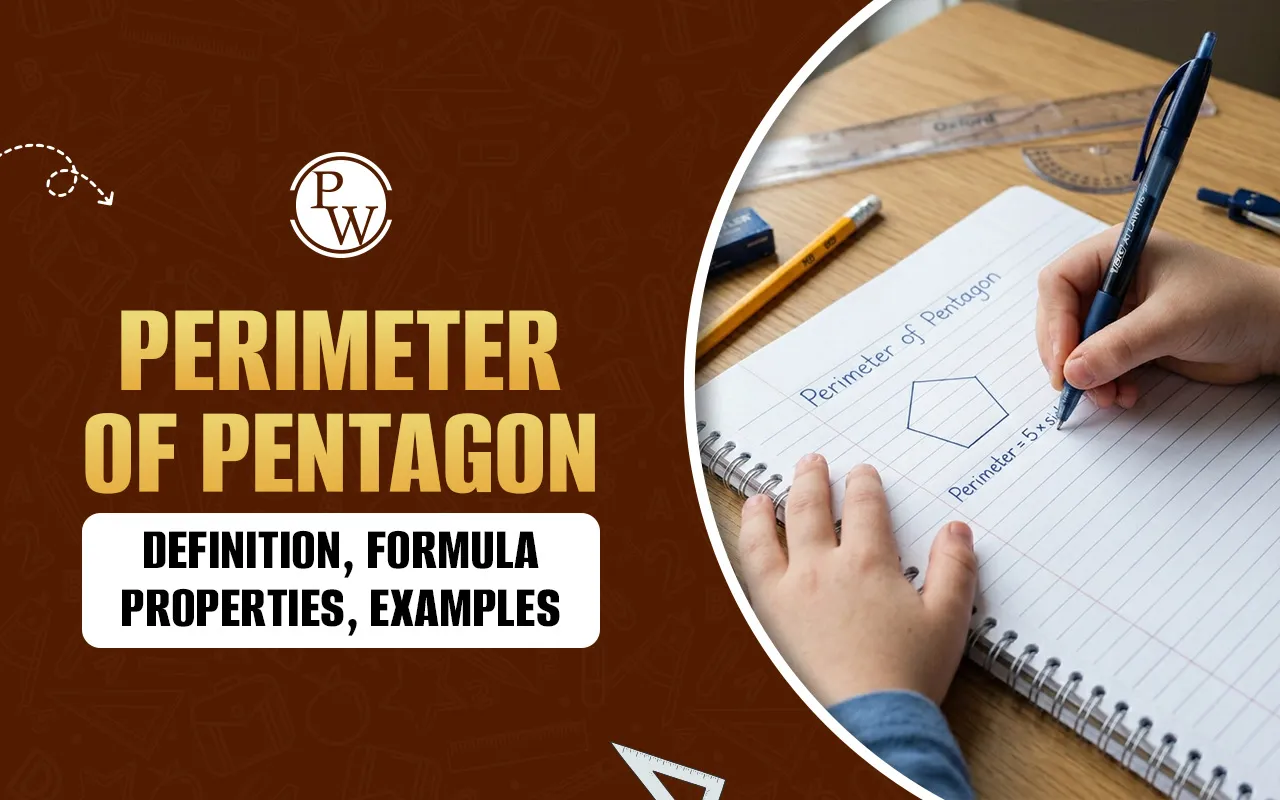
The perimeter of pentagon definition states that it is the sum of the lengths of all five sides of the polygon. Since a pentagon is a closed two-dimensional figure with five straight sides and five vertices, its perimeter is always a linear measurement, expressed in units like centimetres (cm), metres (m), or inches (in).
Perimeter of Pentagon Properties
Before we start doing the maths, it is beneficial to know about the perimeter of pentagon properties. Understanding the properties of a pentagon aids in determining the mathematical calculations for a pentagon.
Five Sides: A pentagon has five sides. It does not matter what the pentagon looks like; it always has five sides.
Closed Figure: The sides of a pentagon must be connected to form a loop. If the sides of a pentagon are not connected, then we cannot calculate its perimeter.
Regular vs. Irregular: There are pentagons and irregular pentagons. In a regular pentagon, all its sides are the same length. In a pentagon, the sides are of different lengths.
Linear Unit: When we talk about the perimeter of a pentagon, we are talking about its length. The perimeter of a pentagon is measured in units like meters or feet, not in units like square meters or square feet.
Read More - Perimeter - Definition, Unit, Formula and Examples
What is the Perimeter of Pentagon Formula?
Depending on the type of pentagon you are dealing with, the perimeter of pentagon formula changes slightly to make your work easier.
1. Regular Pentagon Formula
A regular pentagon is a shape where all five sides of the pentagon are exactly the same length. You don't need to add the sides of a regular pentagon one by one since they're all equal.
-
Formula: Perimeter = 5 × Side
-
If we let "a" represent the length of one side, the formula is: P = 5a
2. Irregular Pentagon Formula
To find the boundary of the irregular pentagon, you need to add all the side lengths together. You have to add each side length of the pentagon to obtain the total.
-
Formula: Perimeter = Side 1 + Side 2 + Side 3 + Side 4 + Side 5
-
If the sides are a, b, c, d, and e, then P = a + b + c + d + e
How to Calculate the Perimeter of Pentagon?
To avoid making mistakes when you add up the sides of a pentagon, you should do things one step at a time.
First you need to figure out what kind of pentagon you are dealing with: is the pentagon regular, meaning all sides are equal or is the pentagon
You should look at the lengths of the sides of the pentagon: what are the measurements for each side of the pentagon?
Then you have to make sure that the units for the sides of the pentagon are all the same: check that all the sides of the pentagon are in the same units, like all the sides of the pentagon are in centimetres. If the pentagon's side is in mm, convert it to the same unit as the other sides first.
Next, you need to use the formula for the pentagon: if the pentagon is regular, you can use the formula 5a, but if the pentagon is irregular, you have to add up all the sides of the pentagon.
Finally, you must state the units used for the pentagon's sides: always include the unit of measurement in your answer.
Perimeter of Pentagon Examples
Let’s look at how these rules work in practice with some perimeter of pentagon examples.
Example 1: The Regular Pentagon
Question: Find the perimeter of a regular pentagon where each side measures 7 cm.
Solution:
-
Since it is a regular pentagon, we use the formula P = 5a.
-
Side (a) = 7 cm.
-
Perimeter = 5 × 7.
-
Perimeter = 35 cm.
Example 2: The Irregular Pentagon
Question: Calculate the perimeter of a pentagon with side lengths of 4 cm, 6 cm, 5 cm, 8 cm, and 3 cm.
Solution:
-
This is an irregular pentagon, so we sum all sides.
-
Perimeter = 4 + 6 + 5 + 8 + 3.
-
Perimeter = 26 cm.
Read More - Perimeter of a Sector – Formula, Definition, Types & Examples
Example 3: Finding a Side from the Perimeter
Question: If the perimeter of a regular pentagon is 50 metres, what is the length of one side?
Solution:
-
We know P = 5a.
-
50 = 5 × a.
-
To find "a", divide 50 by 5.
-
Side = 10 metres.
Regular vs Irregular Pentagons
|
Feature |
Regular Pentagon |
Irregular Pentagon |
|
Side Lengths |
All 5 sides are equal |
Sides can be different |
|
Interior Angles |
All 108 degrees |
Angles vary |
|
Perimeter Calculation |
5 × Side |
Sum of all 5 sides |
|
Symmetry |
High (5 lines of symmetry) |
Usually low or none |
Make Maths Simple and Fun with CuriousJr
CuriousJr helps children develop a strong maths foundation by reducing fear and building confidence. Our Mental Maths online classes for students from Classes 1 to 8 focus on improving speed, accuracy, and logical thinking using easy techniques and interactive learning.
With our dual-mentor approach, students attend engaging live classes and get dedicated support for clearing doubts after every session. Animated lessons, fun activities, and exciting challenges make maths learning interesting and enjoyable.
Parents receive regular progress updates and review sessions, ensuring complete transparency in their child’s learning journey.
Book a demo class today and see how CuriousJr makes maths easy, engaging, and confidence-boosting for your child.